Classification / Names
Noms communs | Synonymes | Catalog of Fishes(Genre, Espèce) | ITIS | CoL | WoRMS | Cloffa
>
Characiformes (Characins) >
Crenuchidae (South American darters) > Characidiinae
Etymology: Characidium: Diminutive of Charax, -akos = a fish without identification (Ref. 45335); heirmostigmata: From the Greek heirmos (series) and stigmata (plural of stigma = marks), in reference to the series of black marks present on the body sides.
Environment: milieu / climate zone / profondeur / distribution range
Écologie
; eau douce benthopélagique. Tropical
South America: known only from rio Abelha, rio Barra Grande and rio Nestor of the upper rio Paraná basin in Brazil.
Taille / Poids / Âge
Maturité: Lm ? range ? - ? cm
Max length : 5.4 cm SL mâle / non sexé; (Ref. 74998)
Description synthétique
Clés d'identification | Morphologie | Morphométrie
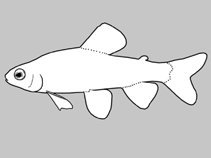
Rayons mous dorsaux (Total) : 13 - 14; Rayons mous anaux: 10 - 11; Vertèbres: 34. Distinguished from all members of the genus Characidium, except Characidium serrano (upper rio Uruguai basin), in having 8-11 incomplete oblique bars on body sides, extending upwards and downwards from the lateral line and independent of the 8 or 9 dorsal transverse bars which usually are present in Characidium species. Can be differentiated from Characidium serrano in having a wider body width (12.2-15.7%) and lower number of perforated scales on lateral line (32-35) vs. 8.7-11.1% in SL and 37-39 scales in Characidium serrano (Ref. 74998).
Body shape (shape guide): fusiform / normal.
Life cycle and mating behavior
Maturité | Reproduction | Frai | Œufs | Fécondité | Larves
da Graça, W.F. and C.S. Pavanelli, 2008. Characidium heirmostigmata, a new characidiin fish (Characiformes: Crenuchidae) from the Upper Rio Paraná basin, Brazil. Neotrop. Ichthyol. 6(1):53-36. (Ref. 74998)
Statut dans la liste rouge de l'IUCN (Ref. 130435: Version 2025-1)
Menace pour l'homme
Harmless
Utilisations par l'homme
Outils
Articles particuliers
Télécharger en XML
Sources Internet
Estimates based on models
Phylogenetic diversity index (Réf.
82804): PD
50 = 0.5000 [Uniqueness, from 0.5 = low to 2.0 = high].
Bayesian length-weight: a=0.01122 (0.00514 - 0.02450), b=3.04 (2.87 - 3.21), in cm total length, based on all LWR estimates for this body shape (Ref.
93245).
Niveau trophique (Réf.
69278): 3.4 ±0.3 se; based on size and trophs of closest relatives
Fishing Vulnerability (Ref.
59153): Low vulnerability (10 of 100).
🛈