>
Ovalentaria/misc (Various families in series Ovalentaria) >
Pomacentridae (Damselfishes) > Pomacentrinae
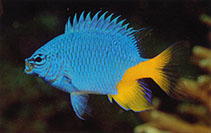
Etymology: Chrysiptera: Greek, chrysos = golden + Greek, pteron = fin, wing (Ref. 45335); giti: Named for the family company of Enki Tan and Cherie Nursalim, who successfully bid to support the conservation of this species at the Blue Auction in Monaco in 2007: treated as a noun in apposition.
Eponymy: Giti Tire Company of Singapore is ranked the eleventh biggest company by revenue in the world. [...] (Ref. 128868), visit book page.
Environment: milieu / climate zone / distribuzione batimetrica / distribution range
Ecologia
marino associati a barriera corallina; distribuzione batimetrica 3 - 20 m (Ref. 90102). Tropical
Western Pacific: Indonesia
Size / Peso / Age
Maturità: Lm ? range ? - ? cm
Max length : 3.6 cm SL maschio/sesso non determinato; (Ref. 74966)
Short description
Chiavi di identificazione | Morfologia | Morfometria
Spine dorsali (totale) : 8; Raggi dorsali molli (totale) : 10 - 11; Spine anali: 2; Raggi anali molli: 12.
Adults inhabit sheltered fringing reefs, usually in bays at depths between about 3 to 20 m. They occur in small aggregations; closely associated with branching formations of live coral, particularly Acropora spp. and the pocilloporid Seriatopora hystrix. The fish hovers a short distance above the substratum, presumably feeding on zooplankton (Ref. 74966). Oviparous, distinct pairing during breeding (Ref. 205). Eggs are demersal and adhere to the substrate (Ref. 205). Males guard and aerate the eggs (Ref. 205).
Life cycle and mating behavior
Maturità | Riproduzione | Deposizione | Uova | Fecundity | Larve
Oviparous, distinct pairing during breeding (Ref. 205). Eggs are demersal and adhere to the substrate (Ref. 205). Males guard and aerate the eggs (Ref. 205).
Allen, G.R. and M.V. Erdmann, 2008. A new species of damselfish (Pomacentridae:Chrysiptera) from western New Guinea and the Togean Islands, Indonesia. aqua, Int. J. Ichthyol. 13(3-4):171-178. (Ref. 74966)
IUCN Red List Status (Ref. 130435: Version 2025-1)
Threat to humans
Harmless
Human uses
Strumenti
Special reports
Download XML
Fonti Internet
Estimates based on models
Preferred temperature (Fonte Biblio.
123201): 28.2 - 29.2, mean 28.8 °C (based on 143 cells).
Phylogenetic diversity index (Fonte Biblio.
82804): PD
50 = 0.5000 [Uniqueness, from 0.5 = low to 2.0 = high].
Bayesian length-weight: a=0.02344 (0.01134 - 0.04848), b=2.98 (2.80 - 3.16), in cm total length, based on LWR estimates for this (Sub)family-body shape (Ref.
93245).
Trophic level (Fonte Biblio.
69278): 2.8 ±0.3 se; based on size and trophs of closest relatives
Resilienza (Fonte Biblio.
120179): Alto, tempo minimo di raddoppiamento della popolazione meno di 15 mesi (Preliminary K or Fecundity.).
Fishing Vulnerability (Ref.
59153): Low vulnerability (10 of 100).
🛈