>
Eupercaria/misc (Various families in series Eupercaria) >
Labridae (Wrasses)
Etymology: Paracheilinus: Greek, para = the side of + Greek, chaite = hair + Greek, odous = teeth (Ref. 45335); nursalim: Named for Sjamsul and Itjih Nursalim; noun in apposition.
Environment: milieu / climate zone / Mức độ sâu / distribution range
Sinh thái học
Biển Cùng sống ở rạn san hô; Mức độ sâu 5 - 50 m (Ref. 74967), usually 20 - 35 m (Ref. 74967). Tropical
Western Pacific: New Guinea, Indonesia.
Bộ gần gũi / Khối lượng (Trọng lượng) / Age
Chín muồi sinh dục: Lm ? range ? - ? cm
Max length : 5.1 cm SL con đực/không giới tính; (Ref. 74967); 2.9 cm SL (female)
Short description
Khóa để định loại | Hình thái học | Sinh trắc học
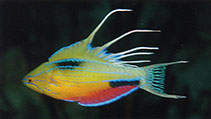
Các tia vây lưng cứng (tổng cộng) : 8 - 9; Các vây lưng mềm (tổng cộng) : 11; Tia cứng vây hậu môn: 3; Tia mềm vây hậu môn: 8 - 10. This species is distinguished by the following set of characters: pored lateral-line scales 11-16+3-10, often 16+5-7; gill rakers usually 12-13 (sometimes 14-15); body depth 2.9-3.5 in SL; often, 4-6 (rarely 3) dorsal soft rays of males prolonged as narrow, tapering filaments that are erected during courtship; in males, caudal fin strongly lunate, the length 1.6 (1.7-2.4) in SL and caudal concavity 0.8-1.5 in HL; pelvic fins 1.6-1.8 in males and 2.0-2.2 in females, both in HL; live colour of male differs from all other Paracheilinus in having a pair of rectangular blackish patches, one on ventral half of caudal peduncle and adjacent body, and the other, often less distinct, on upper back, below middle of spinous dorsal fin. Similar to P. cyaneus in general appearance; sympatric throughout its known range (Misool, Fak Fak Peninsula, and Triton Bay area). The two species are easily distinguished on the basis of male coloration, particularly that associated with courtship displays (Ref. 74967).
Body shape (shape guide): fusiform / normal.
Inhabits semi-sheltered areas, exposed to periodic strong currents; invariably associated with gradual rubble slopes at depths ranging from about 5-50 m or more, but most abundant between about 20 and 35 m. Large aggregations, of about 30 males and several hundred females, were occasionally encountered in only 6 to 10 m at Triton Bay (Ref. 74967).
Life cycle and mating behavior
Chín muồi sinh dục | Sự tái sinh sản | Đẻ trứng | Các trứng | Sự sinh sản | Ấu trùng
Oviparous, distinct pairing during breeding (Ref. 205).
Allen, G.R. and M.W. Erdmann, 2008. Paracheilinus nursalim, a new species of flasher wrasse (Perciformes: Labridae) from the Bird's Head Peninsula of western New Guinea with a key to the species of Paracheilinus,. aqua, Int. J. Ichthyol. 13(3-4):179-188. (Ref. 74967)
IUCN Red List Status (Ref. 130435: Version 2025-1)
Threat to humans
Harmless
Human uses
Các công cụ
Special reports
Download XML
Các nguồn internet
Estimates based on models
Preferred temperature (Tài liệu tham khảo
123201): 27.9 - 29, mean 28.3 °C (based on 32 cells).
Phylogenetic diversity index (Tài liệu tham khảo
82804): PD
50 = 0.5000 [Uniqueness, from 0.5 = low to 2.0 = high].
Bayesian length-weight: a=0.00977 (0.00470 - 0.02030), b=3.07 (2.90 - 3.24), in cm total length, based on LWR estimates for this (Sub)family-body shape (Ref.
93245).
Mức dinh dưỡng (Tài liệu tham khảo
69278): 3.3 ±0.4 se; based on size and trophs of closest relatives
Thích nghi nhanh (Tài liệu tham khảo
120179): Chiêù cao, thời gian nhân đôi của chủng quần tối thiểu là dưới 15 tháng (Preliminary K or Fecundity.).
Fishing Vulnerability (Ref.
59153): Low vulnerability (10 of 100).
🛈
Nutrients (Ref.
124155): Calcium = 181 [102, 412] mg/100g; Iron = 1.21 [0.66, 2.41] mg/100g; Protein = 18.1 [15.1, 20.3] %; Omega3 = 0.192 [0.099, 0.360] g/100g; Selenium = 24.2 [11.5, 51.5] μg/100g; VitaminA = 293 [85, 1,131] μg/100g; Zinc = 2.39 [1.48, 3.85] mg/100g (wet weight);