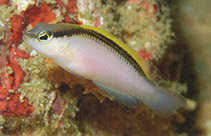
>
Ovalentaria/misc (Various families in series Ovalentaria) >
Pseudochromidae (Dottybacks) > Pseudochrominae
Etymology: Pseudochromis: Greek, pseudes = false + Greek, chromis = a fish, perhaps a perch (Ref. 45335); jace: Named for the four children of Lisa and Michael Anderson, using the first letter of each of their names; noun in apposition.
Eponymy: An acronymic eponym composed of the first letter of Jonathan, Alex, Charlie and Emily, the children of Lisa and Michael Anderson, who successfully bid to conserve this species at the Blue Auction, a black-tie charity auction in Monaco (20 September [...] (Ref. 128868), visit book page.
More on authors: Allen, Gill & Erdmann.
Environment: milieu / climate zone / djupintervall / distribution range
Ekologi
marina bottenlevande; djupintervall 38 - 52 m (Ref. 90102). Tropical; 3°S - 5°S, 134°E - 135°E
Western Pacific: New Guinea, Indonesia.
Size / Vikt / Age
Könsmognad: Lm ? range ? - ? cm
Max length : 6.3 cm SL hane/ej könsbestämd; (Ref. 74964)
Short description
Bestämningsnycklar | Morfologi | Morfometri
Taggstrålar i ryggfenan (totalt) : 3; Mjukstrålar i ryggfenan (totalt) : 26; Taggstrålar i analfenan: 3; Mjukstrålar i analfenan: 15. This species is distinguished from its congeners by the following set of characters: D III,26, all segmented rays branched; A III,15; 30-34 scales in lateral series; 18-20 circumpeduncular scales; gill rakers 6 + 13; teeth of outer ceratobranchial-1 gill rakers well developed on raker tips only; rounded caudal fin with pointed tip; basal one-fifth to one-third of dorsal fin with dark stripe. The new species appears to be closely related to P. pictus (Alor, Indonesian) and P. reticulatus (off NW coast of Australia); where the 3 have similar preserved and probably live coloration (unknown for P. reticulatus), similar morphometric and meristic values, and share an unusual rounded caudal fin with a pointed tip. P. reticulatus
is distinctive in having only 16 circumpeduncular scales (vs. 18-20 in P. jace, and 20 in P. pictus (Ref. 74964).
Body shape (shape guide): elongated; Cross section: compressed.
Observed on rubble slopes at depths of 38 to 52 m; solitarily or in pairs around isolated rock-coral outcrops on otherwise low-profile sand/rubble bottoms (Ref. 74964).
Life cycle and mating behavior
Könsmognad | Reproduktion | Lek | Ägg | Fecundity | Larver
Allen, G.R., A.C. Gill and M.V. Erdmann, 2008. A new species of Pseudochromis (Pisces:Psuedochromidae) from Papua Barat Province, Indonesia. aqua, Int. J. Ichthyol. 13(3-4):155-162. (Ref. 74964)
IUCN Red List Status (Ref. 130435: Version 2025-1)
Threat to humans
Harmless
Human uses
Verktyg
Special reports
Download XML
Internet-källor
Estimates based on models
Phylogenetic diversity index (Ref.
82804): PD
50 = 0.5000 [Uniqueness, from 0.5 = low to 2.0 = high].
Bayesian length-weight: a=0.00501 (0.00193 - 0.01299), b=3.10 (2.88 - 3.32), in cm total length, based on LWR estimates for this (Sub)family-body shape (Ref.
93245).
Trofisk nivå (Ref.
69278): 3.4 ±0.5 se; based on size and trophs of closest relatives
Fishing Vulnerability (Ref.
59153): Low vulnerability (10 of 100).
🛈