Classification / Names
Nombres comunes | Sinónimos | Catalog of Fishes(Género, Especie) | ITIS | CoL | WoRMS | Cloffa
>
Siluriformes (Catfishes) >
Pimelodidae (Long-whiskered catfishes)
Etymology: Pimelodus: Greek, pimele = fat + Greek, odous = teeth (Ref. 45335).
Environment: milieu / climate zone / rango de profundidad / distribution range
Ecología
; agua dulce demersal. Tropical
South America: Brazil.
Tamaño / Peso / Age
Madurez: Lm ? range ? - ? cm
Max length : 25.6 cm SL macho / no sexado; (Ref. 74927)
Short description
Claves de identificación | Morfología | Morfometría
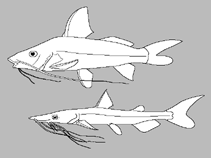
Distinguished from other members of the genus Pimelodus, except Pimelodus maculatus and Pimelodus mysteriosus by having dark brown blotches in the flanks. Differs from Pimelodus argenteus by the blotched color pattern; and from Pimelodus mysteriosus by having smaller maxillary barbel. Can be differentiated from Pimelodus maculatus by having supraoccipital process more robust, with base as broad as long (vs. longer than broad); anterior nostrils 25% of distance between the margin of snout to posterior nostrils (vs. 33%); small saws in the pectoral spine more developed and present in more than half of the anterior margin of spine (vs. small saws present in less than half of that margin); head covered with very thin skin, allowing the grooves in the bones surfaces conspicuous; 22-27 gill rakers in the first branchial arch (vs. 19-24); larger values of interorbital distance, mouth width and maxillary barbel length; and by having smaller base length of adipose-fin (Ref. 74927).
Life cycle and mating behavior
Madurez | Reproducción | Puesta | Huevos | Fecundidad | Larva
de Souza-Filho, H.S. and O.A. Shibatta, 2008. Descrição de uma espécie nova de Pimelodus (Siluriformes, Pimelodidae) da bacia do alto rio Paraguai. Iheringia, Sér. Zool., Porto Alegre, 97(4):472-780. (Ref. 74927)
IUCN Red List Status (Ref. 130435: Version 2025-1)
Threat to humans
Harmless
Human uses
Herramientas
Special reports
Download XML
Fuentes de Internet
Estimates based on models
Phylogenetic diversity index (Referencia
82804): PD
50 = 0.5000 [Uniqueness, from 0.5 = low to 2.0 = high].
Bayesian length-weight: a=0.00676 (0.00301 - 0.01516), b=3.09 (2.91 - 3.27), in cm total length, based on LWR estimates for this Genus-body shape (Ref.
93245).
Nivel trófico (Referencia
69278): 3.3 ±0.5 se; based on size and trophs of closest relatives
Resiliencia (Referencia
120179): Alto, población duplicada en un tiempo mínimo inferior a 15 meses (Preliminary K or Fecundity.).
Fishing Vulnerability (Ref.
59153): Low vulnerability (21 of 100).
🛈