Classification / Names
Populärnamn | synonymer | Catalog of Fishes(Släkte, Arter) | ITIS | CoL | WoRMS | Cloffa
>
Cypriniformes (Carps) >
Nemacheilidae (Brook loaches)
Etymology: Schistura: Greek, schizein = to divide + Greek, oura = tail; an allusion to forked caudal fins (Ref. 45335); papulifera: Derived from the Latin papula (a small rounded tumor on skin) and ferre (to bear on oneself).
adjective.
More on authors: Kottelat, Harries & Proudlove.
Environment: milieu / climate zone / djupintervall / distribution range
Ekologi
; sötvatten bottenlevande. Tropical
Asia: known with certainty only from the Krem Synrang Pamiang system in Meghalaya, India.
Size / Vikt / Age
Könsmognad: Lm ? range ? - ? cm
Max length : 4.9 cm SL hane/ej könsbestämd; (Ref. 57820)
Short description
Bestämningsnycklar | Morfologi | Morfometri
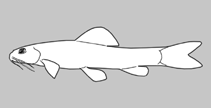
Can be differentiated from all its congeners in having the lower half of the head covered by numerous small skin projections and 5 pores in the supratemporal canal of the cephalic lateral-line system. Additional distinguishing characters include white body, vestigial eyes, incomplete lateral line (reaching only to vertical above pelvic-fin origin) and absence of axillary pelvic bone (Ref. 57820).
Body shape (shape guide): elongated.
Life cycle and mating behavior
Könsmognad | Reproduktion | Lek | Ägg | Fecundity | Larver
Kottelat, M., D.R. Harries and G.S. Proudlove, 2007. Schistura papulifera, a new species of cave loach from Meghalaya, India (Teleostei: Balitoridae). Zootaxa 1393:35-44. (Ref. 57820)
IUCN Red List Status (Ref. 130435: Version 2025-1)
Threat to humans
Harmless
Human uses
Verktyg
Special reports
Download XML
Internet-källor
Estimates based on models
Phylogenetic diversity index (Ref.
82804): PD
50 = 0.5000 [Uniqueness, from 0.5 = low to 2.0 = high].
Bayesian length-weight: a=0.00692 (0.00310 - 0.01545), b=3.02 (2.85 - 3.19), in cm total length, based on LWR estimates for this Genus-body shape (Ref.
93245).
Trofisk nivå (Ref.
69278): 3.0 ±0.3 se; based on size and trophs of closest relatives
Resiliens (Ref.
120179): Hög, lägsta populationsfördubblingstid mindre än 15 månader (Preliminary K or Fecundity.).
Fishing Vulnerability (Ref.
59153): Low vulnerability (10 of 100).
🛈