Elasmobranchii (haaien en roggen) (sharks and rays) >
Myliobatiformes (Stingrays) >
Urolophidae (Round rays)
Etymology: Urolophus: Greek, oura = tail + Greek, lophos = crest (Ref. 45335).
Eponymy: The FRV ‘Kapala’ (formerly of the NSW Fisheries Research Institute, Australia), from which the type specimens were collected, was honoured for the “…extremely valuable fish collections made by the vessel over almost three decades”. (Ref. 128868), visit book page.
More on authors: Yearsley & Last.
Environment: milieu / Klimaatzone / Diepte / distribution range
Ecologie
marien benthopelagisch; diepte 9 - 79 m (Ref. 75595). Subtropical; 27°S - 37°S, 150°E - 153°E (Ref. 75595)
Southwest Pacific: New South Wales, Australia.
Grootte / Gewicht / Leeftijd
Maturiteit: Lm ? range ? - 30.9 cm
Max length : 43.3 cm TL mannelijk / geslacht onbekend; (Ref. 75595); 52.1 cm TL (female)
Korte beschrijving
Determinatiesleutels | Morfologie | Morfometrie
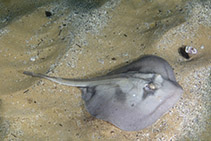
This medium-sized species which lacks broad lobes on posterolateral border of nostrils, has the following set of characters: disc subcircular to weakly rhomboidal, width less than 62% TL; internasal flap bell-shaped; tail with well-developed lateral cutaneous folds; stinging spine long, 12-15% TL; dorsal fin low but prominent, free-rear tip over spine origin; total vertebrae 156-170; pre-spine vertebrae 86-95; dorsal surface of disc greenish, paler laterally; usually with dark suborbital blotch and V-shaped interorbital bar (Ref. 75595).
Body shape (shape guide): other.
Serrated spines on the tail are venomous and can cause excruciating pain (https://fishesofaustralia.net.au/home/species/3544).
Levenscyclus en paargedrag
Maturiteit | Voortplanting | Paaien | Eieren | Fecunditeit | Larven
Yearsley, G.K. and P.R. Last, 2006. Urolophus kapalensis sp. nov., a new stingree (Myliobatiformes: Urolophidae) off eastern Australia. Zootaxa 1176:41-52. (Ref. 75595)
Status op de Rode Lijst van het IUCN (Ref. 130435: Version 2025-1)
Gevaar voor de mens
Venomous
Gebruik door de mens
Tools
Speciale rapporten
Download XML
Internetbronnen
Estimates based on models
Preferred temperature (Ref.
123201): 19.2 - 22.3, mean 20.5 °C (based on 16 cells).
Fylogenetische diversiteitsindex (Ref.
82804): PD
50 = 0.5000 [Uniqueness, from 0.5 = low to 2.0 = high].
Bayesian length-weight: a=0.00813 (0.00372 - 0.01775), b=3.08 (2.88 - 3.28), in cm total length, based on LWR estimates for this (Sub)family-body shape (Ref.
93245).
Trofisch niveau (Ref.
69278): 3.5 ±0.4 se; based on size and trophs of closest relatives
Fishing Vulnerability (Ref.
59153): Moderate vulnerability (41 of 100).
🛈
Nutrients (Ref.
124155): Calcium = 12.5 [1.6, 246.7] mg/100g; Iron = 0.585 [0.054, 6.844] mg/100g; Protein = 19.6 [14.3, 24.9] %; Omega3 = 0.211 [0.063, 0.611] g/100g; Selenium = 19.5 [3.4, 100.3] μg/100g; VitaminA = 14.3 [1.0, 168.4] μg/100g; Zinc = 0.715 [0.046, 8.591] mg/100g (wet weight);