This website uses cookies to enhance your browsing experience and ensure the functionality of our site. For more detailed information about the types of cookies we use and how we protect your privacy, please visit our Privacy Information page.
×
Cookie Settings
This website uses different types of cookies to enhance your experience. Please select your preferences below:
> Gobiiformes (Gobies) > Gobiidae (Gobies) > Gobiinae
Etymology: nobilis:Named for its common name, Majestic shrimpgoby, Latin 'nobilis' meaning noble, English translation of which is a synonym of 'majestic'. Eponymy: Professor Cornelius Jan van der Horst (1889–1951) was a Dutch zoologist who moved to South Africa (1928) and became Head of the Zoology Department, Witwatersrand University, Johannesburg. [...] (Ref. 128868), visit book page. More on authors: Allen & Randall.
Entorno: milieu / zona climática / rango de profundidad / gama de distribución Ecología
marino demersal; rango de profundidad 5 - 30 m (Ref. 90102). Tropical
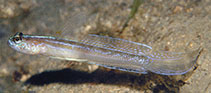
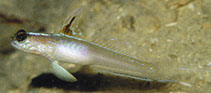
Espinas dorsales (total) : 7; Radios blandos dorsales (total) : 16; Espinas anales: 1; Radios blandos anales: 17. This species is distinguished by the following set of characters: D VI-I, 16; A I, 17; pectoral rays 17-18; scales in longitudinal series 63-68; without scales on head, nape, or prepectoral area; ctenoid scales posteriorly, cycloid anterior to base of sixth dorsal spine; males with elongate body (depth 6.9 in SL), females stouter (depth 5.2-5.3 in SL); gill opening extending forward nearly to a vertical at posterior edge of orbit; dorsal spines progressively longer to third (at least 3.65-4.0 in SL); caudal fin long and pointed (1.9-2.2 in SL); pectoral fins in male reaching to above anal fin origin, or to anus in females, 4.2-4.4 in SL; pelvic fins do not reach base of first anal soft ray (4.1 in SL); distinct colour pattern features of males include a mid-dorsal, neon blue stripe on head, irregular orange spots, bars, and bands on cheek, operculum, and adjacent pectoral fin base, a pair of broad brownish-orange stripes on dorsal half of body edged with pair of narrower stripe of pale blue (clearly evident anteriorly, but becoming diffuse or forming clusters of scattered blue spot/flecks on posterior half ), a dark brown to subtle light brown orange spot (sometimes greatly reduced) on first dorsal fin between second and fifth spines, a dark submarginal stripe on posterior two-thirds of anal fin, and small orange spots covering pelvic fin; females similar, but markings on side less vivid and with distinctive brownish to bright orange yellow spot narrowing distally to middle of fin (Ref. 75784). Body shape (shape guide): elongated; Cross section: compressed.
Inhabits silty-sand bottoms in sheltered waters, singly or in male/female pairs. Shares the same burrows with unidentified species of Alpheus, a snapping shrimp (Ref. 75784).
Ciclo vital y comportamiento de apareamiento Madurez | Reproducción | Puesta | Huevos | Fecundidad | Larva
Allen, G.R. and J.E. Randall, 2006. Vanderhorstia nobilis, a new species of shrimpgoby for Indonesia and the Philippines. aqua, J. Ichthyol. Aquat. Biol. 12(1):39-44. (Ref. 75784)
Situación en la Lista Roja de la UICN (Ref. 130435: Version 2025-2 (Global))
Ecología Trófica Alimentos (presas) Composición de la dieta consumo de alimento Raciones de comida Despredadores
Ecología Ecología
Dinámica de la población Coeficiente del crecimiento para Edades / tallas máximas Longitud-peso rel. Longitud-longitud rel. Longitud-frecuencias Conversión de masas Reclutamiento Abundancia
Ciclo de vida Reproducción Madurez Madurez/Gills rel. Fecundidad Puesta Agregaciones de desove Huevos Desarrollo de los huevos Larva Dinámica larvaria
Fisiología Composición corporal Nutrientes Consumo del oxígeno Tipo de natación Velocidad de natación Pigmentos visuales Sonido de peces Enfermedades y parásitos Toxicidad (CL50)
Temperatura preferida (Referencia 123201): 28.5 - 29.3, mean 28.9 °C (based on 737 cells).
Índice de diversidad filogenética (Referencia 82804): PD50 = 0.5000 [Uniqueness, from 0.5 = low to 2.0 = high].
Bayesian length-weight: a=0.00741 (0.00347 - 0.01582), b=3.09 (2.91 - 3.27), in cm total length, based on LWR estimates for this (Sub)family-body shape (Ref. 93245).
Nivel trófico (Referencia 69278): 3.2 ±0.3 se; based on size and trophs of closest relatives
Resiliencia (Referencia 120179): Alto, población duplicada en un tiempo mínimo inferior a 15 meses (Preliminary K or Fecundity.).
Vulnerabilidad pesquera (Ref. 59153): Low vulnerability (10 of 100). 🛈