



Ladda upp din foton och Videor
Google image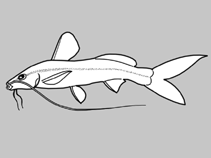 No image available for this species;
drawing shows typical species in Heptapteridae.
Google image
drawing shows typical species in Heptapteridae.
Klassificering / Namn Populärnamn | synonymer | Catalog of Fishes(Släkte, Arter) | ITIS | CoL | WoRMS | Cloffa
> Siluriformes (Catfishes) > Heptapteridae (Three-barbeled catfishes)
Etymology: Rhamdella: Brazilian vernacular name, Nhamdia/Jamdia (Ref. 45335); cainguae: Named from the Guarani, ca'á (forest), and iguá (inhabitant), in reference to the Cainguá, indigenous people of northeastern Argentina.
Etymology: Rhamdella: Brazilian vernacular name, Nhamdia/Jamdia (Ref. 45335); cainguae: Named from the Guarani, ca'á (forest), and iguá (inhabitant), in reference to the Cainguá, indigenous people of northeastern Argentina.
Miljö: miljö / Klimatzon / djupintervall / distributionsområde Ekologi
; sötvatten bottenlevande. Subtropical
Utbredning Territorier | FAO områden | Ekosystem | Förekomster | Prickkarta | Utplanteringar | Faunafri
South America: known only from Arroyo Cuña-Pirú, Río Paraná basin in Argentina.
Storlek / Vikt / Ålder
Kort beskrivning Bestämningsnycklar | Morfologi | Morfometri
Mjukstrålar i ryggfenan (totalt) : 7 - 8; Mjukstrålar i analfenan: 16 - 18. Presence of a distinct and large ovoid area in the supraorbital laterosensory canal between the frontal and sphenotic delimited by the apparently slender dorsal walls of these bones and with foramen for a laterosensory branch. Differs further from other species of Rhamdella by the following combination of characters: barbel tip reaching from the base of pectoral-fin ray in a specimen measuring 8.80 cm SL, to the posterior portion of opercular region, not surpassing the branchial slit, in a 15.75 cm SL specimen; horizontal eye diameter 20.6-23.9% of HL; interorbital distance 17.9-20.7% of HL; snout profile slightly convex but almost straight; branchiostegal rays seven, branchiostegal membranes not reaching the basal part of the first pectoral-fin ray in most specimens; interdorsal length 7.6-11.3% of SL; adipose-fin base length 36.0-41.6% of SL; anal-fin base length 16.6-22.0% of SL; anal-fin rays 16-18, commonly 17; and length of ventral caudal-fin lobe is 55.8-65.5% of length of dorsal lobe in males; snout length 37.9-43.2% of HL; pelvic fin length 13.3-16.9% of SL; a dense concentration of long and slender papillae on the lateral body surface in the pectoral and abdominal regions, most conspicuous near the lateral line, resulting in a hairy aspect; and by the presence of a distinct narrow dark mid lateral stripe (Ref. 75872).
Body shape (shape guide): elongated.
Body shape (shape guide): elongated.
Occurs over rocky bottoms in a clear water stream, approximately 0.5 - 1 m deep, with pools around 3 m deep, running through a densely forested area (Ref. 75872). Tends to be gregarious as individuals were observed in dense group under large stones (Ref. 75872).
Livscykel och parningsbeteende Könsmognad | Reproduktion | Lek | Ägg | Fekunditet | Larver
Huvudreferens
Ladda upp dina referenser | referenser | Koordinator : Bockmann, Flavio | Medarbetare
Bockmann, F.A. and A.M. Miquelarena, 2008. Anatomy and phylogenetic relationships of a new catfish species from northeastern Argentina with comments on the phylogenetic relationships of the genus Rhamdella Eigenmann and Eigenmann 1888 (Siluriformes, Heptapteridae). Zootaxa 1780:1-54. (Ref. 75872)
Status på IUCN:s rödlista (Ref. 130435: Version 2025-2 (Global))
Sårbar (VU) (B1ab(iii)); Date assessed: 24 November 2020
CITES
Not Evaluated
Hot mot människor
Harmless
Mänskliga användningsområden
FAO - Publication: search | FishSource |
Ytterligare information
Trofisk ekologi
Livsmedelsartiklar (preys)
Födosammansättning
Födointag
Matransoner
Predatorer
Livsmedelsartiklar (preys)
Födosammansättning
Födointag
Matransoner
Predatorer
Ekologi
Ekologi
Ekologi
Populationsdynamik
Tillväxtparametrar
Max. åldrar / storlekar
Längd-vikt rel.
Längd-längd rel.
Längd-frekvenser
Massakonvertering
Rekrytering
Abundans
Tillväxtparametrar
Max. åldrar / storlekar
Längd-vikt rel.
Längd-längd rel.
Längd-frekvenser
Massakonvertering
Rekrytering
Abundans
Livscykel
Reproduktion
Könsmognad
Mognad/Gills rel.
Fekunditet
Lek
Lekande aggregat
Ägg
Utveckling av ägg
Larver
Larvdynamik
Reproduktion
Könsmognad
Mognad/Gills rel.
Fekunditet
Lek
Lekande aggregat
Ägg
Utveckling av ägg
Larver
Larvdynamik
Anatomi
Gälyta
Hjärna
Otolit
Gälyta
Hjärna
Otolit
Fysiologi
Kroppssammansättning
Näringsämnen
Syreförbrukning
Typ av simning
Simhastighet
Visuella pigment
Ljud från fisk
Sjukdomar & Parasiter
Toxicitet (LC50)
Kroppssammansättning
Näringsämnen
Syreförbrukning
Typ av simning
Simhastighet
Visuella pigment
Ljud från fisk
Sjukdomar & Parasiter
Toxicitet (LC50)
Genetik
Genom
Genetik
Heterozygositet
Ärftlighet
Genetisk mångfald
Genom
Genetik
Heterozygositet
Ärftlighet
Genetisk mångfald
Människorelaterad
Vattenbrukssystem
Vattenbruksprofiler
Avelslinjer
Ciguatera-fall
Frimärken, mynt, diverse.
Vattenbrukssystem
Vattenbruksprofiler
Avelslinjer
Ciguatera-fall
Frimärken, mynt, diverse.
Verktyg
Särskilda rapporter
Kontrollera för underhåll av akvarium | Kontrollera om det finns faktablad om arter | Kontrollera om det finns faktablad om vattenbruk
Ladda ner XML
Internet-källor
AFORO (otoliths) | Aquatic Commons | BHL | Cloffa | Websites from users | Check FishWatcher | CISTI | Catalog of Fishes: Släkte, Arter | DiscoverLife | ECOTOX | FAO - Publication: search | Faunafri | Fishipedia | Fishtrace | GloBI | Google Books | Google Scholar | Google | IGFA World Record | OneZoom | Open Tree of Life | Otolith Atlas of Taiwan Fishes | PubMed | Reef Life Survey | Socotra Atlas | TreeBase | Tree of Life | Wikipedia: Go, sök | World Records Freshwater Fishing | Zoobank | Zoologiskt register
Uppskattningar baserade på modeller
Index för fylogenetisk mångfald (Ref. 82804): PD50 = 0.5020 [Uniqueness, from 0.5 = low to 2.0 = high].
Bayesian length-weight: a=0.00813 (0.00379 - 0.01743), b=2.97 (2.79 - 3.15), in cm total length, based on LWR estimates for this (Sub)family-body shape (Ref. 93245).
Trofisk nivå (Ref. 69278): 3.5 ±0.4 se; based on size and trophs of closest relatives
Resiliens (Ref. 120179): Låg, lägsta populationsfördubblingstid 4,5-14 år (Preliminary K or Fecundity.).