Klassifizierung / Names
Namen | Synonyme | Catalog of Fishes(Gattung, Arten) | ITIS | CoL | WoRMS | Cloffa
Elasmobranchii (Haie und Rochen) (sharks and rays) >
Rajiformes (Skates and rays) >
Rajidae (Skates)
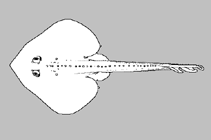
Etymology: oculus: Name refers to the eye-like marking on each pectoral fin.
More on author: Last.
Environment: milieu / climate zone / Tiefenbereich / distribution range
Ökologie
seewasser benthopelagisch; tiefenbereich 200 - 389 m (Ref. 75648). Tropical; 25°S - 34°S, 111°E - 115°E (Ref. 114953)
Eastern Indian Ocean: Australia.
Size / Gewicht / Alter
Geschlechtsreife: Lm ? range ? - ? cm
Max length : 55.7 cm TL (female)
Found primarily near the shelf break and on the upper continental slope. Length of adolescent males varied from 32.8-48.4 cm TL, with the largest measured with fully extended claspers indicating that this is a small skate (Ref. 75648).
Life cycle and mating behavior
Geschlechtsreife | Fortpflanzung | Ablaichen | Eier | Fecundity | Larven
Last, P.R., 2008. New short-snout members of the skate genus Dipturus (Rajoidei: Rajidae) from Australian seas. pp. 53-98. In Last, P.R., W.T. White, J.J. Pogonoski and D.C. Gledhill (eds.): Descriptions of new Australian skates (Batoidea: Rajoidei) pg. 53-98. CSIRO marine and atmospheric research paper no. 021. (Ref. 75648)
IUCN Rote Liste Status (Ref. 130435: Version 2025-1)
Bedrohung für Menschen
Harmless
Nutzung durch Menschen
Tools
Zusatzinformationen
Download XML
Internet Quellen
Estimates based on models
Preferred temperature (Ref.
123201): 10.9 - 16.6, mean 12.7 °C (based on 15 cells).
Phylogenetic diversity index (Ref.
82804): PD
50 = 0.5010 [Uniqueness, from 0.5 = low to 2.0 = high].
Bayesian length-weight: a=0.00302 (0.00141 - 0.00645), b=3.24 (3.07 - 3.41), in cm total length, based on LWR estimates for this (Sub)family-body shape (Ref.
93245).
Trophic level (Ref.
69278): 4.1 ±0.7 se; based on size and trophs of closest relatives
Widerstandsfähigkeit (Ref.
120179): niedrig, Verdopplung der Population dauert 4,5 - 14 Jahre. (Preliminary low fecundity).
Fishing Vulnerability (Ref.
59153): Moderate vulnerability (42 of 100).
🛈