>
Cyprinodontiformes (Rivulines, killifishes and live bearers) >
Poeciliidae (Poeciliids) > Poeciliinae
Etymology: Poecilia: Greek, poikilos = with a lot of colours (Ref. 45335); rositae: Named for Mrs. Rosita Bonhaus, Melle, for her considerable contribution to the production process of numerous aquaristic books, including the new atlas of livebearing fishes.
Eponymy: Rosita Bonhaus is the “long-term partner” of aquarium-book publisher Hans-Albrecht Baensch (q. [...] (Ref. 128868), visit book page.
Environment: milieu / Klimaatzone / Diepte / distribution range
Ecologie
; zoet water benthopelagisch. Tropical
Central America: Río Cahabón system in Guatemala.
Grootte / Gewicht / Leeftijd
Maturiteit: Lm ? range ? - ? cm
Max length : 5.0 cm SL mannelijk / geslacht onbekend; (Ref. 75917)
Korte beschrijving
Determinatiesleutels | Morfologie | Morfometrie
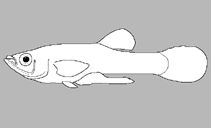
Dorsale zachte stralen (totaal) : 10; Anale zachte stralen: 9; Wervels: 27 - 28. Belongs to the Poecilia (M.) mexicana subgroup of shortfin mollies, which is distinguished by the following characters: longitudinal scale series 28 (rarely 27 or 29), vs. 26 to 27 in Poecilia (M.) mechthildae; predorsal scales 13-14, vs. 12-13 in
Poecilia (M.) mechthildae; caudal peduncle scales 16, vs. 18 in Poecilia (M.) mexicana; pectoral rays 15, vs. 16-17 in Poecilia (M.) mechthildae; dorsal rays 10, vs. 11 in Poecilia (M.) gracilis, 7-8 in Poecilia (M.) sulphuraria; females sometimes lack rows of black spots on body sides, vs. rows of black spots present in Poecilia (M.) sulphuraria, Poecilia (M.) mexicana, vs. weakly developed Poecilia (M.) gracilis; serrae of gonopodium ray 4p massive, vs. less massive in Poecilia (M.) mexicana, Poecilia (M.) gracilis, Poecilia (M.) mechthildae and Poecilia (M.) sulphuraria; distal spine series of gonopodium ray 3 long, vs. short in Poecilia (M.) mexicana, Poecilia (M.) mechthildae and Poecilia (M.) sulphuraria; distal membranous plate absent, vs. present in Poecilia (M.) mexicana (Ref. 75917).
Body shape (shape guide): fusiform / normal.
Levenscyclus en paargedrag
Maturiteit | Voortplanting | Paaien | Eieren | Fecunditeit | Larven
Meyer, M.K., K. Schneider, A.C. Radda, B. Wilde and M. Schartl, 2004. A new species of Poecilia, subgenus Mollienesia, from Upper Río Cahabón system, Guatemala, with remarks on the nomenclature of Mollienesia petenensis Günther, 1886 (Teleostei: Cyprinodontiformes: Poeciliidae). Zool. Abh. 54:145-154. (Ref. 75917)
Status op de Rode Lijst van het IUCN (Ref. 130435: Version 2025-1)
Gevaar voor de mens
Harmless
Gebruik door de mens
Tools
Speciale rapporten
Download XML
Internetbronnen
Estimates based on models
Fylogenetische diversiteitsindex (Ref.
82804): PD
50 = 0.5000 [Uniqueness, from 0.5 = low to 2.0 = high].
Bayesian length-weight: a=0.01318 (0.00564 - 0.03080), b=3.14 (2.96 - 3.32), in cm total length, based on LWR estimates for this Genus-body shape (Ref.
93245).
Trofisch niveau (Ref.
69278): 2.6 ±0.3 se; based on size and trophs of closest relatives
Weerstandsvermogen (Ref.
120179): Hoog, minimale populatieverdubbelingstijd minder dan 15 maanden (Preliminary K or Fecundity.).
Fishing Vulnerability (Ref.
59153): Low vulnerability (10 of 100).
🛈