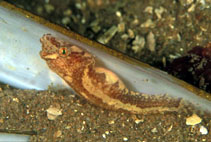
Environment: milieu / climate zone / profondeur / distribution range
Écologie
marin benthopélagique; profondeur 0 - 20 m (Ref. 128876). Temperate; 64°N - 35°N, 11°W - 31°E
Eastern Atlantic: Mediterranean Sea and north-eastern Atlantic (Norway and Faroes south to Gibraltar).
Taille / Poids / Âge
Maturité: Lm ? range ? - ? cm
Max length : 6.0 cm SL mâle / non sexé; (Ref. 35388)
Rayons mous dorsaux (Total) : 4 - 7; Rayons mous anaux: 4 - 7. Body elongated and flattened with red spot on each side, near the tip of dorsal fins. Minute gill openings (Ref. 35388).
Body shape (shape guide): elongated.
Trawled over soft mud bottom. Feeds mainly on benthic organisms (Ref. 12577). Inhabits shallow water on rocky bottoms and bivalve banks. Spawns in June - July, egg measures 1.5 mm. Larvae are pelagic (Ref. 35388).
Life cycle and mating behavior
Maturité | Reproduction | Frai | Œufs | Fécondité | Larves
Fricke, R., M. Bilecenoglu and H.M. Sari, 2007. Annotated checklist of fish and lamprey species (Gnathostoma and Petromyzontomorphi) of Turkey, including a Red List of threatened and declining species. Stuttgarter Beitr. Naturk. Sea A (706):1-172. (Ref. 58342)
Statut dans la liste rouge de l'IUCN (Ref. 130435: Version 2025-1)
Menace pour l'homme
Harmless
Utilisations par l'homme
Pêcheries: sans intérêt
Outils
Articles particuliers
Télécharger en XML
Sources Internet
Estimates based on models
Preferred temperature (Réf.
123201): 8.9 - 13, mean 10.6 °C (based on 260 cells).
Phylogenetic diversity index (Réf.
82804): PD
50 = 0.5039 [Uniqueness, from 0.5 = low to 2.0 = high].
Bayesian length-weight: a=0.00550 (0.00249 - 0.01211), b=3.05 (2.86 - 3.24), in cm total length, based on LWR estimates for this species & (Sub)family-body (Ref.
93245).
Niveau trophique (Réf.
69278): 3.4 ±0.3 se; based on diet studies.
Résilience (Réf.
120179): Milieu, temps minimum de doublement de population : 1,4 à 4,4 années (Preliminary K or Fecundity.).
Fishing Vulnerability (Ref.
59153): Low vulnerability (10 of 100).
🛈
Nutrients (Ref.
124155): Calcium = 51.7 [11.2, 184.0] mg/100g; Iron = 0.36 [0.13, 1.29] mg/100g; Protein = 1.8 [0.0, 5.6] %; Omega3 = 0.552 [0.210, 1.483] g/100g; Selenium = 5.61 [1.19, 20.71] μg/100g; VitaminA = 83.3 [17.7, 364.4] μg/100g; Zinc = 1.09 [0.53, 2.26] mg/100g (wet weight);