



分类 / 名称 俗名 | 同种异名 | Catalog of Fishes(属, 种) | ITIS | CoL | WoRMS | Cloffa
Teleostei > Siluriformes (Catfishes) > Pimelodidae (Long-whiskered catfishes)
Etymology: Pimelodus: Greek, pimele = fat + Greek, odous = teeth (Ref. 45335); pohli: Named for Mr. Johan B. Emanuel Pohl, a participant of the Austrian Mission to Brazil (1817-1836) with Johann Natterer, for collecting samples in several localities of the rio São Francisco drainage.
Eponymy: Johann Baptist Emanuel Pohl (1782–1834) was a physician, entomologist, botanist and geologist, born in what is now the Czech Republic. [...] (Ref. 128868), visit book page.
Etymology: Pimelodus: Greek, pimele = fat + Greek, odous = teeth (Ref. 45335); pohli: Named for Mr. Johan B. Emanuel Pohl, a participant of the Austrian Mission to Brazil (1817-1836) with Johann Natterer, for collecting samples in several localities of the rio São Francisco drainage.
Eponymy: Johann Baptist Emanuel Pohl (1782–1834) was a physician, entomologist, botanist and geologist, born in what is now the Czech Republic. [...] (Ref. 128868), visit book page.
环境:氛围 / 气候带 / 深度上下限 / 分布范围 生态学
; 淡水 居于水底的.
分布 领土 | FAO区域 | 生态系 | 标本纪录 | 分布图 | 简介 | Faunafri
South America: Rio São Francisco drainage in Brazil.
大小 / 重量 / 年龄
简单描述 检索表 | 型态特徵 | 形态测量图
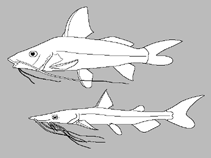
背棘 (总数) : 1; 背的软条 (总数) : 6; 脊椎骨: 40 - 41. Distinguished from other species of Pimelodus by the following combination of characters: body deep, 21.2- 31.0% of SL; comparatively long adipose fin, occupying more than one third of the distance between posterior of the dorsal- fin base and vertical through the end of anal-fin base, 21.8- 26.2% of SL; upper jaw anteriorly projecting, exposing about half of the premaxillary tooth plate; the maxillary barbel slightly surpassing the caudal-fin base; supraoccipital process base broad, 21.6-29.1% of HL; bones of cranial roof ornamented with small granulations; narrow internarial anterior width 10.1-12.8% of HL; uniform gray color pattern, with few dark dots on anterolateral region of body in individuals greater than 10 cm SL (sometimes weak or absent) and three or four rows of small dark dots on sides of body in smaller specimens; and a dark longitudinal bar on ventral lobe of the caudal fin, sometimes
very faint. Can be differentiated from two species (Pimelodus fur and Pimelodus maculatus) occurring in the Rio São Francisco drainage. Differs from Pimelodus fur by having shorter adipose-fin (21.8- 26.2% vs. 26.0-30.0% SL), deeper head (61.5-79.0% vs. 42.3-50.2% HL); wider interorbital distance (21.9-30.4% vs. 12.1-14.9% HL); wider anterior internarial distance (10.1-12.8% vs. 6.9-8.4% HL); wider supraoccipital width (21.6-29.1% vs. 11.7-15.5% HL); longer snout (40.5-47.8% vs. 28.9-33.1% HL); and dorsal supraoccipital process surface conspicuously ornamented with small granulations (vs. supraoccipital with smooth surface). Can be separated from Pimelodus maculatus by possessing greater horizontal eye diameter (26.5-32.2% vs. 19.5-25.1% HL) and by the peculiar color pattern of this species in all ontogenetic stages, consisting of three rows of dark spots (vs. uniform gray color pattern, with a few darks dots on anterolateral region of the body, sometimes very weak or absent in individuals greater than 10 cm SL). Can be distinguished from other species of
Pimelodus described from the adjacent Paraná-Paraguay-Uruguay River drainages: Pimelodus mysteriosus has a very long maxillary barbel, reaching the tips of caudal-fin lobes (vs. maxillary barbel short slightly surpassing the caudal-fin base in Pimelodus pohli); Pimelodus ortmanni has dark spots on dorsal and caudal fins (vs. absent in Pimelodus pohli) ; Pimelodus platicirris and Pimelodus heraldoi have, respectively, three rows of spots and small dots irregularly placed forming eight to nine rows on the lateral of body (vs. dark spots when present restricted to the anterodorsal region of the body in specimens larger than 10 cm SL, in Pimelodus pohli); Pimelodus platicirris has a relatively longer snout and Pimelodus heraldoi has striated lips (vs. lips smooth in Pimelodus pohli) and smaller orbital diameter (19.4-26.0% HL vs. 26.5-32.2% HL in Pimelodus pohli); Pimelodus paranaensis and Pimelodus absconditus 1995 also have small spots on the body sides, but Pimelodus pohli differs from the former in having the premaxillary tooth plate with rounded posterolateral corners (vs. pointed in Pimelodus paranaensis) and from the latter by the poorly developed lips (vs. well developed in Pimelodus absconditus) (Ref. 75972).
生命周期和交配行为 成熟度 | 繁殖 | 产卵场 | 卵 | 孕卵数 | 仔鱼
主要参考文献
上传您的参考资料 | 参考文献 | 合作者 | 合作者
Ribeiro, F.R.V. and C.A.S. de Lucena, 2006. A new species of Pimelodus LaCépède, 1803 (Siluriformes: Pimelodidae) from the Rio São Francisco drainage, Brazil. Neotrop. Ichthyol. 4(4):411-418. (Ref. 75972)
CITES
Not Evaluated
对人类的威胁
人类利用
FAO - Publication: search | FishSource |
更多信息
营养生态学
食物(猎物)
食性组成
食物消耗量
口粮
捕食者
食物(猎物)
食性组成
食物消耗量
口粮
捕食者
生态学
生态学
生态学
人口动态
成长参数
最大年龄/尺寸
长度-重量关系
长短关系
体长-频率
质量转换
入添量
丰度
成长参数
最大年龄/尺寸
长度-重量关系
长短关系
体长-频率
质量转换
入添量
丰度
解剖学
鳃区
大脑
耳石
鳃区
大脑
耳石
生理学
身体成分
营养素
耗氧量
游泳类型
游泳速度
视觉色素
鱼声
疾病与寄生虫
毒性(半数致死浓度)
身体成分
营养素
耗氧量
游泳类型
游泳速度
视觉色素
鱼声
疾病与寄生虫
毒性(半数致死浓度)
遗传学
基因组
遗传学
异质性
遗传率
基因多样性
基因组
遗传学
异质性
遗传率
基因多样性
工具
特别资料
下载 XML
网络资源
AFORO (otoliths) | Aquatic Commons | BHL | Cloffa | Websites from users | 核实 FishWatcher | CISTI | Catalog of Fishes: 属, 种 | DiscoverLife | ECOTOX | FAO - Publication: search | Faunafri | Fishipedia | Fishtrace | GloBI | Google Books | Google Scholar | Google | IGFA World Record | OneZoom | Open Tree of Life | Otolith Atlas of Taiwan Fishes | PubMed | Reef Life Survey | Socotra Atlas | TreeBase | 树状分类阶层 | Wikipedia: 转至, 搜寻 | World Records Freshwater Fishing | Zoobank | 动物学的记录
基于模型的估算
系统发育多样性指数 (参考文献 82804): PD50 = 0.5000 [Uniqueness, from 0.5 = low to 2.0 = high].
Bayesian length-weight: a=0.00692 (0.00304 - 0.01573), b=3.10 (2.92 - 3.28), in cm total length, based on LWR estimates for this Genus-body shape (Ref. 93245).
营养阶层 (参考文献 69278): 3.2 ±0.5 se; based on size and trophs of closest relatives
回复力 (参考文献 120179): 高度, 族群倍增时间少于 15个月 (Preliminary K or Fecundity.).