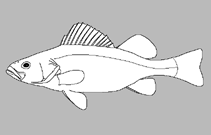
Classification / Names
Κοινά ονόματα | Συνώνυμα | Catalog of Fishes(Γένος, Είδη) | ITIS | CoL | WoRMS | Cloffa
>
Perciformes/Percoidei (Perchs) >
Percidae (Perches) > Etheostomatinae
Etymology: Percina: Latin, diminutive of perch = perch (Ref. 45335); williamsi: Named after James D. Williams, a contemporary ichthyologist, malacologist and natural historian extraordinaire.
Eponymy: Dr James ‘Jim’ David Williams (d: 1941) is a biologist and conservationist who worked in the Department of the Interior at the US Florida Fish & Wildlife Service and US Geological Survey (1974–2006), Florida Fish & Wildlife Conservation Commission [...] (Ref. 128868), visit book page.
Environment: milieu / climate zone / εύρος βάθους / distribution range
Οικολογία
; Γλυκού νερού βενθοπελαγικό. Subtropical
North America: restricted to the upper Tennessee River drainage of Tennessee, Virginia and North Carolina, USA.
Μέγεθος / Βάρος / Age
Γεννητική Ωρίμανση: Lm ? range ? - ? cm
Max length : 9.1 cm SL (female)
Short description
Κλείδες προσδιορισμού | Μορφολογία | Μορφομετρία
Ραχιαίες άκανθες (συνολικά) : 11 - 16; Μαλακές ραχιαίες ακτίνες (συνολικά) : 12 - 13; Εδρικές άκανθες: 2; Σπόνδυλοι: 44 - 45. Distinguished from all congeners, except Percina macrocephala, by having a sickle-shaped suborbital bar and a black bar subtending a medial black spot on the caudal-fin base. Differs from Percina macrocephala by having larger scales (usually 24-26 scales around the caudal peduncle vs. 27-31), 21-23 transverse scales (vs. 23-26), and 70-77 lateral scales (vs. 76-86). Has values for the combination of caudal peduncle, transverse and lateral scales and lateral scales usually 120-129 (vs. 128-141); has shorter snout on average; snout ranges from 20-28% of HL compared to 24-31 in Percina macrocephala (Ref. 75766).
Body shape (shape guide): elongated.
Inhabits flowing pools over rocky, sandy or silty substrates in clear creeks or small rivers (Ref. 75766). Occurs most often near woody debris, vegetation such as water willow, or large boulders (Ref. 75766). Spawning takes place in gravel shoals in later winter (Ref. 75766).
Life cycle and mating behavior
Γεννητική Ωρίμανση | Αναπαραγωγή | Γεννοβολία | Αβγά | Γονιμότητα | Προνύμφες
Page, L.M. and T.J. Near, 2007. A New darter from the upper Tennessee River drainage related to Percina macrocephala (Percidae: Etheostomatinae). Copeia 2007(3):605-613. (Ref. 75766)
IUCN Red List Status (Ref. 130435: Version 2025-1)
Vulnerable (VU) (B1ab(ii,iii,iv,v)+2ab(ii,iii,iv,v)); Date assessed: 20 April 2012
Threat to humans
Harmless
Human uses
Εργαλεία
Special reports
Download XML
Διαδικτυακές πηγές
Estimates based on models
Phylogenetic diversity index (Αναφ.
82804): PD
50 = 0.5000 [Uniqueness, from 0.5 = low to 2.0 = high].
Bayesian length-weight: a=0.00575 (0.00268 - 0.01234), b=3.13 (2.95 - 3.31), in cm total length, based on LWR estimates for this (Sub)family-body shape (Ref.
93245).
Τροφικό Επίπεδο (Αναφ.
69278): 3.4 ±0.4 se; based on size and trophs of closest relatives
Ελαστικότητα (Αναφ.
120179): Υψηλό, ελάχιστος χρόνος για διπλασιασμό πληθυσμού < 15 μήνες (Preliminary K or Fecundity.).
Fishing Vulnerability (Ref.
59153): Low vulnerability (10 of 100).
🛈