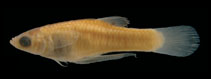
Phalloceros heptaktinos, Seven ray toothcarp

You can sponsor this page

Phalloceros heptaktinos Lucinda, 2008

Seven ray toothcarp
Uploaden van uw Foto's en video's
Afbeeldingen | Google afbeelding
Image of Phalloceros heptaktinos (Seven ray toothcarp)
Phalloceros heptaktinos
Male Afbeelding van Lucinda, P.H.F.

Classificatie / Namen Lokale namen | Synoniemen | Catalog of Fishes(Genus, Soort(en)) | ITIS | CoL | WoRMS | Cloffa

> Cyprinodontiformes (Rivulines, killifishes and live bearers) > Poeciliidae (Poeciliids) > Poeciliinae
Etymology: Phalloceros: Greek, phallos = penis + Greek, keras = horn (Ref. 45335)heptaktinos: Derived from the Greek 'hepta' (seven) and 'aktinos' (rays), referring to the number of dorsal-fin rays in females.

Environment: milieu / Klimaatzone / Diepte / distribution range Ecologie

; zoet water benthopelagisch. Tropical

Verspreiding Landen | FAO regio's | Ecosystemen | Voorkomen | Verspreidingskaart | Introducties | Faunafri

South America: known only from tributarues of the arroio dos Ratos, Jacuí basin in Rio Grande do Sul, Brazil.

Grootte / Gewicht / Leeftijd

Maturiteit: Lm ?  range ? - ? cm
Max length : 2.4 cm SL mannelijk / geslacht onbekend; (Ref. 76852); 3.0 cm SL (female)

Korte beschrijving Determinatiesleutels | Morfologie | Morfometrie

Dorsale zachte stralen (totaal) : 7 - 8; Anale zachte stralen: 9 - 11; Wervels: 31. Diagnosed from its congeners by the absence of the basal process of first gonactinost. Can be differentiated from its congeners by the sexual dimorphism on number of dorsal-fin rays, males with eight rays (very exceptionally seven) and females with seven rays (very exceptionally eight) (Ref. 76852).

Biologie     Verklarende woordenlijst (bv. epibenthic)

Levenscyclus en paargedrag Maturiteit | Voortplanting | Paaien | Eieren | Fecunditeit | Larven

Hoofdreferentie Upload uw referenties | Referenties | Coördinator | Medewerkers

Lucinda, P.H.F., 2008. Systematics and biogeography of the genus Phalloceros Eigenmann, 1907 (Cyprinodontiformes: Poeciliidae: Poeciliinae), with the description of twenty-one new species. Neotrop. Ichthyol. 6(2):113-158. (Ref. 76852)

Status op de Rode Lijst van het IUCN (Ref. 130435: Version 2025-1)

  Onvoldoende gegevens (DD) ; Date assessed: 07 November 2018

CITES

Not Evaluated

CMS (Ref. 116361)

Not Evaluated

Gevaar voor de mens

  Harmless


Gebruik door de mens

FAO - Publication: search | FishSource |

Meer informatie

Trofische ecologie
Food items (preys)
Dieetsamenstelling
Voedselconsumptie
Food rations
Predatoren
Ecologie
Ecologie
Home ranges
Population dynamics
Groeiparameters
Max. ages / sizes
Length-weight rel.
Length-length rel.
Lengtefrequenties
Massaconversie
Rekrutering
Abundantie
Life cycle
Voortplanting
Maturiteit
Maturity/Gills rel.
Fecunditeit
Paaien
Spawning aggregations
Eieren
Ontwikkeling van de eieren
Larven
Larvale populatiedynamiek
Verspreiding
Landen
FAO regio's
Ecosystemen
Voorkomen
Introducties
BRUVS - Videos
Anatomy
Kieuwoppervlak
Brain
Otolith
Physiology
Body composition
Nutrients
Zuurstofverbruik
Zwemtype
Zwemsnelheid
Visual pigments
Fish sound
Diseases & Parasites
Toxicity (LC50s)
Genetica
genoom
Genetica
Heterozygosity
Erfelijkheid
Human related
Aquaculture systems
Aquacultuurprofielen
Kweeklijnen
Ciguatera cases
Stamps, coins, misc.
Outreach
Medewerkers
Referenties
Referenties

Tools

Speciale rapporten

Download XML

Internetbronnen

AFORO (otoliths) | Aquatic Commons | BHL | Cloffa | Websites from users | Bekijk FishWatcher | CISTI | Catalog of Fishes: Genus, Soort(en) | DiscoverLife | ECOTOX | FAO - Publication: search | Faunafri | Fishipedia | Fishtrace | GloBI | Google Books | Google Scholar | Google | IGFA World Record | OneZoom | Open Tree of Life | Otolith Atlas of Taiwan Fishes | PubMed | Reef Life Survey | Socotra Atlas | TreeBase | Tree of Life | Wikipedia: ga naar, zoek | Zoobank | Zoological Record

Estimates based on models

Fylogenetische diversiteitsindex (Ref. 82804):  PD50 = 0.5000   [Uniqueness, from 0.5 = low to 2.0 = high].
Bayesian length-weight: a=0.00851 (0.00374 - 0.01935), b=3.14 (2.95 - 3.33), in cm total length, based on LWR estimates for this (Sub)family-body shape (Ref. 93245).
Trofisch niveau (Ref. 69278):  3.0   ±0.4 se; based on size and trophs of closest relatives
Weerstandsvermogen (Ref. 120179):  Hoog, minimale populatieverdubbelingstijd minder dan 15 maanden (Preliminary K or Fecundity.).
Fishing Vulnerability (Ref. 59153):  Low vulnerability (10 of 100). 🛈