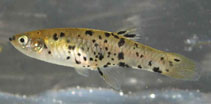
Classification / Names
Κοινά ονόματα | Συνώνυμα | Catalog of Fishes(Γένος, Είδη) | ITIS | CoL | WoRMS | Cloffa
>
Cyprinodontiformes (Rivulines, killifishes and live bearers) >
Poeciliidae (Poeciliids) > Poeciliinae
Etymology: Phalloceros: Greek, phallos = penis + Greek, keras = horn (Ref. 45335).
Environment: milieu / climate zone / εύρος βάθους / distribution range
Οικολογία
; Γλυκού νερού βενθοπελαγικό. Tropical
South America: Rio Paraná-Paraguay basin and coastal drainages from rio Itaboapana to rio Araranguá.
Μέγεθος / Βάρος / Age
Γεννητική Ωρίμανση: Lm ? range ? - ? cm
Max length : 3.4 cm SL αρσενικό/απροσδιόριστο; (Ref. 76852); 4.7 cm SL (female)
Short description
Κλείδες προσδιορισμού | Μορφολογία | Μορφομετρία
Μαλακές ραχιαίες ακτίνες (συνολικά) : 7 - 9; Μαλακές εδρικές ακτίνες: 8 - 12; Σπόνδυλοι: 31 - 33. Diagnosed from Phalloceros anisophallos, Phalloceros megapolos, Phalloceros spiloura, Phalloceros reisi, Phalloceros buckupi,
Phalloceros alessandrae, Phalloceros lucenorum, Phalloceros uai, Phalloceros pellos, and Phalloceros malabarbai by the female urogenital papilla straight along midline and located between the anus and the base of first anal-fin ray (vs. curved to the right, located laterally; border of the anal aperture in contact with the first anal-fin ray). Differs from Phalloceros tupinamba, Phalloceros leptokeras, and Phalloceros aspilos by the female urogenital papilla straight along midline (vs. slightly left turned); absence of a lateral ramus of the female urogenital papilla (vs. lateral ramus present); and small and simple hook in gonopodial appendix (vs. large sickle like hook).
Can be distinguished from Phalloceros caudimaculatus, Phalloceros heptaktinos, Phalloceros ocellatus, Phalloceros mikrommatos, and Phalloceros leticiae by having a hook in the gonopodial appendix (vs. hook absent); from Phalloceros titthos by the absence of symphyseal papillae on large females (vs. symphyseal papillae present); and from Phalloceros enneaktinos by the possession
of seven or eight dorsal-fin rays (vs. nine) (see remarks); from Phalloceros elachistos by the hook of gonopodial appendix not forming a lateral protuberance (vs. very small in adults, forming a lateral minute protuberance). In juveniles hook present and located on the appendix corner (vs. absent or (rarely) minuscule, when present in juveniles hook never situated on the appendix corner). Skin present covering the tip of appendix on juveniles (vs. skin absent). Distal half of appendix narrower than proximal half (vs. approximately as wide as or slightly narrower than proximal half) (Ref. 76852).
Life cycle and mating behavior
Γεννητική Ωρίμανση | Αναπαραγωγή | Γεννοβολία | Αβγά | Γονιμότητα | Προνύμφες
Lucinda, P.H.F., 2008. Systematics and biogeography of the genus Phalloceros Eigenmann, 1907 (Cyprinodontiformes: Poeciliidae: Poeciliinae), with the description of twenty-one new species. Neotrop. Ichthyol. 6(2):113-158. (Ref. 76852)
IUCN Red List Status (Ref. 130435: Version 2025-1)
Threat to humans
Harmless
Human uses
Εργαλεία
Special reports
Download XML
Διαδικτυακές πηγές
Estimates based on models
Phylogenetic diversity index (Αναφ.
82804): PD
50 = 0.5000 [Uniqueness, from 0.5 = low to 2.0 = high].
Bayesian length-weight: a=0.01047 (0.00834 - 0.01315), b=3.17 (3.11 - 3.23), in cm total length, based on LWR estimates for this species (Ref.
93245).
Τροφικό Επίπεδο (Αναφ.
69278): 3.0 ±0.4 se; based on size and trophs of closest relatives
Ελαστικότητα (Αναφ.
120179): Υψηλό, ελάχιστος χρόνος για διπλασιασμό πληθυσμού < 15 μήνες (Preliminary K or Fecundity.).
Fishing Vulnerability (Ref.
59153): Low vulnerability (10 of 100).
🛈