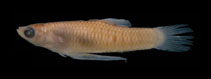
>
Cyprinodontiformes (Rivulines, killifishes and live bearers) >
Poeciliidae (Poeciliids) > Poeciliinae
Etymology: Phalloceros: Greek, phallos = penis + Greek, keras = horn (Ref. 45335); reisi: Named for Roberto E. Reis, in recognition of his many contributions to Neotropical ichthyology.
Eponymy: Dr Roberto Esser dos Reis is a Brazilian ichthyologist. [...] (Ref. 128868), visit book page.
Environment: milieu / climate zone / rango de profundidad / distribution range
Ecología
; agua dulce bentopelágico. Tropical
South America: headwaters of rio Tietê, rio Paraíba do Sul, rio Ribeira de Iguape, and small coastal drainages in São Paulo, Brazil.
Tamaño / Peso / Age
Madurez: Lm ? range ? - ? cm
Max length : 2.7 cm SL macho / no sexado; (Ref. 76852); 5.0 cm SL (female)
Short description
Claves de identificación | Morfología | Morfometría
Radios blandos dorsales (total) : 7 - 9; Radios blandos anales: 9 - 11; Vértebra: 31 - 32. Diagnosed by the following combination of characters: female urogenital papilla curved to the right, located laterally; border of the anal aperture in contact with the first anal-fin ray or very close to it; absence of the right hook and presence of the left one; gonopodial appendix asymmetrical, its halves different from each other, right half wider than left one; absence of a caudal peduncle spot; presence of a wide and square-shaped lateral spot in large specimens; rectangular tip of hook on left half of gonopodial appendix; lateral spot in adult females very narrow, forming a vertically elongated bar covering up to the length corresponding to two scales length in horizontal direction and 2-4 scales in vertical direction; background coloration light brown or yellow; and margin of scales on prepelvic region not visible, not bordered by dark chromatophores, forming a light, plain yellow region; and lateral spot absent or small and discrete not covering one or two scales in horizontal or vertical directions (Ref. 76852).
Life cycle and mating behavior
Madurez | Reproducción | Puesta | Huevos | Fecundidad | Larva
Lucinda, P.H.F., 2008. Systematics and biogeography of the genus Phalloceros Eigenmann, 1907 (Cyprinodontiformes: Poeciliidae: Poeciliinae), with the description of twenty-one new species. Neotrop. Ichthyol. 6(2):113-158. (Ref. 76852)
IUCN Red List Status (Ref. 130435: Version 2025-1)
Threat to humans
Harmless
Human uses
Herramientas
Special reports
Download XML
Fuentes de Internet
Estimates based on models
Phylogenetic diversity index (Referencia
82804): PD
50 = 0.5000 [Uniqueness, from 0.5 = low to 2.0 = high].
Bayesian length-weight: a=0.00851 (0.00374 - 0.01935), b=3.14 (2.95 - 3.33), in cm total length, based on LWR estimates for this (Sub)family-body shape (Ref.
93245).
Nivel trófico (Referencia
69278): 3.0 ±0.4 se; based on size and trophs of closest relatives
Resiliencia (Referencia
120179): Alto, población duplicada en un tiempo mínimo inferior a 15 meses (Preliminary K or Fecundity.).
Fishing Vulnerability (Ref.
59153): Low vulnerability (10 of 100).
🛈