This website uses cookies to enhance your browsing experience and ensure the functionality of our site. For more detailed information about the types of cookies we use and how we protect your privacy, please visit our Privacy Information page.
×
Cookie Settings
This website uses different types of cookies to enhance your experience. Please select your preferences below:
Élasmobranches (requins et raies) (sharks and rays) > Carcharhiniformes (Ground sharks) > Scyliorhinidae (Cat sharks) > Scyliorhininae
Etymology: Cephaloscyllium:cephalus, from kephale (Gr.), head, referring to its very broad and depressed head; skylion, Greek for dogfish or small shark (See ETYFish); variegatum:Latin for varied or various, referring to strong intraspecific and ontogenetic variability in color pattern and morphology amongst the specimens examined (See ETYFish). More on authors: Last & White.
Environnement : milieu / zone climatique / profondeur / gamme de distribution Écologie
marin bathypélagique; profondeur 114 - 606 m (Ref. 76948). Subtropical
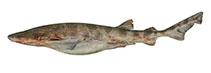
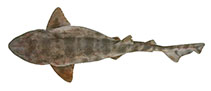
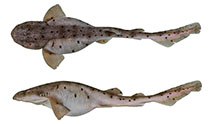
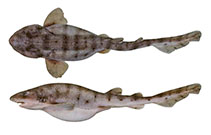
This medium-sized species is distinguished by the following set of characters: head 9.4-10.5% TL in height, trunk width 14.5-17.1% TL; origin of first dorsal fin over or slightly behind mid pelvic-fin base; prenarial 4.4-5.0% TL in length; length of preorbital snout, 1.5-1.7 times prenarial length, 2.9-3.3 in prepectoral length, 6.4-7.2 in prepelvic length; snout-vent length long, 50.5-52.9% TL; nostril 2.4-2.6% TL in width; eye-spiracle space wide, 0.8-1.3% TL; pectoral fin large, height 12.9-13.2% TL, posterior margin length 10.4-12.1% TL; anal fin 3.5-4.1% TL in height; anal-caudal space 4.5-5.7% SL; precaudal 76-78% TL in length; interdorsal space 6.5-8.0% TL; teeth with 3-7 cusps near symphysis of upper jaw; flank denticles are mainly unicuspidate; back with no greatly enlarged denticles; long adult clasper, up to 8.1% TL, almost reaching anal fin, interspace about 5.4 in anal-fin base; vertebral centra 116-124; teeth in each jaw 68-82; variable colour pattern, not similar between adults and juveniles; adults have 11 distinct or indistinct dark saddle-like markings on body and tail while juveniles are without saddles, instead with fine blackish spots; predorsal saddles are not much wider than interspaces between them; interspiracular saddle width is subequal to eye length; obvious dark blotch over gill slits none; fleshy part of caudal fin appearing as a pale stripe, well demarcated from darker areas above and below (Ref. 76948). Body shape (shape guide): elongated.
Cycle de vie et comportement reproducteur Maturité | Reproduction | Frai | Œufs | Fécondité | Larves
Last, P.R. and W.T. White, 2008. Two new saddled swellsharks (Cephaloscyllium: Scyliorhinidae) from Eastern Australia. In Last, P.R., White, W.T. & Pogonoski, J.J. (eds.): Descriptions of New Australian Chondrichthyans. CSIRO Marine and Atmospheric Research Paper no. 22. (Ref. 76948)
Statut dans la liste rouge de l'IUCN (Ref. 130435: Version 2025-2 (Global))
Dynamique des populations Paramètres de croissance Âges / tailles maximales Longueur-poids rel. Rel. longueur-longueur. Fréquences de longueurs Conversion de masse Recrutement Abondance
Cycle de vie Reproduction Maturité Maturité/épines rel. Fécondité Frai Agrégats de frai Œufs Développement de l'œuf Larves Dynamique des populations larvaires
Physiologie Composition corporelle Nutriments Consommation d'oxygène Type de natation Vitesse de nage Pigments visuels Son de poisson Maladies et parasites Toxicité (CL50)
Température préférée (Réf. 123201): 12 - 17.7, mean 13.8 °C (based on 13 cells).
Indice de diversité phylogénétique (Réf. 82804): PD50 = 0.5000 [Uniqueness, from 0.5 = low to 2.0 = high].
Bayesian length-weight: a=0.00269 (0.00140 - 0.00518), b=3.21 (3.04 - 3.38), in cm total length, based on LWR estimates for this (Sub)family-body shape (Ref. 93245).
Niveau trophique (Réf. 69278): 4.1 ±0.5 se; based on size and trophs of closest relatives
Résilience (Réf. 120179): Faible, temps minimum de doublement de population : 4,5 à 14 années (Preliminary K or Fecundity.).
Vulnérabilité de la pêche (Ref. 59153): Moderate to high vulnerability (50 of 100). 🛈