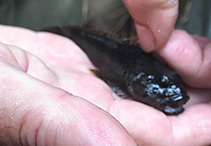
Classification / Names
Nomi Comuni | Sinonimi | Catalog of Fishes(Genere, Specie) | ITIS | CoL | WoRMS | Cloffa
>
Perciformes/Cottoidei (Sculpins) >
Cottidae (Sculpins)
Etymology: Cottus: Greek, kottos = a fish (Ref. 45335); tallapoosae: The specific name is in reference to the Tallapoosa River, to which this species is endemic. Tallapoosa is an ancient Upper Creek American Indian settlement on the river; originally derived from the Choctaw 'pulverized rock'.
Environment: milieu / climate zone / distribuzione batimetrica / distribution range
Ecologia
; acqua dolce benthopelagico. Subtropical
North America: endemic to the Tallapoosa River drainage above the Fall Line in the east-central Alabama and west-central Georgia, USA.
Size / Peso / Age
Maturità: Lm ? range ? - ? cm
Max length : 7.7 cm SL maschio/sesso non determinato; (Ref. 72414)
Short description
Chiavi di identificazione | Morfologia | Morfometria
Spine dorsali (totale) : 6 - 8; Raggi dorsali molli (totale) : 14 - 18; Raggi anali molli: 10 - 14; Vertebre: 29 - 32. Diagnosed from all congeners except Cottus chattahoochee by the combination of the following characters: modally eight infraorbital canal pores; five bones in the suborbital series; reduced palatine teeth; a flexible spine and four rays in the pelvic fin; preoperculomandibular canals not fused at anterior rami of mandibles, with two pores at tip of chin; pectoral rays simple; preopercular armature well-developed with two or three spines; chin not mottled; and dorsal fins separate. Differs from Cottus chattahoochee by having the following features: usually incomplete lateral line (vs. complete); dermal prickling reduced or absent, when present generally restricted to a few scattered prickles in area along anterior part of lateral line (vs. a robust postpectoral patch in addition to prickles along the anterior lateral line); and narrow to moderately wide saddles (vs. moderate or wide) (Ref. 72414).
Inhabits clean gravel or rocky bottomed streams with moderate to swift current. Frequently found in streams 3-15 m wide and at depths of 0.5-0.7 m (Ref. 72414). Feeds on anything alive which fits into its mouth (Ref. 72414).
Life cycle and mating behavior
Maturità | Riproduzione | Deposizione | Uova | Fecundity | Larve
Neely, D.A., J.D. Williams and R.L. Mayden, 2007. Two new sculpins of the genus Cottus (Teleostei: Cottidae) from rivers of the eastern north America. Copeia 2007(3):641-655. (Ref. 72414)
IUCN Red List Status (Ref. 130435: Version 2025-1)
Threat to humans
Harmless
Human uses
Pesca: di nessun interesse
Strumenti
Special reports
Download XML
Fonti Internet
Estimates based on models
Phylogenetic diversity index (Fonte Biblio.
82804): PD
50 = 0.5000 [Uniqueness, from 0.5 = low to 2.0 = high].
Bayesian length-weight: a=0.00955 (0.00344 - 0.02648), b=3.09 (2.85 - 3.33), in cm total length, based on LWR estimates for this (Sub)family-body shape (Ref.
93245).
Trophic level (Fonte Biblio.
69278): 3.3 ±0.4 se; based on size and trophs of closest relatives
Resilienza (Fonte Biblio.
120179): Medio, tempo minimo di raddoppiamento della popolazione 1.4 - 4.4 anni (Preliminary K or Fecundity.).
Fishing Vulnerability (Ref.
59153): Low vulnerability (10 of 100).
🛈