



Eusurculus pristinus Schwarzhans & Møller, 2007
Pristine viviparous brotula
Hochladen Photos und videos
Bilder | Google Bild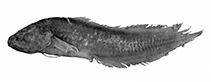 Eusurculus pristinus
Male Photo von W. Schwarzhans & P. R. Møller
Bilder | Google Bild
Male Photo von W. Schwarzhans & P. R. Møller
Klassifizierung / Names Namen | Synonyme | Catalog of Fishes(Gattung, Arten) | ITIS | CoL | WoRMS | Cloffa
> Ophidiiformes (Cusk eels) > Dinematichthyidae (Viviparous brotula)
Etymology: Eusurculus: Name from Latin and Greek 'eu' for good or real and Latin 'surculus' for grapevine tendril, refers to the functional analogy with the pseudoclaspers and the specific shape of the inner pseudoclasper; pristinus: Name from Latin 'pristinus' for ancient or original, refers to the simpler pattern of the inner pseudoclasper when compared to the sucker-disk of E. andamanensis and E. pistillum; noun in apposition.
More on authors: Schwarzhans & Møller.
Etymology: Eusurculus: Name from Latin and Greek 'eu' for good or real and Latin 'surculus' for grapevine tendril, refers to the functional analogy with the pseudoclaspers and the specific shape of the inner pseudoclasper; pristinus: Name from Latin 'pristinus' for ancient or original, refers to the simpler pattern of the inner pseudoclasper when compared to the sucker-disk of E. andamanensis and E. pistillum; noun in apposition.
More on authors: Schwarzhans & Møller.
Umwelt: Milieu / Klimazone / Tiefenbereich / Verbreitungsgebiet Ökologie
seewasser demersal. Tropical
Verbreitung Territorien | FAO Gebiete | Ökosysteme | Vorkommen | Punkt Karte | Einführungen | Faunafri
Western Pacific, Bismarck Sea to the Solomons and Vanuatu.
Größe / Gewicht / Alter
Geschlechtsreife: Lm ? range ? - ? cm
Max length : 4.5 cm SL Männchen/unbestimmt; (Ref. 76869); 4.6 cm SL (female)
Max length : 4.5 cm SL Männchen/unbestimmt; (Ref. 76869); 4.6 cm SL (female)
Kurzbeschreibung Bestimmungsschlüssel | Morphologie | Morphometrie
Rückenflossenweichstrahlen (insgesamt) : 74 - 86; Afterflossenweichstrahlen: 58 - 70; Wirbelzahl: 41 - 44. This species is distinguished by the following characters: D 74-86, A 58-70, D/A 18-27, V in D 2.0-2.3; vertebrae 11-12+30-33=41-44, anterior nostril located 1/4 to 1/5 distance from upper lip to aggregate distance to anterior margin of eye; free pseudoclaspers 2 pairs, outer pseudoclasper wing-shaped with moderately broad base and distally widened supporter with strong anterior hook (covered by ligament), the inner one is stalked, with slightly widened base and miniature sucker-disk with two small hooks; 5-8 scale rows on upper part, 3-4 rows on lower part of the cheek; otoliths with distinct ostium and cauda, partly fused colliculi, otolith length to height 2.0-2.1, ostial colliculum length to caudal colliculum length 3.5-5 (Ref. 76869).
Body shape (shape guide): elongated; Cross section: compressed.
Body shape (shape guide): elongated; Cross section: compressed.
Lebenszyklus und Paarungsverhalten Geschlechtsreife | Fortpflanzung | Ablaichen | Eier | Fruchtbarkeit | Larven
Hauptreferenz
Laden Sie Ihre Referenzen hoch | Referenzen | Koordinator | Partner
Schwarzhans, W. and P.R. Møller, 2007. Review of the Dinematichthyini (Teleostei: Bythitidae) of the Indo-west Pacific. Part III. Beaglichthys, Brosmolus, Monothrix and eight new genera with description of 20 new species. The Beagle, Records of the Museums and Art Galleries of the Northern Territory 23:29-110. (Ref. 76869)
IUCN Rote Liste Status (Ref. 130435: Version 2025-2 (Global))
nicht bedroht (LC) ; Date assessed: 16 August 2019
CITES
Not Evaluated
Bedrohung für Menschen
Nutzung durch Menschen
FAO - Publication: search | FishSource |
Mehr Information
Trophische Ökologie
Lebensmittel (Beutetiere)
Nahrungszusammensetzung
Nahrungsaufnahme
Lebensmittelrationen
Räuber
Lebensmittel (Beutetiere)
Nahrungszusammensetzung
Nahrungsaufnahme
Lebensmittelrationen
Räuber
Ökologie
Ökologie
Ökologie
Populationsdynamik
Wachstumsparameter
Max. Alter/Größen
Länge-Gewicht-Rel.
Länge-Länge-Verhältnis.
Längenhäufigkeiten
Massenkonvertierung
Rekrutierung
Dichte
Wachstumsparameter
Max. Alter/Größen
Länge-Gewicht-Rel.
Länge-Länge-Verhältnis.
Längenhäufigkeiten
Massenkonvertierung
Rekrutierung
Dichte
Lebenszyklus
Fortpflanzung
Geschlechtsreife
Reifung/Kiemen rel.
Fruchtbarkeit
Ablaichen
Laichaggregationen
Eier
Eientwicklung
Larven
Larven Pop.Dyn.
Fortpflanzung
Geschlechtsreife
Reifung/Kiemen rel.
Fruchtbarkeit
Ablaichen
Laichaggregationen
Eier
Eientwicklung
Larven
Larven Pop.Dyn.
Anatomie
Kiemenoberfläche
Gehirn
Otolith
Kiemenoberfläche
Gehirn
Otolith
Physiologie
Körperliche Zusammensetzung
Nährstoffe
Sauerstoffverbrauch
Schwimmart
Schwimmgeschwindigkeit
Visuelle Pigmente
Fischgeräusche
Krankheiten und Parasiten
Toxizität (LC50s)
Körperliche Zusammensetzung
Nährstoffe
Sauerstoffverbrauch
Schwimmart
Schwimmgeschwindigkeit
Visuelle Pigmente
Fischgeräusche
Krankheiten und Parasiten
Toxizität (LC50s)
Genetik
Genom
Genetik
Heterozygotie
Vererbbarkeit
Genetische Vielfalt
Genom
Genetik
Heterozygotie
Vererbbarkeit
Genetische Vielfalt
Menschenbezogen
Aquakultur-Systeme
Aquakultur Profile
Zuchtlinien
Ciguatera-Fälle
Briefmarken, Münzen, Verschiedenes.
Aquakultur-Systeme
Aquakultur Profile
Zuchtlinien
Ciguatera-Fälle
Briefmarken, Münzen, Verschiedenes.
Tools
Zusatzinformationen
Download XML
Zusammenfassung | Punktdaten | Namen | Photos
Internet Quellen
AFORO (otoliths) | Aquatic Commons | BHL | Cloffa | Websites from users | FishWatcher Einträge suchen | CISTI | Catalog of Fishes: Gattung, Arten | DiscoverLife | ECOTOX | FAO - Publication: search | Faunafri | Fishipedia | Fishtrace | GloBI | Google Books | Google Scholar | Google | IGFA World Record | OneZoom | Open Tree of Life | Otolith Atlas of Taiwan Fishes | PubMed | Reef Life Survey | Socotra Atlas | TreeBase | Tree of Life | Wikipedia: Gehe zu, Suchen | World Records Freshwater Fishing | Zoobank | Zoologischer Rekord
Schätzungen auf der Grundlage von Modellen
Phylogenetischer Diversitätsindex (Ref. 82804): PD50 = 0.6250 [Uniqueness, from 0.5 = low to 2.0 = high].
Bayesian length-weight: a=0.00389 (0.00180 - 0.00842), b=3.12 (2.94 - 3.30), in cm total length, based on all LWR estimates for this body shape (Ref. 93245).
Trophische Ebene (Ref. 69278): 3.2 ±0.5 se; based on size and trophs of closest relatives