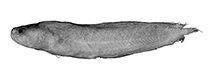
Classificação / Nomes
Nomes comuns | Sinônimos | Catalog of Fishes(Gênero, Espécies) | ITIS | CoL | WoRMS | Cloffa
>
Ophidiiformes (Cusk eels) >
Dinematichthyidae (Viviparous brotula)
Etymology: Lapitaichthys: Name based on the local word ‘xaapeta’ = ‘dig a hole’, which was misheard and became ‘lapita’. Named for Lapita culture, an early indigenous pottery culture of Polynesia, first discovered in New Caledonia, region where the genus appears to be endemic; frickei: Named for Ronald Fricke, SMNS, Stuttgart.
Eponymy: Dr Ronald Fricke (d: 1959) is a fish taxonomist. [...] (Ref. 128868), visit book page.
More on authors: Schwarzhans & Møller.
Environment: milieu / Zona climática / intervalo de profundidade / distribution range
Ecologia
marinhas associadas(os) a recifes; intervalo de profundidade 0 - 2 m (Ref. 76869). Tropical
Western Pacific: New Caledonia.
Tamanho / Peso / Idade
Maturidade: Lm ? range ? - ? cm
Max length : 4.9 cm SL macho/indeterminado; (Ref. 76869); 5.0 cm SL (female)
Descrição suscinta
Chaves de identificação | Morfologia | Morfometria
Raios dorsais (total) : 89 - 99; Raios anais : 62 - 74; Vértebras: 43 - 45. This species is distinct and has the following set of characters: anterior nostril placed moderately low on snout, 1/3.5 the distance from upper lip to aggregate distance to anterior margin of eye; copulatory organ of male with a pair of small (outer) pseudoclaspers with single supporter and small hook at anterior rim; small, size not exceeding 5.0 cm SL; 12-13 precaudal vertebrae, 43-45 total vertebrae; D 92-99, V in D 2.4-2.6; branchiostegal rays 6-7; scale patch on cheek only, none on operculum; presence of upper preopercular pore; moderately elongated otolith, its length to height 2.0-2.1, slightly inclined (5°) sulcus, separated colliculi, ostium length to cauda length 2.5-2.8; maxilla expanded posterio-ventrally (Ref. 76869).
Restricted to lagoonal and back reef environments; most specimens were found in crevices of coralline rock of fringing lagoonal reefs associated with live corals (Ref. 76869).
Ciclo de vida ou comportamento de acasalamento
Maturidade | Reprodução | Desova | Ovos | Fecundidade | Larvas
Schwarzhans, W. and P.R. Møller, 2007. Review of the Dinematichthyini (Teleostei: Bythitidae) of the Indo-west Pacific. Part III. Beaglichthys, Brosmolus, Monothrix and eight new genera with description of 20 new species. The Beagle, Records of the Museums and Art Galleries of the Northern Territory 23:29-110. (Ref. 76869)
Status na Lista Vermelha da UICN (Ref. 130435: Version 2025-1)
Uso pelos humanos
Ferramentas
Relatórios especiais
Baixar XML
Fontes da internet
Estimates based on models
Índice de diversidade filogenética (Ref.
82804): PD
50 = 1.0000 [Uniqueness, from 0.5 = low to 2.0 = high].
Bayesian length-weight: a=0.00389 (0.00180 - 0.00842), b=3.12 (2.94 - 3.30), in cm total length, based on all LWR estimates for this body shape (Ref.
93245).
Nível Trófico (Ref.
69278): 3.2 ±0.5 se; based on size and trophs of closest relatives
Fishing Vulnerability (Ref.
59153): Low vulnerability (10 of 100).
🛈