>
Scombriformes (Mackerels) >
Trichiuridae (Cutlassfishes) > Aphanopodinae
Etymology: Aphanopus: Greek, aphanes = hidden + Greek, pous = foot (Ref. 45335).
More on author: Lowe.
Environment: milieu / Zona climática / intervalo de profundidade / distribution range
Ecologia
marinhas batipelágico; oceanódromo (Ref. 108735); intervalo de profundidade 200 - 2300 m (Ref. 108733), usually 700 - 1300 m (Ref. 108735). Deep-water; 71°N - 23°S, 82°W - 17°E (Ref. 6181)
North Atlantic: on both sides and at underwater rises from Denmark Strait to Cape Verde.
Comprimento de primeira maturação / Tamanho / Peso / Idade
Maturidade: Lm 111.6 range ? - 117.5 cm
Max length : 151 cm TL macho/indeterminado; (Ref. 108708); common length : 70.0 cm SL macho/indeterminado; (Ref. 3698); peso máx. publicado: 0.00 g
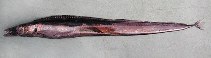
Espinhos dorsais (total) : 34 - 41; Raios dorsais (total) : 52 - 56; Espinhos anais: 2; Raios anais : 43 - 48; Vértebras: 97 - 100. Body is extremely elongated, with body depth 10.8 to 13.4 times in SL. The snout is large with strong fang-like teeth. Pelvic fins represented by a single spine in juveniles but entirely absent in adults. Color is coppery black with iridescent tint. The inside of the mouth and gill cavities black.
Body shape (shape guide): eel-like; Cross section: compressed.
Juveniles mesopelagic (Ref. 6181). Bathypelagic (Ref. 58426). Migrate to midwater at night and feed on crustaceans, cephalopods and fishes (mostly macrourids, morids and alepocephalids). Mature at 80 to 85 cm. Eggs and larvae are pelagic (Ref. 6768). Data from study reveal mature individuals undertake horizontal migration to spawning and nursery grounds located off the Madeira and Canary islands (Ref. 108708). Commercial catch up to 1000 t was caught off Madeira with a specialized commercial deep water longline (Ref. 6255). Appear as bycatch in the trawl fishery west of the British Isles, along the Middle-Atlantic Ridge and at Corner Rise. Important and fabled food fish in Madeira (Ref. 4537). Some specimens reach 145 cm (Nuno Marques, Nomad@netmadeira.com, 12/09).
Displays determinate fecundity (Ref. 108695). Mature individuals undertake horizontal migration to spawning and nursery grounds (Ref. 108708). Suspended pre-spawning stages occurred in some areas of the Northeast Atlantic caused by atresia in ovaries (Ref. 108708).
Nakamura, I. and N.V. Parin, 1993. FAO Species Catalogue. Vol. 15. Snake mackerels and cutlassfishes of the world (families Gempylidae and Trichiuridae). An annotated and illustrated catalogue of the snake mackerels, snoeks, escolars, gemfishes, sackfishes, domine, oilfish, cutlassfishes,. scabbardfishes, hairtails, and frostfishes known to date. FAO Fish. Synop. 125(15):136 p. (Ref. 6181)
Status na Lista Vermelha da UICN (Ref. 130435: Version 2025-1)
Ameaça para os humanos
Harmless
Uso pelos humanos
Pescarias: altamente comercial
Ferramentas
Relatórios especiais
Baixar XML
Fontes da internet
Estimates based on models
Preferred temperature (Ref.
123201): 1.1 - 12.6, mean 7.1 °C (based on 244 cells).
Índice de diversidade filogenética (Ref.
82804): PD
50 = 0.5078 [Uniqueness, from 0.5 = low to 2.0 = high].
Bayesian length-weight: a=0.00046 (0.00033 - 0.00063), b=3.15 (3.06 - 3.24), in cm total length, based on LWR estimates for this species (Ref.
93245).
Nível Trófico (Ref.
69278): 4.5 ±0.77 se; based on food items.
Resiliência (Ref.
120179): médio(a), tempo mínimo de duplicação da população 1,4 - 4,4 anos (K=0.11-0.25, tmax=14?; tm=3).
Prior r = 0.20, 95% CL = 0.13 - 0.30, Based on 3 full stock assessments.
Fishing Vulnerability (Ref.
59153): High vulnerability (64 of 100).
🛈
Climate Vulnerability (Ref.
125649): Moderate vulnerability (44 of 100).
🛈
Nutrients (Ref.
124155): Calcium = 11.6 [6.0, 18.7] mg/100g; Iron = 0.192 [0.097, 0.400] mg/100g; Protein = 17.4 [16.1, 18.7] %; Omega3 = 0.161 [0.071, 0.370] g/100g; Selenium = 34.7 [15.7, 77.9] μg/100g; VitaminA = 15.8 [1.6, 130.4] μg/100g; Zinc = 0.391 [0.267, 0.539] mg/100g (wet weight); based on
nutrient studies.