



Ladda upp din foton och Videor
Bilder | Google image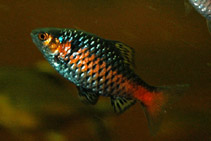 Pethia padamya
Bild av Greco, F.M.
Bilder | Google image
Bild av Greco, F.M.
Klassificering / Namn Populärnamn | synonymer | Catalog of Fishes(Släkte, Arter) | ITIS | CoL | WoRMS | Cloffa
> Cypriniformes (Carps) > Cyprinidae (Minnows or carps) > Smiliogastrinae
Etymology: Pethia: Pethia is the generic vernacular name for small cyprinids in Sinhala; padamya: Padamya is the Burmese word for ruby, given here with reference to the name ruby barb used in the ornamental fish trade, and to the bright red color of the males. It is to be treated as a noun in apposition.
More on authors: Kullander & Britz.
Etymology: Pethia: Pethia is the generic vernacular name for small cyprinids in Sinhala; padamya: Padamya is the Burmese word for ruby, given here with reference to the name ruby barb used in the ornamental fish trade, and to the bright red color of the males. It is to be treated as a noun in apposition.
More on authors: Kullander & Britz.
Miljö: miljö / Klimatzon / djupintervall / distributionsområde Ekologi
; sötvatten pelagiska. Tropical; 23°N - 21°N, 94°W - 96°W
Utbredning Territorier | FAO områden | Ekosystem | Förekomster | Prickkarta | Utplanteringar | Faunafri
Asia: Myanmar. Known only from the type locality, an artificial pond in Toe Gyi village, situated just above the Anisakan Falls, near Pyin Oo Lwin, on the road Mandalay-Hsipaw, and from the lower Chindwin River.
Storlek / Vikt / Ålder
Kort beskrivning Bestämningsnycklar | Morfologi | Morfometri
Mjukstrålar i ryggfenan (totalt) : 11 - 12; Mjukstrålar i analfenan: 8. A member of the Puntius conchonius species group which can be distinguished from all its congeners in that group by a combination of the following characters: maxillary barbels present, minute; lateral line abbreviated, on 5-8 scales; circumpeduncular scales 12; dorsal, anal and pelvic fins in adult males hyaline, margined with black and crossed by two or three rows of contrasting deep black spots; humeral spot vertically elongate, three or more scales deep; caudal peduncle blotch covering parts of one or two scales, and indistinct in adult males. Similar only to P. didi, sharing abbreviated lateral line, presence of maxillary barbels, 12 circumpeduncular scales, and colour pattern including both vertically extended humeral blotch and caudal peduncle blotch, other vertical bars absent. Can be separated from P.didi in extension of humeral blotch which reaches ventrally to lateral line scales, vs. extending down to level of pectoral fin base in P. didi; in colour pattern of adult males in which sides yellowish white with contrasting brown blotches at scale bases and abdomen dark pigmented, vs. sides lightly pigmented, gradually lighter ventrally, abdomen whitish in males of P. didi; pelvic fins in males hyaline with two rows of deep black spots and deep black marginal band vs. pelvic fins either without dark markings or blackish marginal stripe and single row of black spots across middle of fin in P. didi; anal fin in males hyaline with deep black margin and two or three rows of deep black spots, vs. blackish margin and at most one row of blackish spots in P. didi; males with conspicuous red colour along middle of side from opercle to base of caudal fin vs. red colour absent from sides in males of P. didi (Ref. 79001).
Body shape (shape guide): short and / or deep.
Body shape (shape guide): short and / or deep.
Found in an artificial pond (Ref. 79001).
Livscykel och parningsbeteende Könsmognad | Reproduktion | Lek | Ägg | Fekunditet | Larver
Huvudreferens
Ladda upp dina referenser | referenser | Koordinator | Medarbetare
Kullander, S.O. and R. Britz, 2008. Puntius padamya, a new species of cyprinid fish from Myanmar (Teleostei: Cyprinidae). Electronic J. Ichthyol. (2):56-66. (Ref. 79001)
Status på IUCN:s rödlista (Ref. 130435: Version 2025-2 (Global))
Data deficient (DD) ; Date assessed: 24 February 2010
CITES
Not Evaluated
Hot mot människor
Harmless
Mänskliga användningsområden
FAO - Publication: search | FishSource |
Ytterligare information
Trofisk ekologi
Livsmedelsartiklar (preys)
Födosammansättning
Födointag
Matransoner
Predatorer
Livsmedelsartiklar (preys)
Födosammansättning
Födointag
Matransoner
Predatorer
Ekologi
Ekologi
Ekologi
Populationsdynamik
Tillväxtparametrar
Max. åldrar / storlekar
Längd-vikt rel.
Längd-längd rel.
Längd-frekvenser
Massakonvertering
Rekrytering
Abundans
Tillväxtparametrar
Max. åldrar / storlekar
Längd-vikt rel.
Längd-längd rel.
Längd-frekvenser
Massakonvertering
Rekrytering
Abundans
Livscykel
Reproduktion
Könsmognad
Mognad/Gills rel.
Fekunditet
Lek
Lekande aggregat
Ägg
Utveckling av ägg
Larver
Larvdynamik
Reproduktion
Könsmognad
Mognad/Gills rel.
Fekunditet
Lek
Lekande aggregat
Ägg
Utveckling av ägg
Larver
Larvdynamik
Anatomi
Gälyta
Hjärna
Otolit
Gälyta
Hjärna
Otolit
Fysiologi
Kroppssammansättning
Näringsämnen
Syreförbrukning
Typ av simning
Simhastighet
Visuella pigment
Ljud från fisk
Sjukdomar & Parasiter
Toxicitet (LC50)
Kroppssammansättning
Näringsämnen
Syreförbrukning
Typ av simning
Simhastighet
Visuella pigment
Ljud från fisk
Sjukdomar & Parasiter
Toxicitet (LC50)
Genetik
Genom
Genetik
Heterozygositet
Ärftlighet
Genetisk mångfald
Genom
Genetik
Heterozygositet
Ärftlighet
Genetisk mångfald
Människorelaterad
Vattenbrukssystem
Vattenbruksprofiler
Avelslinjer
Ciguatera-fall
Frimärken, mynt, diverse.
Vattenbrukssystem
Vattenbruksprofiler
Avelslinjer
Ciguatera-fall
Frimärken, mynt, diverse.
Verktyg
Särskilda rapporter
Kontrollera för underhåll av akvarium | Kontrollera om det finns faktablad om arter | Kontrollera om det finns faktablad om vattenbruk
Ladda ner XML
Internet-källor
AFORO (otoliths) | Aquatic Commons | BHL | Cloffa | Websites from users | Check FishWatcher | CISTI | Catalog of Fishes: Släkte, Arter | DiscoverLife | ECOTOX | FAO - Publication: search | Faunafri | Fishipedia | Fishtrace | GloBI | Google Books | Google Scholar | Google | IGFA World Record | OneZoom | Open Tree of Life | Otolith Atlas of Taiwan Fishes | Offentliga akvarier | PubMed | Reef Life Survey | Socotra Atlas | TreeBase | Tree of Life | Wikipedia: Go, sök | World Records Freshwater Fishing | Zoologiskt register
Uppskattningar baserade på modeller
Index för fylogenetisk mångfald (Ref. 82804): PD50 = 0.5000 [Uniqueness, from 0.5 = low to 2.0 = high].
Bayesian length-weight: a=0.01622 (0.00606 - 0.04338), b=2.94 (2.71 - 3.17), in cm total length, based on LWR estimates for this (Sub)family-body shape (Ref. 93245).
Trofisk nivå (Ref. 69278): 2.7 ±0.2 se; based on size and trophs of closest relatives
Resiliens (Ref. 120179): Hög, lägsta populationsfördubblingstid mindre än 15 månader (Preliminary K or Fecundity.).