Classification / Names
Nombres comunes | Sinónimos | Catalog of Fishes(Género, Especie) | ITIS | CoL | WoRMS | Cloffa
>
Siluriformes (Catfishes) >
Loricariidae (Armored catfishes) > Hypostominae
Etymology: Hypostomus: Greek, hypo = under + Greek, stoma = mouth (Ref. 45335); faveolus: From the Latin adjective 'faveolus', after 'favus', meaning honeycomb, in reference to the color pattern formed by the pale blotches with thin dark limits.
Environment: milieu / climate zone / rango de profundidad / distribution range
Ecología
; agua dulce demersal. Tropical
South America: Rio Tocantins basin and the upper rio Xingu basin in central Brazil.
Tamaño / Peso / Age
Madurez: Lm ? range ? - ? cm
Max length : 20.6 cm SL macho / no sexado; (Ref. 79072)
Short description
Claves de identificación | Morfología | Morfometría
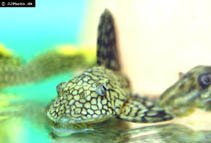
Espinas dorsales (total) : 1; Radios blandos dorsales (total) : 7; Espinas anales: 1; Radios blandos anales: 4. Differs from all other species of the genus Hypostomus by having a unique combination of pale blotches over a darker background in body and fins, and conspicuous keels on head, predorsal region and lateral plates. Geographic variation is evident where most of the specimens from the rio Xingu basin have dark limits of coloration larger when compared to specimens of the rio Tocantins basin, and the limits between pale blotches are about same size or slightly larger than the blotches. Small specimens (up to 50 mm SL) from the rio Xingu basin mostly possess pale blotches on the head forming vermiculations (vs. small specimens from the rio Tocantins basin have a pattern similar to that in adults). However, the color pattern of specimens from one lot of Hypostomus faveolus from the rio Suiá Miçu in the upper rio Xingu basin is more similar to specimens from the rio Araguaia basin (Ref. 79072).
on its diagnosis.
Body shape (shape guide): elongated.
Facultative air-breathing in the genus (Ref. 126274); Found both in rapids and slow flowing sections of middle to large rivers, both in rocky and soft substrates. A few juveniles occur in small streams and oxbow lakes (Ref. 79072).
Life cycle and mating behavior
Madurez | Reproducción | Puesta | Huevos | Fecundidad | Larva
Zawadzki, C.H., J.L.O. Birindelli and F.C.T. Lima, 2008. A new pale-spotted species of Hypostomus Lacépède (Siluriformes: Loricariidae) from the rio Tocantins and rio Xingu basins in central Brazil. Neotrop. Ichthyol. 6(3):395-402. (Ref. 79072)
IUCN Red List Status (Ref. 130435: Version 2025-1)
Threat to humans
Harmless
Human uses
Pesquerías: sin interés
Herramientas
Special reports
Download XML
Fuentes de Internet
Estimates based on models
Phylogenetic diversity index (Referencia
82804): PD
50 = 0.5000 [Uniqueness, from 0.5 = low to 2.0 = high].
Bayesian length-weight: a=0.01622 (0.00733 - 0.03589), b=2.96 (2.79 - 3.13), in cm total length, based on LWR estimates for this Genus-body shape (Ref.
93245).
Resiliencia (Referencia
120179): Medio, población duplicada en un tiempo mínimo de 1.4-4.4 años (Preliminary K or Fecundity.).
Fishing Vulnerability (Ref.
59153): Low vulnerability (15 of 100).
🛈