Classification / Names
Noms communs | Synonymes | Catalog of Fishes(Genre, Espèce) | ITIS | CoL | WoRMS | Cloffa
>
Siluriformes (Catfishes) >
Pimelodidae (Long-whiskered catfishes)
Etymology: Pimelodus: Greek, pimele = fat + Greek, odous = teeth (Ref. 45335); stewarti: Named for Donald Stewart, in recognition of his many contributions to catfish systematics.
Eponymy: Dr Donald James Stewart (d: 1946) is Professor of Environment & Forest Biology at the College of Environmental Science and Forestry, State University of New York, Syracuse, where he presently teaches Ichthyology & Tropical Ecology. [...] (Ref. 128868), visit book page.
Environment: milieu / climate zone / profondeur / distribution range
Écologie
; eau douce démersal. Tropical
South America: Rio Tocantins drainage in Brazil.
Taille / Poids / Âge
Maturité: Lm ? range ? - ? cm
Max length : 6.6 cm SL mâle / non sexé; (Ref. 79502)
Description synthétique
Clés d'identification | Morphologie | Morphométrie
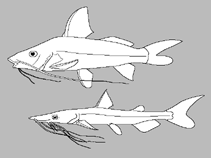
Épines dorsales (Total) : 2; Rayons mous dorsaux (Total) : 6 - 7; Vertèbres: 40. Differs from its congeners, except Pimelodus halisodous, Pimelodus joannis, Pimelodus ornatus and Pimelodus pictus, by having the following characters: distal portion of dorsal-fin rays 2-4 with a dark spot; just anterior to dorsal fin with dark transverse band; shorter distance between the posterior nostril and the anterior orbital border (posterior nostril closer to anterior orbital border. Can be separated from Pimelodus ornatus and Pimelodus pictus by its flank with uniform gray coloration lateral line with a light narrow band; from Pimelodus joannis by having a greater posterior cleithral-process length (12.7-15.6 vs. 10.2-12.4% of SL) and by lacking dark blotches on the caudal-fin base and from Pimelodus halisodous by a smaller pectoral- spine length (15.4-19.6 vs. 20.0-23.5% of SL); a shorter snout (36.1-40.9 vs. 43.1-47.9% of HL); and by having fewer rows of premaxillary teeth (5-8 vs. 13-16) (Ref. 79502).
Body shape (shape guide): elongated.
Life cycle and mating behavior
Maturité | Reproduction | Frai | Œufs | Fécondité | Larves
Ribeiro, F.R.V., C.A.S. Lucena and P.H.F. Lucinda, 2008. Three new Pimelodus species (Siluriformes: Pimelodidae) from the rio Tocantins drainage, Brazil. Neotrop. Ichthyol. 6(3):455-464. (Ref. 79502)
Statut dans la liste rouge de l'IUCN (Ref. 130435: Version 2025-1)
Menace pour l'homme
Harmless
Utilisations par l'homme
Outils
Articles particuliers
Télécharger en XML
Sources Internet
Estimates based on models
Phylogenetic diversity index (Réf.
82804): PD
50 = 0.5000 [Uniqueness, from 0.5 = low to 2.0 = high].
Bayesian length-weight: a=0.00676 (0.00301 - 0.01516), b=3.09 (2.91 - 3.27), in cm total length, based on LWR estimates for this Genus-body shape (Ref.
93245).
Niveau trophique (Réf.
69278): 3.2 ±0.5 se; based on size and trophs of closest relatives
Résilience (Réf.
120179): Haut, temps minimum de doublement de population inférieur à 15 mois (Preliminary K or Fecundity.).
Fishing Vulnerability (Ref.
59153): Low vulnerability (10 of 100).
🛈