Environment: milieu / climate zone / ระดับความลึก / distribution range
นิเวศวิทยา
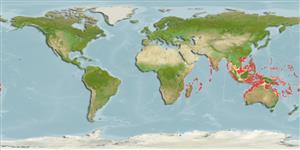
เกี่ยวกับทะเล,น้ำเค็ม เกี่ยวกับหินโสโครก; ระดับความลึก 50 - 300 m (Ref. 4319). Tropical; 21°N - 32°S, 30°E - 179°W (Ref. 5222)
Indo-West Pacific: Natal coast of South Africa, northern Mozambique, Reunion, Mauritius, New Caledonia, Philippines, New Guinea, New Ireland, and Fiji. Recently recorded from Tonga (Ref. 53797). Unknown in the Red Sea and Persian Gulf.
ขนาด / น้ำหนัก / Age
วัยเจริญพันธุ์: Lm ? range ? - ? cm
Max length : 150 cm TL เพศผู้/กระเทย; (Ref. 4787); น้ำหนักสูงสุดที่มีการรายงาน: 50.0 kg (Ref. 4787)
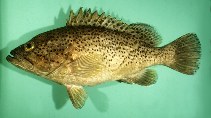
เงี่ยงครีบหลัง (รวม) : 11; ก้านครีบอ่อนที่หาง (รวม) : 14 - 15; เงี่ยงครีบก้น: 3; ก้านครีบอ่อนที่ก้น: 8. Distinguished by the following characteristics: pale brown body color with small dark brown to greyish green spots unevenly scattered on the dorsolateral parts of the head and body, dorsal and caudal fin; one row of close-set spots running posteriorly from the eye in a distinct line; absence of spots on the body below the level of the pectoral fins or on the anal and paired fins; body depth contained 2.7-3.2 times in SL; head length 2.2-2.4 times in SL; flat to convex interorbital area, dorsal head profile almost straight; angular preopercle, 2-4 distinctly enlarged serrae at angle; slightly convex upper edge of operculum; posterior nostril not much larger than anterior nostril; maxilla reaches below rear half of eye, ventral edge with low step at the distal expansion; 2 rows of teeth on midlateral part of lower jaw, inner teeth larger than outer teeth (Ref. 89707).
Body shape (shape guide): fusiform / normal; Cross section: compressed.
Known only in deep water in the vicinity of coral reefs. Biology unknown. It is an excellent food fish.
Life cycle and mating behavior
วัยเจริญพันธุ์ | การสืบพันธุ์ | การวางไข่ | เซลสืบพันธ์ของเพศเมีย(ไข่) | ความดกของไข่ | ตัวอ่อน
Heemstra, P.C. and J.E. Randall, 1993. FAO Species Catalogue. Vol. 16. Groupers of the world (family Serranidae, subfamily Epinephelinae). An annotated and illustrated catalogue of the grouper, rockcod, hind, coral grouper and lyretail species known to date. Rome: FAO. FAO Fish. Synop. 125(16):382 p. (Ref. 5222)
IUCN Red List Status (Ref. 130435: Version 2025-1)
Threat to humans
Harmless
Human uses
การประมง: การค้า
เครื่องมือ
Special reports
Download XML
แหล่งที่มาจากอินเตอร์เน็ต
Estimates based on models
Preferred temperature (อ้างอิง
123201): 17.9 - 27.6, mean 23.7 °C (based on 194 cells).
Phylogenetic diversity index (อ้างอิง
82804): PD
50 = 0.5000 [Uniqueness, from 0.5 = low to 2.0 = high].
Bayesian length-weight: a=0.01820 (0.01098 - 0.03017), b=3.10 (2.96 - 3.24), in cm total length, based on LWR estimates for this species & Genus-body shape (Ref.
93245).
ระดับชั้นอาหาร (อ้างอิง
69278): 4.1 ±0.6 se; based on size and trophs of closest relatives
ความสามารถในการกลับคืนสู่ปกติ (อ้างอิง
120179): ต่ำ, เวลาต่ำสุดที่จะทำให้ประชากรเพิ่มขึ้นเป็น 2 เท่าใช้เวลา 4.5 - 14 ปี (tmax=11; Fec=46,769).
Fishing Vulnerability (Ref.
59153): Very high vulnerability (90 of 100).
🛈
Nutrients (Ref.
124155): Calcium = 15.1 [7.1, 33.8] mg/100g; Iron = 0.431 [0.219, 0.880] mg/100g; Protein = 18.8 [17.3, 20.2] %; Omega3 = 0.125 [0.072, 0.215] g/100g; Selenium = 66.9 [36.0, 135.9] μg/100g; VitaminA = 76.6 [20.8, 280.9] μg/100g; Zinc = 0.862 [0.587, 1.270] mg/100g (wet weight);