Klassifizierung / Names
Namen | Synonyme | Catalog of Fishes(Gattung, Arten) | ITIS | CoL | WoRMS | Cloffa
>
Characiformes (Characins) >
Parodontidae (Scrapetooths)
Etymology: Apareiodon: Greek, a = without + Greek, pareia, -as = cheek + Greek, odous = teeth (Ref. 45335); agmatos: From the Greek noun 'agmatos', meaning fragment, derived from 'agmos, meaning break or fracture, in reference to the incomplete lateral line that distinguishes this species from all other parodontids.
Environment: milieu / climate zone / Tiefenbereich / distribution range
Ökologie
; süßwasser benthopelagisch. Tropical
South America: upper Mazaruni River basin in Guyana.
Size / Gewicht / Alter
Geschlechtsreife: Lm ? range ? - ? cm
Max length : 8.0 cm SL Männchen/unbestimmt; (Ref. 79584)
Kurzbeschreibung
Bestimmungsschlüssel | Morphologie | Morphometrie
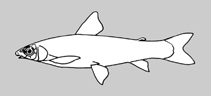
Rückenflossenweichstrahlen (insgesamt) : 11; Afterflossenweichstrahlen: 7 - 10; Wirbelzahl: 39 - 41. Differs from all congeners by having the following characters: incomplete lateral line with only the anterior five to 14 scales perforated by the lateral line canal; more predorsal scales 19-25 (vs. 16 or fewer); and more transverse scales 16-17 (vs. nine to 11). Can be further separated from all its congeners, except Apareidon gransabana, by its color pattern, consisting of a dark stripe along the dorsal midline (present in most congeners) combined with four more narrow lateral stripes on the sides. The second stripe on the midlateral surface includes the perforated lateral series of scales and is the widest and darkest, which continues anteriorly through the eye onto the snout and posteriorly onto the middle caudal-fin rays. Each premaxilla possesses five teeth, a character shared only with Apareiodon gransabana and Parodon guyanensis. The premaxillary teeth usually with one large central spatulate cusp bordered on each side by one (two in one individual examined) minute lateral cusp on either side (vs. more than 9 cusps in all other species of the family) (Ref. 79584).
Occurs in backwaters or streams with little or no current and with substrate generally comprising of a mixture of sand and mud, frequently with abundant flocculent sediments and leaf litter (Ref. 79584). Forms large schools (Ref. 79584). The extremely long intestinal tract, high gill-raker counts and the habitat preference of this species indicate a detritivorous diet (Ref. 79584).
Life cycle and mating behavior
Geschlechtsreife | Fortpflanzung | Ablaichen | Eier | Fecundity | Larven
Taphorn B., D.C., H. López-Fernández and C.R. Bernard, 2008. Apareiodon agmatos, a new species from the upper Mazaruni river, Guyana (Teleostei: Characiformes: Parodontidae). Zootaxa 1925:31-38. (Ref. 79584)
IUCN Rote Liste Status (Ref. 130435: Version 2025-1)
Bedrohung für Menschen
Harmless
Nutzung durch Menschen
Tools
Zusatzinformationen
Download XML
Internet Quellen
Estimates based on models
Phylogenetic diversity index (Ref.
82804): PD
50 = 0.5000 [Uniqueness, from 0.5 = low to 2.0 = high].
Bayesian length-weight: a=0.01023 (0.00374 - 0.02799), b=3.06 (2.82 - 3.30), in cm total length, based on LWR estimates for this (Sub)family-body shape (Ref.
93245).
Widerstandsfähigkeit (Ref.
120179): mittel, Verdopplung der Population dauert 1,4 - 4,4 Jahre. (Preliminary K or Fecundity.).
Fishing Vulnerability (Ref.
59153): Low vulnerability (10 of 100).
🛈