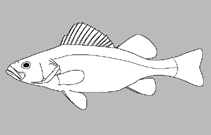
Klassifizierung / Names
Namen | Synonyme | Catalog of Fishes(Gattung, Arten) | ITIS | CoL | WoRMS | Cloffa
>
Perciformes/Percoidei (Perchs) >
Percidae (Perches) > Etheostomatinae
Etymology: Etheostoma: Greek, etheo = to strain + Greek, stoma = mouth; Rafinesque said "various mouths", but Jordan and Evermann suggest the name might have been intended as "Heterostoma (Ref. 45335); marmorpinnum: The name marmorpinnum comes from marmor which means marbled and pinna for fin and refers to the distinct marbled pattern of the second dorsal fin of nuptial males, as does the common name Marbled Darter.
Environment: milieu / climate zone / Tiefenbereich / distribution range
Ökologie
; süßwasser benthopelagisch. Temperate
North America: USA. Etheostoma marmorpinnum occurs in lower Little River (Tennessee drainage), Blount County, Tennessee, but is generally rare in the upstream reaches. The species does not appear to be continuously distributed. The stronghold is just upstream of the backwaters of Fort Loudoun Reservoir (Layman 1991). Also known from a single specimen from the South Fork Holston River in Sullivan County, Tennessee, collected in 1947, three years before construction of the South Fork Holston Dam was completed. The capture site was 0.6 rkm above the dam, whose tailwater has long been and continues to be cold-water. The species is now extirpated from the Holston River (Ref. 79849).
Size / Gewicht / Alter
Geschlechtsreife: Lm ? range ? - ? cm
Max length : 4.1 cm SL Männchen/unbestimmt; (Ref. 79849)
Kurzbeschreibung
Bestimmungsschlüssel | Morphologie | Morphometrie
Etheostoma marmorpinnum is distinguished from all other members of the species complex
by higher percentage of belly covered by scales (60–80% vs. 10% or less); higher percentage of body area along the first dorsal-fin base covered with scales (100% vs. 70% or less); dark distinct marbling in second dorsal fin of nuptial males (vs. lighter diffuse marbling or marbling absent); narrower band width for caudal fin (range = 12–15% of fin length vs. 15–25%) and anal-fin (range = 29–33% vs. 33–58%); more scales
around caudal peduncle (25 vs. 23 or 24); and higher first dorsal fin (D1H, =117 vs. 105 or less). The species is further distinguished from E. percnurum by fewer caudal fin rays (15 vs. 18); narrower distal band on pectoral fin (range = 17–20% vs. 27–32% of fin length) and second dorsal fin (14–21% vs. 23–25% of fin
height); and by prominent tessellation of medial region of caudal fin of nuptial males (vs. uniformly dusky). Further distinguished from E percnurum and E. sitikuense by an intermediate number of pored lateral-line scales (27 vs. 22 or 33 respectively). Means of other measurements were also informative in distinguishing E. marmorpinnum from other members of the complex (Ref. 79849).
Body shape (shape guide): elongated.
Life cycle and mating behavior
Geschlechtsreife | Fortpflanzung | Ablaichen | Eier | Fecundity | Larven
Blanton, R.E. and R.E. Jenkins, 2008. Three new darter species of the Etheostoma percnurum species complex (Percidae, subgenus Catonotus) from the Tennessee and Cumberland river drainages. Zootaxa 1963:1-24. (Ref. 79849)
IUCN Rote Liste Status (Ref. 130435: Version 2025-1)
Bedrohung für Menschen
Harmless
Nutzung durch Menschen
Tools
Zusatzinformationen
Download XML
Internet Quellen
Estimates based on models
Phylogenetic diversity index (Ref.
82804): PD
50 = 0.5000 [Uniqueness, from 0.5 = low to 2.0 = high].
Bayesian length-weight: a=0.00676 (0.00301 - 0.01516), b=3.12 (2.94 - 3.30), in cm total length, based on LWR estimates for this Genus-body shape (Ref.
93245).
Trophic level (Ref.
69278): 3.2 ±0.5 se; based on size and trophs of closest relatives
Widerstandsfähigkeit (Ref.
120179): hoch, Verdopplung der Population dauert weniger als 15 Monate. (Preliminary K or Fecundity.).
Fishing Vulnerability (Ref.
59153): Low vulnerability (10 of 100).
🛈