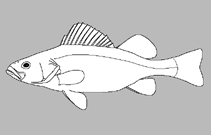
分類 / Names
共通名の | 類義語 | Catalog of Fishes(部類, 種) | ITIS | CoL | WoRMS | Cloffa
>
Perciformes/Percoidei (Perchs) >
Percidae (Perches) > Etheostomatinae
Etymology: Etheostoma: Greek, etheo = to strain + Greek, stoma = mouth; Rafinesque said "various mouths", but Jordan and Evermann suggest the name might have been intended as "Heterostoma (Ref. 45335); lemniscatum: The name marmorpinnum comes from marmor which means marbled and pinna for fin and refers to the distinct marbled pattern of the second dorsal fin of nuptial males, as does the common name Marbled Darter.
Environment: milieu / climate zone / 深さの範囲 / distribution range
生態学
; 新鮮な水 底生の漂泳性. Temperate
North America: USA. The Tuxedo Darter occurs in an approximately 19 km mainstem stretch of the Big South Fork Cumberland River, with most individuals observed from the mouth of Station Camp Creek, Scott County, Tennessee, to Bear Creek, McCreary County, Kentucky (Eisenhour & Burr 2000) (Ref. 79849).
サイズ / 重さ / 年齢
成熟: Lm ? range ? - ? cm
Max length : 5.4 cm SL オス/雌雄の選別がない; (Ref. 79849)
簡単な記述
検索表 | 形態学 | 形態計測学
Etheostoma lemniscatum is distinguished from all members of the complex by more posterior positioned anal fin (B6–B8, =332 vs. 317 or less); pectoral fin of nuptial males with dark, distal band confined to rays of the dorsal half or less of fin (vs. across all rays or all but 1–4 ventral rays); and nuptial males with dark and distinctly defined black bands on the distal margin of the caudal, anal, and second dorsal fins
(bands more diffuse in other species). Etheostoma lemniscatum is further distinguished from all members of the complex except E. marmorpinnum by higher modal (44 vs. 43 or less) number of lateral scale rows; and intermediate number of pored lateral line scales (26 or 28 vs. 22 in E. percnurum, and 34 in E. sitikuense). From E. marmorpinnum and E. percnurum by intermediate percentage of the first dorsal base area covered by scales (60% vs. 100% in E. marmorpinnum and 20% in E. percnurum); and an intermediate number of scales around caudal peduncle (24 vs. 25 and 23, respectively). From E. marmorpinnum and E. sitikuense by wider
distal band on anal fin (50% of fin height vs. 29–39%) and second dorsal fin (25% of fin height vs. 14–16%); and lack of marbling or tessellations in the medial portion of the second dorsal fin of nuptial males. From E.
marmorpinnum by lower percentage of belly covered by scales (10% vs. 60–80%); and wider, distal caudal–fin band (18% of fin length vs. 12–15%). From E. percnurum by lower number of caudal-fin rays (16 vs. 18); presence of strong tessellations on medial portion of caudal fin of nuptial males (vs. no tessellations); and
narrower distal band on the pectoral fin (range = 14–18% vs. 27–32%). Means of other measurements were also informative for distinguishing E. lemniscatum from members of the complex (Ref. 79849).
Body shape (shape guide): elongated.
Life cycle and mating behavior
成熟 | 繁殖 | 放精 | 卵 | 生産力 | 幼生
Blanton, R.E. and R.E. Jenkins, 2008. Three new darter species of the Etheostoma percnurum species complex (Percidae, subgenus Catonotus) from the Tennessee and Cumberland river drainages. Zootaxa 1963:1-24. (Ref. 79849)
IUCNのレッドリストの状況は (Ref. 130435: Version 2025-1)
Human uses
用具
特記事項
XMLをダウンロードして下さい
インターネットの情報源
Estimates based on models
Phylogenetic diversity index (参照
82804): PD
50 = 0.5000 [Uniqueness, from 0.5 = low to 2.0 = high].
Bayesian length-weight: a=0.00676 (0.00301 - 0.01516), b=3.12 (2.94 - 3.30), in cm total length, based on LWR estimates for this Genus-body shape (Ref.
93245).
栄養段階 (参照
69278): 3.3 ±0.5 se; based on size and trophs of closest relatives
回復力 (参照
120179): 高い, 15か月以下の倍増期間の最小個体群 (Preliminary K or Fecundity.).
Fishing Vulnerability (Ref.
59153): Low vulnerability (10 of 100).
🛈