



Upload your photos and videos
Pictures | Google image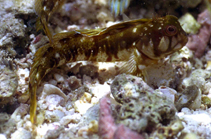 Scartella itajobi
Picture by Bertran Feitoza
Pictures | Google image
Picture by Bertran Feitoza
Classification / Names Common names | Synonyms | Catalog of Fishes(genus, species) | ITIS | CoL | WoRMS | Cloffa
Teleostei (teleosts) > Blenniiformes (Blennies) > Blenniidae (Combtooth blennies) > Salariinae
Etymology: itajobi: The name signifies 'green stone or emerald' (ita = stone; jobi =green) in 'Tupi', a native South-American language; refers to the emerald-green color of the species and an allusion to its type locality known as 'The Emerald of Atlantic'.
Etymology: itajobi: The name signifies 'green stone or emerald' (ita = stone; jobi =green) in 'Tupi', a native South-American language; refers to the emerald-green color of the species and an allusion to its type locality known as 'The Emerald of Atlantic'.
Environment: milieu / climate zone / depth range / distribution range Ecology
Marine; demersal. Tropical; 3°S - 4°S, 32°W - 33°W
Distribution Territories | FAO areas | Ecosystems | Occurrences | Point map | Introductions | Faunafri
Atlantic Ocean, Western South: Fernando de Noronha Archipelago, a volcanic island located 345km off northeastern Brazil. Considered as endemic of the Noronha-Rocas island complex (Ref. 80496).
Size / Weight / Age
Short description Identification keys | Morphology | Morphometrics
Dorsal spines (total): 12; Dorsal soft rays (total): 13 - 15; Anal spines: 2; Anal soft rays: 15 - 16. Distinguished from its Atlantic congeners by the following combination of characters: a small blue spot on the 2nd dorsal spine (noted mainly in adult males), head with tiny black spots (vs. speckles absent in Scartella cristata), modally 14 segmented dorsal-fin rays (vs. 15 in S. cristata from Brazilian localities, S. caboverdiana, and S. nuchifilis; and 16 in S. springeri), modally 15
segmented anal-fin rays (vs. 16 in S. poiti, 17 in S. cristata from Brazilian localities, S. caboverdiana, and S. nuchifilis; and 18 in S. springeri), and modally 23 caudal vertebrae (vs. 24 in S. cristata from other Brazilian
localities, S. caboverdiana, and S. nuchifilis; and 25 in S. springeri) (Ref. 80496).
Body shape (shape guide): fusiform / normal.
Body shape (shape guide): fusiform / normal.
Collected in shallow-waters and tide pools of the type locality. Similar to its congeners, this species is extremely tolerant to salinity and temperature variations. Some individuals were
also found in small crevices of emerged rocks (2 meters above sea surface), remaining up to 20 minutes out of the water, probably avoiding predators. (Ref. 80496). Similar to its congeners, this species is oviparous. Eggs are demersal and adhesive (Ref. 205), and are attached to the substrate via a filamentous, adhesive pad or pedestal (Ref. 94114). Larvae are planktonic, often found in shallow, coastal waters (Ref. 94114).
Life cycle and mating behavior Maturity | Reproduction | Spawning | Eggs | Fecundity | Larvae
Oviparous, distinct pairing (Ref. 205).
Main reference
Upload your references | References | Coordinator : Williams, Jeffrey T. | Collaborators
Rangel, C.A. and L.F. Mendes, 2009. Review of blenniid fishes from Fernando de Noronha Archipelago, Brazil, with description of a new species of Scartella (Teleostei: Blenniidae). Zootaxa 2006:51-61. (Ref. 80496)
IUCN Red List Status (Ref. 130435: Version 2025-2 (Global))
Least Concern (LC) ; Date assessed: 23 March 2011
CITES
Not Evaluated
Threat to humans
Harmless
Human uses
FAO - Publication: search | FishSource |
More information
Trophic ecology
Food items (preys)
Diet composition
Food consumption
Food rations
Predators
Food items (preys)
Diet composition
Food consumption
Food rations
Predators
Population dynamics
Growth parameters
Max. ages / sizes
Length-weight rel.
Length-length rel.
Length-frequencies
Mass conversion
Recruitment
Abundance
Growth parameters
Max. ages / sizes
Length-weight rel.
Length-length rel.
Length-frequencies
Mass conversion
Recruitment
Abundance
Life cycle
Reproduction
Maturity
Maturity/Gills rel.
Fecundity
Spawning
Spawning aggregations
Eggs
Egg development
Larvae
Larval dynamics
Reproduction
Maturity
Maturity/Gills rel.
Fecundity
Spawning
Spawning aggregations
Eggs
Egg development
Larvae
Larval dynamics
Anatomy
Gill area
Brain
Otolith
Gill area
Brain
Otolith
Physiology
Body composition
Nutrients
Oxygen consumption
Swimming type
Swimming speed
Visual pigments
Fish sound
Diseases & Parasites
Toxicity (LC50s)
Body composition
Nutrients
Oxygen consumption
Swimming type
Swimming speed
Visual pigments
Fish sound
Diseases & Parasites
Toxicity (LC50s)
Genetics
Genome
Genetics
Heterozygosity
Heritability
Genetic Diversity
Genome
Genetics
Heterozygosity
Heritability
Genetic Diversity
Human related
Aquaculture systems
Aquaculture profiles
Strains
Ciguatera cases
Stamps, coins, misc.
Aquaculture systems
Aquaculture profiles
Strains
Ciguatera cases
Stamps, coins, misc.
Tools
Special reports
Download XML
Internet sources
AFORO (otoliths) | Aquatic Commons | BHL | Cloffa | Websites from users | Check FishWatcher | CISTI | Catalog of Fishes: genus, species | DiscoverLife | ECOTOX | FAO - Publication: search | Faunafri | Fishipedia | Fishtrace | GloBI | Google Books | Google Scholar | Google | IGFA World Record | OneZoom | Open Tree of Life | Otolith Atlas of Taiwan Fishes | PubMed | Reef Life Survey | Socotra Atlas | TreeBase | Tree of Life | Wikipedia: Go, Search | World Records Freshwater Fishing | Zoobank | Zoological Record
Estimates based on models
Phylogenetic diversity index (Ref. 82804): PD50 = 0.5078 [Uniqueness, from 0.5 = low to 2.0 = high].
Bayesian length-weight: a=0.01047 (0.00463 - 0.02370), b=2.98 (2.79 - 3.17), in cm total length, based on LWR estimates for this (Sub)family-body shape (Ref. 93245).
Trophic level (Ref. 69278): 2.8 ±0.3 se; based on size and trophs of closest relatives
Resilience (Ref. 120179): High, minimum population doubling time less than 15 months (Preliminary K or Fecundity.).