klasifikasi / Names
Nama-nama umum | Sinonim (persamaan) | Catalog of Fishes(Marga, Jenis) | ITIS | CoL | WoRMS | Cloffa
>
Blenniiformes (Blennies) >
Blenniidae (Combtooth blennies) > Salariinae
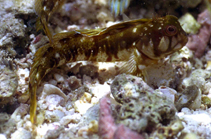
Etymology: itajobi: The name signifies 'green stone or emerald' (ita = stone; jobi =green) in 'Tupi', a native South-American language; refers to the emerald-green color of the species and an allusion to its type locality known as 'The Emerald of Atlantic'.
Environment: milieu / climate zone / kisaran kedalaman / distribution range
Ekologi
laut dasar (demersal). Tropical; 3°S - 4°S, 32°W - 33°W
Atlantic Ocean, Western South: Fernando de Noronha Archipelago, a volcanic island located 345km off northeastern Brazil. Considered as endemic of the Noronha-Rocas island complex (Ref. 80496).
Size / Weight / umur
Kematangan: Lm ? range ? - ? cm
Max length : 4.7 cm SL jantan/; (Ref. 80496)
deskripsi pendek
Kunci identifiaksi (pengenalan) | Morfologi | Morfometrik
Duri punggung (Keseluruhan (total)) : 12; duri punggung lunak (Keseluruhan (total)) : 13 - 15; Duri dubur: 2; Sirip dubur lunak: 15 - 16. Distinguished from its Atlantic congeners by the following combination of characters: a small blue spot on the 2nd dorsal spine (noted mainly in adult males), head with tiny black spots (vs. speckles absent in Scartella cristata), modally 14 segmented dorsal-fin rays (vs. 15 in S. cristata from Brazilian localities, S. caboverdiana, and S. nuchifilis; and 16 in S. springeri), modally 15
segmented anal-fin rays (vs. 16 in S. poiti, 17 in S. cristata from Brazilian localities, S. caboverdiana, and S. nuchifilis; and 18 in S. springeri), and modally 23 caudal vertebrae (vs. 24 in S. cristata from other Brazilian
localities, S. caboverdiana, and S. nuchifilis; and 25 in S. springeri) (Ref. 80496).
Body shape (shape guide): fusiform / normal.
Collected in shallow-waters and tide pools of the type locality. Similar to its congeners, this species is extremely tolerant to salinity and temperature variations. Some individuals were
also found in small crevices of emerged rocks (2 meters above sea surface), remaining up to 20 minutes out of the water, probably avoiding predators. (Ref. 80496). Similar to its congeners, this species is oviparous. Eggs are demersal and adhesive (Ref. 205), and are attached to the substrate via a filamentous, adhesive pad or pedestal (Ref. 94114). Larvae are planktonic, often found in shallow, coastal waters (Ref. 94114).
Oviparous, distinct pairing (Ref. 205).
Rangel, C.A. and L.F. Mendes, 2009. Review of blenniid fishes from Fernando de Noronha Archipelago, Brazil, with description of a new species of Scartella (Teleostei: Blenniidae). Zootaxa 2006:51-61. (Ref. 80496)
Status IUCN Red List (Ref. 130435: Version 2025-1)
ancaman kepada manusia
Harmless
penggunaan manusia
Alat, peralatan
laporan khas
muat turun XML
Sumber internet
Estimates based on models
Phylogenetic diversity index (Acuan
82804): PD
50 = 0.5078 [Uniqueness, from 0.5 = low to 2.0 = high].
Bayesian length-weight: a=0.01047 (0.00461 - 0.02381), b=2.98 (2.79 - 3.17), in cm total length, based on LWR estimates for this (Sub)family-body shape (Ref.
93245).
Trophic level (Acuan
69278): 2.8 ±0.3 se; based on size and trophs of closest relatives
Daya lenting (Acuan
120179): Tinggi, Waktu penggandaan populasi minimum kurang dari 15 bulan (Preliminary K or Fecundity.).
Fishing Vulnerability (Ref.
59153): Low vulnerability (10 of 100).
🛈