



Centrophorus harrissoni McCulloch, 1915
Dumb gulper shark
Προσθέστε την παρατήρησή σας στο Fish Watcher
| Native range | All suitable habitat | Point map | Year 2050 |

|
| This map was computer-generated and has not yet been reviewed. |
| Centrophorus harrissoni AquaMaps Data sources: GBIF OBIS |
Ανεβάστε το φωτογραφίες και Βίντεο
Φωτογραφίες | Google image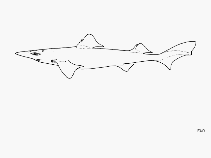 Centrophorus harrissoni
Εικόνα από FAO
Φωτογραφίες | Google image
Εικόνα από FAO
Ταξινόμηση / Ονόματα Κοινά ονόματα | Συνώνυμα | Catalog of Fishes(Γένος, Είδη) | ITIS | CoL | WoRMS | Cloffa
Ελασμοβράγχιοι (καρχαρίες και σαλάχια) (sharks and rays) > Squaliformes (Sleeper and dogfish sharks) > Centrophoridae (Gulper sharks)
Etymology: Centrophorus: centr[um] (L.), prickle or sharp point; phorus, from phoreus (Gr.), bearer or carrier, referring to grooved spines on dorsal fins (See ETYFish); harrissoni: In honor of biologist Charles Turnbull Harrisson (1869-1914), responsible for collecting and preserving many of the “more interesting” fishes during the “fishing experiments” of FIS Endeavour off the coast of Australia, 1909-1914 [he disappeared along with his ship and all hands in December 1914; no distress message had been given and no trace of the ship has been found] (See ETYFish).
Eponymy: Charles Turnbull Harrisson (1866*–1914) was a biologist from Tasmania who took part in the Mawson Antarctic Expedition (1911–1914) and was responsible for collecting many interesting fish species. [...] (Ref. 128868), visit book page.
Etymology: Centrophorus: centr[um] (L.), prickle or sharp point; phorus, from phoreus (Gr.), bearer or carrier, referring to grooved spines on dorsal fins (See ETYFish); harrissoni: In honor of biologist Charles Turnbull Harrisson (1869-1914), responsible for collecting and preserving many of the “more interesting” fishes during the “fishing experiments” of FIS Endeavour off the coast of Australia, 1909-1914 [he disappeared along with his ship and all hands in December 1914; no distress message had been given and no trace of the ship has been found] (See ETYFish).
Eponymy: Charles Turnbull Harrisson (1866*–1914) was a biologist from Tasmania who took part in the Mawson Antarctic Expedition (1911–1914) and was responsible for collecting many interesting fish species. [...] (Ref. 128868), visit book page.
Περιβάλλον: περιβάλλον / κλιματική ζώνη / εύρος βάθους / εύρος διανομής Οικολογία
Θαλασσινό(ά) βαθύβιο(ς); εύρος βάθους 250 - 790 m (Ref. 6871). Temperate; 26°S - 45°S, 111°E - 155°E
Κατανομή Εδάφη | Περιοχές FAO | Οικοσυστήματα | Παρουσίες | Σημειακός χάρτης | Εισαγωγές | Faunafri
Eastern Indian Ocean: Western Australia. Southwest Pacific: New South Wales to Tasmania. Recorded in Norfolk Ridge, Three Kings Ridge amd Kermadec Ridge, extending the species eastern range (Ref. 89942). Record from Taiwan uncertain. This species is very close to Centrophorus uyato and may be a junior synonym of that species (Ref. 247).
Μήκος κατά την πρώτη ωρίμανση / Μέγεθος / Βάρος / Ηλικία
Γεννητική Ωρίμανση: Lm 99.0 range ? - ? cm
Max length : 111 cm TL αρσενικό/απροσδιόριστο; (Ref. 76933)
Max length : 111 cm TL αρσενικό/απροσδιόριστο; (Ref. 76933)
Σύντομη περιγραφή Κλείδες προσδιορισμού | Μορφολογία | Μορφομετρία
A moderate-sized species distinguished by the following set of adult characters: length of pre-second dorsal 61.9-63.2% TL, 6.6-8.4 times the dorsal-caudal space; length of pre-first dorsal 30.4-32.0% TL; interdorsal space 18.2-20.6% TL, 2.2-2.6 times dorsal-caudal space; dorsal-caudal space 7.5-9.4% TL, 3.2-4.0 in pectoral-pelvic space; long and robust head, its length 22.4-24.6% TL, 2.7-3.0 times mouth width, its width 13.2-14.0% TL, 4.5-4.8 in pre-second dorsal length; width at anterior of nostrils 7.7-7.9% TL; long snout, its preoral length 11.4-12.4% TL, 2.0-2.2 times head height at anterior of mouth, 1.3-1.5 times mouth width, the horizontal preorbital length 7.1-8.2% TL, the horizontal prenarial length 4.4-5.4% TL; large mouth, its width 7.8-8.5% TL; moderately large pectoral fin, its anterior margin 11.9-12.4% TL, 2.3-2.4 times base length; large caudal fin, the dorsal caudal margin 19.1-19.5% TL; 2.1-2.5 times dorsal-caudal space; moderately large and tall first dorsal fin, its height 6.2-7.0% TL, with moderately robust spine, the base width 0.9-1.0% TL. The dorsal fins of juveniles have a distinct blackish oblique blotch anteriorly and a white blotch on the upper posterior margin; in adults a less distinct dark blotch, often apparent in fresh specimens and with a white blotch restricted to a narrow white posterior margin (occasionally indistinct in largest specimens). Adults with flank denticles flat, block-like, not overlapping, and crenulate. Females and immature males with upper teeth that are strongly oblique, similar in shape, but much smaller than lower teeth; in mature males upper teeth are erect, upright, becoming only slightly oblique laterally. 37-39/30 or 31 (n=3) tooth row count; 117-126 (mean 121.6, n=20) total vertebral centra; 53-59 (56.4, n=21) monospondylous precaudal centra; 29-37 (32.7, n=21) diplospondylous precaudal centra; 85-94 (89.1, n=21) precaudal centra (Ref. 76933).
Body shape (shape guide): elongated.
Body shape (shape guide): elongated.
Found on the continental slope (Ref. 6871, 75154).
Presumably ovoviviparous (Ref. 6871). Smallest mature male
recorded at 82.5 cm TL (Ref. 76933). Longevity assumed to be
high similar to close relative C. zeehaani with
estimated longevity exceeding 46 yrs (Ref. 107026).
Κύκλος ζωής και συμπεριφορά ζευγαρώματος Γεννητική Ωρίμανση | Αναπαραγωγή | Γεννοβολία | Αβγά | Γονιμότητα | Προνύμφες
Κύρια αναφορά
Ανεβάστε τις αναφορές σας | Αναφορές | Συντονιστής : Compagno, Leonard J.V. | Συνεργάτες
Compagno, L.J.V., 1984. FAO Species Catalogue. Vol. 4. Sharks of the world. An annotated and illustrated catalogue of shark species known to date. Part 1 - Hexanchiformes to Lamniformes. FAO Fish. Synop. 125(4/1):1-249. Rome, FAO. (Ref. 247)
Κατάσταση Κόκκινου Καταλόγου IUCN (Ref. 130435: Version 2025-2 (Global))
Endangered (EN) (A2bd); Date assessed: 21 November 2019
CITES
Not Evaluated
Απειλή για τον άνθρωπο
Harmless
Ανθρώπινες χρήσεις
αλιεία: χωρίς ενδιαφέρον
FAO - αλιεία: προφίλ του είδους; Publication: search | FishSource |
Περισσότερες πληροφορίες
Τροφική Οικολογία
Τρόφιμα (θηράματα)
Σύσταση δίαιτας
Κατανάλωση τροφής
Μερίδες τροφίμων
Θηρευτές
Τρόφιμα (θηράματα)
Σύσταση δίαιτας
Κατανάλωση τροφής
Μερίδες τροφίμων
Θηρευτές
Οικολογία
Οικολογία
Οικολογία
Πληθυσμιακή δυναμική
Παράμετροι Αύξησης
Μέγιστες ηλικίες / μεγέθη
Μήκος-βάρος σχετ.
Μήκος-μήκος rel.
Μήκος-συχνότητες
Μετατροπή μάζας
Στρατολόγηση
Αφθονία
Παράμετροι Αύξησης
Μέγιστες ηλικίες / μεγέθη
Μήκος-βάρος σχετ.
Μήκος-μήκος rel.
Μήκος-συχνότητες
Μετατροπή μάζας
Στρατολόγηση
Αφθονία
Κύκλος ζωής
Αναπαραγωγή
Γεννητική Ωρίμανση
Ωριμότητα / Gills rel.
Γονιμότητα
Γεννοβολία
Συγκεντρώσεις αναπαραγωγής
Αβγά
Ανάπτυξη αυγών
Προνύμφες
Δυναμική προνυμφών
Αναπαραγωγή
Γεννητική Ωρίμανση
Ωριμότητα / Gills rel.
Γονιμότητα
Γεννοβολία
Συγκεντρώσεις αναπαραγωγής
Αβγά
Ανάπτυξη αυγών
Προνύμφες
Δυναμική προνυμφών
Φυσιολογία
Σύνθεση σώματος
Θρεπτικά συστατικά
Κατανάλωση οξυγόνου
Τύπος κολύμβησης
Ταχύτητα κολύμβησης
Οπτικές χρωστικές ουσίες
Ήχος ψαριών
Ασθένειες & παράσιτα
Τοξικότητα (LC50)
Σύνθεση σώματος
Θρεπτικά συστατικά
Κατανάλωση οξυγόνου
Τύπος κολύμβησης
Ταχύτητα κολύμβησης
Οπτικές χρωστικές ουσίες
Ήχος ψαριών
Ασθένειες & παράσιτα
Τοξικότητα (LC50)
Ανθρώπινη σχέση
Συστήματα υδατοκαλλιέργειας
Προφίλ υδατοκαλλιεργειών
Στελέχοι
Περιπτώσεις Ciguatera
Γραμματόσημα, νομίσματα, διάφορα.
Συστήματα υδατοκαλλιέργειας
Προφίλ υδατοκαλλιεργειών
Στελέχοι
Περιπτώσεις Ciguatera
Γραμματόσημα, νομίσματα, διάφορα.
Εργαλεία
Ηλεκτρονικό βιβλίο | Οδηγός πεδίου | Ανάλυση κατά μήκος συνθέσεων | Εργαλείο ιστορίας ζωής | Σημειακός χάρτης |
Catch-MSY |
Ειδικές εκθέσεις
Έλεγχος για συντήρηση ενυδρείου | Ελέγξτε για ενημερωτικά δελτία ειδών | Ελέγξτε για ενημερωτικά δελτία υδατοκαλλιέργειας
Λήψη XML
Διαδικτυακές πηγές
AFORO (otoliths) | Aquatic Commons | BHL | Cloffa | Websites from users | Check FishWatcher | CISTI | Catalog of Fishes: Γένος, Είδη | DiscoverLife | ECOTOX | FAO - αλιεία: προφίλ του είδους; Publication: search | Faunafri | Fishipedia | Fishtrace | GloBI | Google Books | Google Scholar | Google | IGFA World Record | OneZoom | Open Tree of Life | Otolith Atlas of Taiwan Fishes | PubMed | Reef Life Survey | Socotra Atlas | TreeBase | Δέντρο Ζωής | Wikipedia: Go, αναζήτηση | World Records Freshwater Fishing | Zoobank | Zoological Record
Εκτιμήσεις βάσει μοντέλων
Προτιμώμενη θερμοκρασία (Αναφ. 123201): 9.5 - 13.3, mean 10.4 °C (based on 22 cells).
Δείκτης φυλογενετικής ποικιλότητας (Αναφ. 82804): PD50 = 0.5001 [Uniqueness, from 0.5 = low to 2.0 = high].
Bayesian length-weight: a=0.00251 (0.00120 - 0.00527), b=3.19 (3.01 - 3.37), in cm total length, based on LWR estimates for this (Sub)family-body shape (Ref. 93245).
Τροφικό Επίπεδο (Αναφ. 69278): 4.3 ±0.3 se; based on size and trophs of closest relatives
Ελαστικότητα (Αναφ. 120179): Χαμηλό, ελάχιστος χρόνος για διπλασιασμό πληθυσμού 4,5 - 14 έτη (Fec assumed to be <100).
Θρεπτικά συστατικά (Ref. 124155): Calcium = 6.99 [1.35, 36.31] mg/100g; Iron = 0.217 [0.055, 0.667] mg/100g; Protein = 20.1 [17.7, 22.4] %; Omega3 = 0.463 [0.170, 1.408] g/100g; Selenium = 15.9 [4.6, 55.0] μg/100g; VitaminA = 22.4 [4.7, 111.5] μg/100g; Zinc = 0.444 [0.206, 0.839] mg/100g (wet weight);