>
Ophidiiformes (Cusk eels) >
Dinematichthyidae (Viviparous brotula)
Etymology: Alionematichthys: Name from Latin alius meaning the other or different, and nematichthys, the stem of the genus name Dinematichthys, to which this genus is most similar; suluensis: Named for its type locality, Sulu Sea; an adjective.
More on authors: Møller & Schwarzhans.
Environment: milieu / climate zone / rango de profundidad / distribution range
Ecología
marino asociado a arrecife; rango de profundidad 0 - 5 m (Ref. 90102). Tropical
Western Pacific: the Philippines.
Tamaño / Peso / Age
Madurez: Lm ? range ? - ? cm
Max length : 4.9 cm SL macho / no sexado; (Ref. 81230)
Short description
Claves de identificación | Morfología | Morfometría
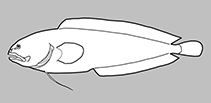
Radios blandos dorsales (total) : 72 - 82; Radios blandos anales: 56 - 64; Vértebra: 41 - 43. This species is distinguished by the following characters: D 72-82; A 56-64; moderately large eyes (2.1-2.5%SL); slender body; no cirri on snout; scales only cheeks; with upper preopercular pore; outer pseudoclasper moderately broad-based, long, sometimes beyond the hood when in resting position, while the inner one is half as long as the outer one, the anterior lobe large very long, twice as long as the posterior lobe; otolith length to height 2.1-2.2, with shallow dorsal rim and postdorsal angle; otolith length to sulcus length 1.7-1.8, ostium length to cauda length 3.3-3.7; vertebrae 11-12 + 30-32 = 41-43 (Ref. 81230).
Body shape (shape guide): elongated; Cross section: compressed.
Occurs in rocky surge area, rocky tidepool. A 3.9 cm SL gravid female (USNM 376179) with 325 embryos, 0.37 cm TL in length. Collected by rotenone (Ref. 81230). Cryptic, solitary inhabitant of shallow water (usually <5) (Ref 90102).
Life cycle and mating behavior
Madurez | Reproducción | Puesta | Huevos | Fecundidad | Larva
Møller, P.R. and W. Schwarzhans, 2008. Review of the Dinematichthyini (Teleostei, Bythitidae) of the Indo-west Pacific, Part IV. Dinematichthys and two new genera with descriptions of nine new species. The Beagle 24:87-146. (Ref. 81230)
IUCN Red List Status (Ref. 130435: Version 2025-1)
Threat to humans
Harmless
Human uses
Pesquerías: sin interés
Herramientas
Special reports
Download XML
Fuentes de Internet
Estimates based on models
Preferred temperature (Referencia
123201): 28.5 - 29.2, mean 28.8 °C (based on 250 cells).
Phylogenetic diversity index (Referencia
82804): PD
50 = 0.5005 [Uniqueness, from 0.5 = low to 2.0 = high].
Bayesian length-weight: a=0.00389 (0.00180 - 0.00842), b=3.12 (2.94 - 3.30), in cm total length, based on all LWR estimates for this body shape (Ref.
93245).
Nivel trófico (Referencia
69278): 3.2 ±0.5 se; based on size and trophs of closest relatives
Fishing Vulnerability (Ref.
59153): Low vulnerability (10 of 100).
🛈