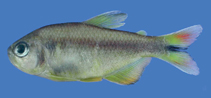
Classification / Names
ชื่อสามัญ | ชื่อพ้อง | Catalog of Fishes(สกุล, ชนิด) | ITIS | CoL | WoRMS | Cloffa
>
Characiformes (Characins) >
Acestrorhamphidae (American tetras) > Acestrorhamphinae
Etymology: Psalidodon: Greek, psalis, -idos = scissors + Greek, odous = teeth (Ref. 45335); xavante: Named after Xavante ethnic group, natives inhabiting the Serra do Roncador and middle rio Araguaia, Mato Grosso, Brazil. A noun in apposition.
Eponymy: The Xavante are an indigenous ethnic group who live in the region between Rio das Mortes and Rio Culuene, Mato Grosso, Brazil. They are the largest Amerindian tribe in the area where the rivuline species was discovered. (Ref. 128868), visit book page.
Environment: milieu / climate zone / ระดับความลึก / distribution range
นิเวศวิทยา
; น้ำจืด กลุ่มสัตว์หน้าดิน,กลุ่มสัตว์พื้นท้องน้ำ. Tropical
South America: middle rio Araguaia in Mato Grosso, Brazil.
Length at first maturity / ขนาด / น้ำหนัก / Age
วัยเจริญพันธุ์: Lm ?, range 3 - ? cm
Max length : 6.0 cm SL เพศผู้/กระเทย; (Ref. 82392)
Occurs in crystalline water streams with flow from 0.05 to 0.70 m3/s. Prefers to occupy the water surface and the spaces among plants roots and tree branches. Usually aggregates with up to 2 dozens individuals, but schools with about 150 individuals have also been observed. An omnivorous fish which feeds on insects, plants, crustaceans, filamentous algae and fish (Ref. 82392).
Life cycle and mating behavior
วัยเจริญพันธุ์ | การสืบพันธุ์ | การวางไข่ | เซลสืบพันธ์ของเพศเมีย(ไข่) | ความดกของไข่ | ตัวอ่อน
Terán, G.E., M.F. Benitez and J.M. Mirande, 2020. Opening the Trojan house: phylogeny of Astyanax, two genera and resurrection of Psalidodon (Teleostei: Characidae). Zool. J. Lin. Soc. 190(4):1217-1234. (Ref. 123753)
IUCN Red List Status (Ref. 130435: Version 2025-1)
Threat to humans
Harmless
Human uses
เครื่องมือ
Special reports
Download XML
แหล่งที่มาจากอินเตอร์เน็ต
Estimates based on models
Phylogenetic diversity index (อ้างอิง
82804): PD
50 = 0.5000 [Uniqueness, from 0.5 = low to 2.0 = high].
Bayesian length-weight: a=0.01349 (0.00593 - 0.03067), b=3.08 (2.91 - 3.25), in cm total length, based on LWR estimates for this Genus-body shape (Ref.
93245).
ระดับชั้นอาหาร (อ้างอิง
69278): 3.0 ±0.3 se; based on size and trophs of closest relatives
ความสามารถในการกลับคืนสู่ปกติ (อ้างอิง
120179): ความสูง, เวลาต่ำสุดที่จะทำให้ประชากรเพิ่มขึ้นเป็น 2 เท่าใช้เวลาน้อยกว่า 15 เดือน (Lm=2.5-2.6).
Fishing Vulnerability (Ref.
59153): Low vulnerability (10 of 100).
🛈