Classificação / Nomes
Nomes comuns | Sinônimos | Catalog of Fishes(Gênero, Espécies) | ITIS | CoL | WoRMS | Cloffa
>
Cichliformes (Cichlids, convict blennies) >
Cichlidae (Cichlids) > Pseudocrenilabrinae
Etymology: Otopharynx: Greek, ous = hear + Greek, pharyngx = pharynx (Ref. 45335); spelaeotes: The specific epiteth is derived from the Greek and means cave dweller (Ref. 82798).
Environment: milieu / Zona climática / intervalo de profundidade / distribution range
Ecologia
; Água doce demersal. Tropical
Africa: Lake Malawi (Ref. 82798).
Tamanho / Peso / Idade
Maturidade: Lm ? range ? - ? cm
Max length : 11.7 cm SL macho/indeterminado; (Ref. 82798)
Descrição suscinta
Chaves de identificação | Morfologia | Morfometria
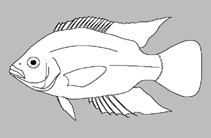
Espinhos dorsais (total) : 16 - 17; Raios dorsais (total) : 10 - 12; Espinhos anais: 3; Raios anais : 8 - 10. A medium-sized cave-dwelling haplochromine with relatively deep body with greatest body depth at base of eighth or ninth dorsal spine (Ref. 82798). Otopharynx spelaeotes has a larger eye, 36.1-38.4% of head length, than most other Otopharynx species, and it has fewer lateral-line scales, 31-33, than Otopharynx argyrosoma (Ref. 82798). It differs from Otopharynx lithobates by having more teeth in the outer row of the left lower jaw (18-24), fewer gill rakerson the ceratobranchial (11-13) and by the male breeding coloration that includes yellow/orange ocelli on the anal fin and a blue/black dorsal fin with a very narrow white margin with orange/red lappets (Ref. 82798). It is distinguished from Otopharynx antron by a larger horizontal eye diameter (36.1-38.4% of head length), a shallower caudal peduncle, and more teeth in the outer row of the left lower jaw (Ref. 82798).
This species has a preference for large caves and is therefore often found in rocky habitats that consist of large boulders (Ref. 82798). Most individuals are seen solitary and often at a depth of more than 10m (Ref. 82798). The mode of feeding consists of scavenging material lying on the rocky substrate of their environment (Ref. 82798).
Ciclo de vida ou comportamento de acasalamento
Maturidade | Reprodução | Desova | Ovos | Fecundidade | Larvas
Cleaver, R.M., A.F. Konings and J.R. Stauffer Jr., 2009. Two new cave-dwelling cichlids of Lake Malaŵi, Africa. Ichthyol. Explor. Freshwat. 20(2):163-178. (Ref. 82798)
Status na Lista Vermelha da UICN (Ref. 130435: Version 2025-1)
Ameaça para os humanos
Harmless
Uso pelos humanos
Ferramentas
Relatórios especiais
Baixar XML
Fontes da internet
Estimates based on models
Índice de diversidade filogenética (Ref.
82804): PD
50 = 0.5000 [Uniqueness, from 0.5 = low to 2.0 = high].
Bayesian length-weight: a=0.01000 (0.00244 - 0.04107), b=3.04 (2.81 - 3.27), in cm total length, based on all LWR estimates for this body shape (Ref.
93245).
Nível Trófico (Ref.
69278): 3.4 ±0.4 se; based on size and trophs of closest relatives
Resiliência (Ref.
120179): Elevada, tempo mínimo de duplicação da população menor que 15 meses (Preliminary K or Fecundity.).
Fishing Vulnerability (Ref.
59153): Low vulnerability (10 of 100).
🛈