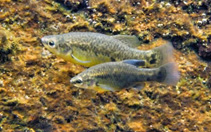
Classification / Names
Noms communs | Synonymes | Catalog of Fishes(Genre, Espèce) | ITIS | CoL | WoRMS | Cloffa
>
Cyprinodontiformes (Rivulines, killifishes and live bearers) >
Goodeidae (Splitfins) > Goodeinae
Etymology: Zoogoneticus: Greek, zoon = little animal + Latin, genesis = genesis (Ref. 45335); purhepechus: Name for purhepecha, the name of the indigenous ethnic group which inhabited part of the distribution range of this species, including the type locality.
Environment: milieu / climate zone / profondeur / distribution range
Écologie
; eau douce benthopélagique; profondeur 2 - 4 m (Ref. 83562). Tropical
North America: Mexico.
Length at first maturity / Taille / Poids / Âge
Maturité: Lm 2.8 range ? - ? cm
Max length : 4.1 cm SL mâle / non sexé; (Ref. 127570); 4.1 cm SL (female)
Description synthétique
Clés d'identification | Morphologie | Morphométrie
Rayons mous dorsaux (Total) : 13 - 14; Rayons mous anaux: 13 - 14. This species differs from its sister species Zoogoneticus quitzeoensis in having a shorter preorbital distance (Prol/SL mean = 0.056, SD =0.01); a longer dorsal fin base length (DFL/SL mean = 0.18, SD = 0.03); 13-14 dorsal fin rays (Ref. 83562).
The type locality is a permanent spring of lentic and clear waters and forms a small pond of approximately 1500 sq.m; the bottom rocky in its periphery and muddy in most of the pond. Aquatic vegetation composed of Iris sp. and Ceratophyllum sp, emergent vegetation Typha sp. and Scirpus sp., and the introduced species Eichhornia sp; the terrestrial vegetation is of the subtropical forest type. Associated fish fauna are the native species, Alloophorus robustus, Chapalichthys encaustus, Goodea atripinnis, Skiffia multipunctata (Goodeidae); Poeciliopsis infans (Poeciliidae); Lampetra geminis (Petromyzontidae); and introduced species Poecilia mexicana, Xiphophorus hellerii (Poeciliidae), Oreochromis spp. (Cichlidae), Cyprinus carpio, and Ctenopharingodon idella (Cyprinidae) (Ref. 83562).
Life cycle and mating behavior
Maturité | Reproduction | Frai | Œufs | Fécondité | Larves
Domínguez-Domínguez, O., R. Pérez-Rodríguez and I. Doadrio, 2008. Morphological and genetic comparative analyses of populations of Zoogoneticus quitzeoensis (Cyprinodontiformes: Goodeidae) from central Mexico, with description of a new species. Revista Mexicana de Biodiversidad 79:373-383. (Ref. 83562)
Statut dans la liste rouge de l'IUCN (Ref. 130435: Version 2025-1)
Vulnerable (VU) (B1ab(i,ii,iii,iv)+2ab(i,ii,iii,iv)); Date assessed: 12 September 2018
Menace pour l'homme
Harmless
Utilisations par l'homme
Pêcheries: sans intérêt
Outils
Articles particuliers
Télécharger en XML
Sources Internet
Estimates based on models
Phylogenetic diversity index (Réf.
82804): PD
50 = 0.6250 [Uniqueness, from 0.5 = low to 2.0 = high].
Bayesian length-weight: a=0.00389 (0.00180 - 0.00842), b=3.12 (2.94 - 3.30), in cm total length, based on all LWR estimates for this body shape (Ref.
93245).
Niveau trophique (Réf.
69278): 2.2 ±0.1 se; based on size and trophs of closest relatives
Fishing Vulnerability (Ref.
59153): Low vulnerability (10 of 100).
🛈