>
Perciformes/Cottoidei (Sculpins) >
Liparidae (Snailfishes)
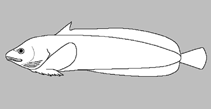
Etymology: Paraliparis: Greek, para = the side of + Greek, liparis = fat (Ref. 45335); bullacephalus: Named for its large, round head covered with gelatinous tissue; from Latin words 'bulla' meaning bubble and 'cephalus' for head.
Environment: milieu / climate zone / rango de profundidad / distribution range
Ecología
marino batipelágico; rango de profundidad 233 - 322 m (Ref. 82595). Temperate
Gulf of Alaska.
Tamaño / Peso / Age
Madurez: Lm ? range ? - ? cm
Max length : 6.2 cm SL macho / no sexado; (Ref. 82595); 9.4 cm SL (female)
Short description
Claves de identificación | Morfología | Morfometría
Radios blandos dorsales (total) : 60; Radios blandos anales: 53 - 55; Vértebra: 63 - 64. The species is distinguished from its congeners by the following set of characters: D 60; A 53-55; pectoral-fin rays 20-21; caudal-fin rays 6; vertebrae 63-64; dorsal contour of head rounded to snout, covered with gelatinous tissue; short snout with rounded tip projecting past upper jaw; small mouth, horizontal, inferior, with cleft reaching to nearly vertical below center of eye; large eye with dorsal margin level with or slightly above top of gill
opening; large opercular flap, rounded, projecting slightly toward dorsal; upper lobe of pectoral fin with 15 rays, one in
notch, and 4 or 5 in lower lobe, both lobes extending beyond anal-fin origin; cephalic pores are equal to or smaller in diameter than nostril; suprabranchial pore elevated, anterior of gill opening a distance about equal to opercular flap width; 3 pyloric caeca (Ref. 82595).
Body shape (shape guide): elongated.
The male (5.30 and 6.20 cm) specimens appear to be mature, while the female (9.40 cm) was mature with ovaries containing numerous mature and immature, spherical, pale-colored, opaque, yolked oocytes, ranging in diameter from 0.20-2.12 mm; from gross observation, there appear to be fewer than 100 eggs in each ovary. Specimens were collected with a 60 cm bongo net, epibenthic sled and bottom trawl (Ref. 82595).
Life cycle and mating behavior
Madurez | Reproducción | Puesta | Huevos | Fecundidad | Larva
Busby, M.S. and R.L. Cartwright, 2009. Paraliparis adustus and Paraliparis bullacephalus: two new snailfish species (Teleostei: Liparidae) from Alaska. Ichthyol. Res. 56:245-252. (Ref. 82595)
IUCN Red List Status (Ref. 130435: Version 2025-1)
Threat to humans
Harmless
Human uses
Pesquerías: sin interés
Herramientas
Special reports
Download XML
Fuentes de Internet
Estimates based on models
Preferred temperature (Referencia
123201): 4.1 - 6.4, mean 5.1 °C (based on 9 cells).
Phylogenetic diversity index (Referencia
82804): PD
50 = 0.5000 [Uniqueness, from 0.5 = low to 2.0 = high].
Bayesian length-weight: a=0.00525 (0.00237 - 0.01161), b=3.15 (2.96 - 3.34), in cm total length, based on LWR estimates for this (Sub)family-body shape (Ref.
93245).
Nivel trófico (Referencia
69278): 3.4 ±0.5 se; based on size and trophs of closest relatives
Resiliencia (Referencia
120179): Alto, población duplicada en un tiempo mínimo inferior a 15 meses (Preliminary K or Fecundity.).
Fishing Vulnerability (Ref.
59153): Low vulnerability (10 of 100).
🛈