



Hypostomus kopeyaka Carvalho, Lima & Zawadzki, 2010
Ladda upp din foton och Videor
Google image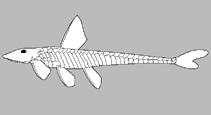 No image available for this species;
drawing shows typical species in Loricariidae.
Google image
drawing shows typical species in Loricariidae.
Klassificering / Namn Populärnamn | synonymer | Catalog of Fishes(Släkte, Arter) | ITIS | CoL | WoRMS | Cloffa
> Siluriformes (Catfishes) > Loricariidae (Armored catfishes) > Hypostominae
Etymology: Hypostomus: Greek, hypo = under + Greek, stoma = mouth (Ref. 45335); kopeyaka: After its common name among the Tuyuka and Tukano indians, kope yaka, or kope ya’ka, meaning “pleco from the holes”, an allusion to the fact that, according to the Indians, the fishes spend most of their time hiding in holes in the river ban.
Etymology: Hypostomus: Greek, hypo = under + Greek, stoma = mouth (Ref. 45335); kopeyaka: After its common name among the Tuyuka and Tukano indians, kope yaka, or kope ya’ka, meaning “pleco from the holes”, an allusion to the fact that, according to the Indians, the fishes spend most of their time hiding in holes in the river ban.
Miljö: miljö / Klimatzon / djupintervall / distributionsområde Ekologi
; sötvatten bottenlevande. Tropical; 1°N - 0°N, 69°W - 70°W
Utbredning Territorier | FAO områden | Ekosystem | Förekomster | Prickkarta | Utplanteringar | Faunafri
South America: Brazil and probably Colombia. Hypostomus kopeyaka is known only from the rio Tiquié basin, a tributary of the rio Uaupés, upper rio Negro drainage, Brazil. According to Tuyuka fishermen, the species also occurs at the upper rio Tiquié into Departamento Vaupés in Colombia, but no specimens are available from the latter area (Ref. 83896).
Storlek / Vikt / Ålder
Kort beskrivning Bestämningsnycklar | Morfologi | Morfometri
Distinguished from all congeners, except those belonging to the Hypostomus cochliodon group, by having few teeth (10 to 13) bearing a small lateral cusp and acutely angled dentaries. Diagnosed from the remaining members of the Hypostomus cochliodon group, except H. hemicochliodon, H. sculpodon, H. soniae Hollanda, Carvalho & Weber, and H. weberi, by possessing bicuspid teeth with mesial cusp rounded, considerably larger than outer cusp (vs. teeth generally unicuspid, outer cusp, if present, almost imperceptible, mesial cusp large and distinctly spoon-shaped). Hypostomus kopeyaka can be distinguished from H. hemicochliodon, H. sculpodon, H. soniae, and H. weberi by a distinctive color pattern composed of conspicuously horizontally elongated, closely-set black spots on the head and dorsal surfaces of the body (vs. spots absent in H. soniae, spots present but rounded in the remaining species, spots small in H. hemicochliodon and H. sculpodon, and large and widely-set in H. weberi). Additionally, it is differs from all the members of the Hypostomus cochliodon group, except H. weberi, H. ericae Hollanda Carvalho & Weber, H. hemicochliodon, H. paucipunctatus Hollanda Carvalho & Weber, H. sculpodon and H. waiampi Hollanda Carvalho & Weber, by possessing a buccal papilla (Ref. 83896).
Body shape (shape guide): elongated.
Body shape (shape guide): elongated.
Facultative air-breathing in the genus (Ref. 126274); Found in rapids, cataract pools, and slow-flowing portions of the rio Tiquié and some large tributaries (Ref. 83896).
Livscykel och parningsbeteende Könsmognad | Reproduktion | Lek | Ägg | Fekunditet | Larver
Huvudreferens
Ladda upp dina referenser | referenser | Koordinator : Fisch-Muller, Sonia | Medarbetare
Carvalho, P.H., F.C.T. Lima and C.H. Zawadzki, 2010. Two new species of the Hypostomus cochliodon group (Siluriformes: Loricariidae) from the Rio Negro basin in Brazil. Neotrop. Ichthyol. 8(1):39-48. (Ref. 83896)
Status på IUCN:s rödlista (Ref. 130435: Version 2025-2 (Global))
Least Concern (LC) ; Date assessed: 07 November 2018
CITES
Not Evaluated
Hot mot människor
Harmless
Mänskliga användningsområden
Fiskeri: saknar intresse
FAO - Publication: search | FishSource |
Ytterligare information
Trofisk ekologi
Livsmedelsartiklar (preys)
Födosammansättning
Födointag
Matransoner
Predatorer
Livsmedelsartiklar (preys)
Födosammansättning
Födointag
Matransoner
Predatorer
Populationsdynamik
Tillväxtparametrar
Max. åldrar / storlekar
Längd-vikt rel.
Längd-längd rel.
Längd-frekvenser
Massakonvertering
Rekrytering
Abundans
Tillväxtparametrar
Max. åldrar / storlekar
Längd-vikt rel.
Längd-längd rel.
Längd-frekvenser
Massakonvertering
Rekrytering
Abundans
Livscykel
Reproduktion
Könsmognad
Mognad/Gills rel.
Fekunditet
Lek
Lekande aggregat
Ägg
Utveckling av ägg
Larver
Larvdynamik
Reproduktion
Könsmognad
Mognad/Gills rel.
Fekunditet
Lek
Lekande aggregat
Ägg
Utveckling av ägg
Larver
Larvdynamik
Anatomi
Gälyta
Hjärna
Otolit
Gälyta
Hjärna
Otolit
Fysiologi
Kroppssammansättning
Näringsämnen
Syreförbrukning
Typ av simning
Simhastighet
Visuella pigment
Ljud från fisk
Sjukdomar & Parasiter
Toxicitet (LC50)
Kroppssammansättning
Näringsämnen
Syreförbrukning
Typ av simning
Simhastighet
Visuella pigment
Ljud från fisk
Sjukdomar & Parasiter
Toxicitet (LC50)
Genetik
Genom
Genetik
Heterozygositet
Ärftlighet
Genetisk mångfald
Genom
Genetik
Heterozygositet
Ärftlighet
Genetisk mångfald
Människorelaterad
Vattenbrukssystem
Vattenbruksprofiler
Avelslinjer
Ciguatera-fall
Frimärken, mynt, diverse.
Vattenbrukssystem
Vattenbruksprofiler
Avelslinjer
Ciguatera-fall
Frimärken, mynt, diverse.
Verktyg
Särskilda rapporter
Kontrollera för underhåll av akvarium | Kontrollera om det finns faktablad om arter | Kontrollera om det finns faktablad om vattenbruk
Ladda ner XML
Internet-källor
AFORO (otoliths) | Aquatic Commons | BHL | Cloffa | Websites from users | Check FishWatcher | CISTI | Catalog of Fishes: Släkte, Arter | DiscoverLife | ECOTOX | FAO - Publication: search | Faunafri | Fishipedia | Fishtrace | GloBI | Google Books | Google Scholar | Google | IGFA World Record | OneZoom | Open Tree of Life | Otolith Atlas of Taiwan Fishes | PubMed | Reef Life Survey | Socotra Atlas | TreeBase | Tree of Life | Wikipedia: Go, sök | World Records Freshwater Fishing | Zoobank | Zoologiskt register
Uppskattningar baserade på modeller
Index för fylogenetisk mångfald (Ref. 82804): PD50 = 0.5000 [Uniqueness, from 0.5 = low to 2.0 = high].
Bayesian length-weight: a=0.01585 (0.00726 - 0.03460), b=2.95 (2.78 - 3.12), in cm total length, based on LWR estimates for this Genus-body shape (Ref. 93245).
Resiliens (Ref. 120179): Mellan, lägsta populationsfördubblingstid 1,4-4,4 år (Preliminary K or Fecundity.).