Классификация / Names
народные названия | синонимы | Catalog of Fishes(род, виды) | ITIS | CoL | WoRMS | Cloffa
>
Cyprinodontiformes (Rivulines, killifishes and live bearers) >
Poeciliidae (Poeciliids) > Poeciliinae
Etymology: Gambusia: Gambusia: From the Cuban term, Gambusino, which means "nothing", usually in the context of a joke or a farce. Fishing for gambusinos = when one catches nothing (Ref. 45335); zarskei: Named after Dr. Axel Zarske in recognition of his valuable contributions to discussions on the conservation biology and problems of endangered fishes such as G. zarskei (Ref. 84135).
Eponymy: Dr Axel Zarske (d: 1952) is a German ichthyologist who is a section head in the ichthyology department of Senckenberg Natural History Museum. [...] (Ref. 128868), visit book page.
Environment: milieu / climate zone / пределы глубины / distribution range
экология
; пресноводный пелагический; pH range: 7.9 - ?. Subtropical; 24°C - 26°C (Ref. 84135); 29°N - 28°N, 105°W - 106°W
North America: Mexico. Only known from the upper Rio Conchos system in the Sierra San Diego area, east of San Diego de Alcalá, Chihuahua, Mexico (Ref. 84135).
Size / Вес / Возраст
половая зрелость: Lm ? range ? - ? cm
Max length : 2.3 cm SL самец/пол неопределен; (Ref. 84135); 2.9 cm SL (female)
Краткое описание
определительные ключи | морфология | морфометрия
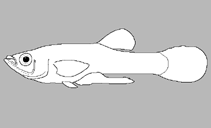
позвонки: 30 - 31. Gambusia zarskei is a small sized species of the subgenus Arthrophallus (SL in males usually not exceeding 25 mm and in females 35 mm), which is distinguished from all other species of the senilis species group by the following characters: shafts of distal spines of gonopodium ray 3 much prolonged, lateral projection on elbow weekly developed, vs. well developed in G. amistadensis and G. hurtadoi or absent in G. alvarezi, G. gaigei and G. senilis. G. zarskei is also distinguished by the following unique combination of characters: relative gonopodial ray 4p serra length of gonopodium long; frequency distribution of SEL/SEW radius 1.35 – 1.65, vs. 0.95 – 1.25 in G. alvarezi, 1.55 – 1.90 in G. amistadensis, 1.00 – 1.35 in G. gaigei and 0.75 – 1.05 in G. hurtadoi; elbow on gonopodium ray 4a simple and not rounded or distally hooked, vs. usually hooked in G. alvarezi, G. gaigei, G. senilis; 8 dorsal fi n rays, vs. usually 9 in G. alvarezi and G. hurtadoi; black anal spot present vs. absent in G. senilis.
Life cycle and mating behavior
половая зрелость | размножение | нерест | икра | Fecundity | личинки
Meyer, M.K., S. Schories and M. Schartl, 2010. Description of Gambusia zarskei sp. n. - a new poeciliid fish from the upper Rio Conchos system, Chihuahua, Mexico (Teleostei: Cyprinodontiformes: Poeciliidae). Verteb. Zool. 60(1):11-18. (Ref. 84135)
Статус Красного Списка МСОП (Ref. 130435: Version 2025-1)
Угроза для людей
Harmless
Использование человеком
дополнительная информация
инструменты
Специальные отчеты
Скачать в формате XML
ресурсы в Интернет
Estimates based on models
Phylogenetic diversity index (ссылка
82804): PD
50 = 0.5000 [Uniqueness, from 0.5 = low to 2.0 = high].
Bayesian length-weight: a=0.01072 (0.00342 - 0.03356), b=3.08 (2.82 - 3.34), in cm total length, based on LWR estimates for this (Sub)family-body shape (Ref.
93245).
Trophic level (ссылка
69278): 3.1 ±0.4 se; based on size and trophs of closest relatives
устойчивость к внешним воздействиям (ссылка
120179): высокий, минимальное время удвоения популяции до 15 месяцев (Preliminary K or Fecundity.).
Fishing Vulnerability (Ref.
59153): Low vulnerability (10 of 100).
🛈