



Trichogenes claviger de Pinna, Helmer, Britski & Nunes, 2010
Ανεβάστε το φωτογραφίες και Βίντεο
Φωτογραφίες | Google image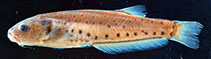 Trichogenes claviger
Εικόνα από Sarmento-Soares, L.M.
Φωτογραφίες | Google image
Εικόνα από Sarmento-Soares, L.M.
Ταξινόμηση / Ονόματα Κοινά ονόματα | Συνώνυμα | Catalog of Fishes(Γένος, Είδη) | ITIS | CoL | WoRMS | Cloffa
> Siluriformes (Catfishes) > Trichomycteridae (Pencil or parasitic catfishes) > Trichogeninae
Etymology: Trichogenes: Greek, thrix = hair + Greek, genes, genesis = birth, race (Ref. 45335); claviger: The specific name refers to club-bearing in Latin, an allusion to the peculiar shape of the hypertrophied posterior process of the opercle in males of this species. An adjective.
Etymology: Trichogenes: Greek, thrix = hair + Greek, genes, genesis = birth, race (Ref. 45335); claviger: The specific name refers to club-bearing in Latin, an allusion to the peculiar shape of the hypertrophied posterior process of the opercle in males of this species. An adjective.
Περιβάλλον: περιβάλλον / κλιματική ζώνη / εύρος βάθους / εύρος διανομής Οικολογία
; Γλυκού νερού βενθικό(ς). Tropical
Κατανομή Εδάφη | Περιοχές FAO | Οικοσυστήματα | Παρουσίες | Σημειακός χάρτης | Εισαγωγές | Faunafri
South America: known only from the type locality, an upland tributary of the headwaters of the rio Itapemirim drainage in southeastern Brazil.
Μέγεθος / Βάρος / Ηλικία
Σύντομη περιγραφή Κλείδες προσδιορισμού | Μορφολογία | Μορφομετρία
Three autapomorphies distinguish T. claviger from all other members of the family: the sexually dimorphic posterior process of the opercle, much elongated in males (vs. short in both males and females); the terminal mouth (vs.subterminal or inferior); and the presence of an anterodorsal claw-like process on the dorsal surface of the neural arch of each of the anterior four free vertebrae. This species is distinguished from T. longipinnis, by several additional characteristics (some of which may also be autapomorphic, pending more detailed analysis): shape of the interopercle, with odontodes extending onto the posterodorsal margin of the interopercle on a bony expansion (vs. odontodes mostly restricted to ventral and posterior margins of the bone); posterior naris broader than long (vs. round); presence of an entirely differentiated fleshy lobe laterally on the lower lip (vs. fleshy lobe mostly continuous with the lower lip); no branched anal-fin rays in specimens of any size (vs. most rays branched in specimens over 41 mm SL); less deep caudal peduncle, 9.3-11.5 (vs. 10.3-12.6% SL); deeper head, head depth 72.9-86.6 (vs. 50.3-62.8% HL); no antorbital (vs. plate-like antorbital present dorsally to antorbital process of lateral ethmoid); deep coronoid process of the lower jaw (vs. coronoid process approximately one-third less deep); flattened bifurcated tooth cusps, with roundish margins (vs. bifurcated tooth cusps conical, pointed); vertebrae 35 (vs. 38 or 39); branchiostegal rays 6 (vs. 7); no pelvic splint (vs. present); pleural ribs 8 (vs. 10 or 11); few sparse dark spots on body (spots more numerous and more densely arranged); well-defined thin dark line along base of anal fin, formed by a regular row of slanted elongate spots on the distal portion of each pterygiophore (vs. no such line); no dark spots on the sides of head (vs. lateral surfaces of head with roundish spots); dark spots on body not extending onto base of caudal fin (vs. spots covering bases of principal caudal-fin rays). The deepest part of the body of T. claviger is at the middle of the abdomen, continuously less deep posteriorly to the base of the caudal fin, and the dorsal and ventral profiles of the head forming broad symmetrical arcs with the body profile, and these result in a rather different general aspect when compared to T. longipinnis, where the deepest part of the body is at the origin of the anal fin, and the body depth is approximately even along its entire length, only slightly decreasing towards the caudal fin. Also, the dorsal and ventral profiles of the head and body are not symmetrical, in T. claviger, it is gently convex and in T. longipinnis it is approximately straight (Ref. 85858).
Body shape (shape guide): elongated.
Body shape (shape guide): elongated.
The specimens were collected in a shallow sector (ca. 30 cm) of the córrego Picada Comprida, on a plateau at ca. 1150 m altitude, water is darkly tea-stained and transparent, with slow current and negligible altitudinal gradient. The stream runs through an area of moderately impacted high-altitude rainforest mingled with sectors of exotic pine culture. The substrate is mostly exposed sand, with masses of accumulated leaf litter and other vegetable debris in many spots. Fish were concentrated on quiet shaded areas with litter, swimming in midwater, and were collected with hand seines. No associated fish species were found with this species. Gut contents revealed numerous disarticulated arthropod remains, indicating that the feeding habits of the species are broadly similar to those of T. longipinnis. The species were also observed swimming in two other nearby spots in tributaries to the córrego Picada Comprida, but were not seen in four additional collection points in the same stream system and their distribution seems to be patchy (Ref. 85858).
Κύκλος ζωής και συμπεριφορά ζευγαρώματος Γεννητική Ωρίμανση | Αναπαραγωγή | Γεννοβολία | Αβγά | Γονιμότητα | Προνύμφες
Κύρια αναφορά
Ανεβάστε τις αναφορές σας | Αναφορές | Συντονιστής : Pinna, Mário de | Συνεργάτες
de Pinna, M.C.C., J.L. Helmer, H.A. Britski and L.R. Nunes, 2010. A new species of Trichogenes from the rio Itapemirim drainage, southeastern Brazil, with comments on the monophyly of the genus (Siluriformes: Trichomycteridae). Neotrop. Ichthyol. 8(4):707-717. (Ref. 85858)
Κατάσταση Κόκκινου Καταλόγου IUCN (Ref. 130435: Version 2025-2 (Global))
Critically Endangered (CR) (B2ab(iii)); Date assessed: 07 November 2018
CITES
Not Evaluated
Απειλή για τον άνθρωπο
Harmless
Ανθρώπινες χρήσεις
FAO - Publication: search | FishSource |
Περισσότερες πληροφορίες
Τροφική Οικολογία
Τρόφιμα (θηράματα)
Σύσταση δίαιτας
Κατανάλωση τροφής
Μερίδες τροφίμων
Θηρευτές
Τρόφιμα (θηράματα)
Σύσταση δίαιτας
Κατανάλωση τροφής
Μερίδες τροφίμων
Θηρευτές
Οικολογία
Οικολογία
Οικολογία
Πληθυσμιακή δυναμική
Παράμετροι Αύξησης
Μέγιστες ηλικίες / μεγέθη
Μήκος-βάρος σχετ.
Μήκος-μήκος rel.
Μήκος-συχνότητες
Μετατροπή μάζας
Στρατολόγηση
Αφθονία
Παράμετροι Αύξησης
Μέγιστες ηλικίες / μεγέθη
Μήκος-βάρος σχετ.
Μήκος-μήκος rel.
Μήκος-συχνότητες
Μετατροπή μάζας
Στρατολόγηση
Αφθονία
Κύκλος ζωής
Αναπαραγωγή
Γεννητική Ωρίμανση
Ωριμότητα / Gills rel.
Γονιμότητα
Γεννοβολία
Συγκεντρώσεις αναπαραγωγής
Αβγά
Ανάπτυξη αυγών
Προνύμφες
Δυναμική προνυμφών
Αναπαραγωγή
Γεννητική Ωρίμανση
Ωριμότητα / Gills rel.
Γονιμότητα
Γεννοβολία
Συγκεντρώσεις αναπαραγωγής
Αβγά
Ανάπτυξη αυγών
Προνύμφες
Δυναμική προνυμφών
Ανατομία
Επιφάνεια βραγχίων
Εγκέφαλος
Ωτόλιθος
Επιφάνεια βραγχίων
Εγκέφαλος
Ωτόλιθος
Φυσιολογία
Σύνθεση σώματος
Θρεπτικά συστατικά
Κατανάλωση οξυγόνου
Τύπος κολύμβησης
Ταχύτητα κολύμβησης
Οπτικές χρωστικές ουσίες
Ήχος ψαριών
Ασθένειες & παράσιτα
Τοξικότητα (LC50)
Σύνθεση σώματος
Θρεπτικά συστατικά
Κατανάλωση οξυγόνου
Τύπος κολύμβησης
Ταχύτητα κολύμβησης
Οπτικές χρωστικές ουσίες
Ήχος ψαριών
Ασθένειες & παράσιτα
Τοξικότητα (LC50)
Γενετική
Γονιδίωμα
Γενετική
Ετεροζυγωτία
Κληρονομικότητα
Γενετική ποικιλομορφία
Γονιδίωμα
Γενετική
Ετεροζυγωτία
Κληρονομικότητα
Γενετική ποικιλομορφία
Ανθρώπινη σχέση
Συστήματα υδατοκαλλιέργειας
Προφίλ υδατοκαλλιεργειών
Στελέχοι
Περιπτώσεις Ciguatera
Γραμματόσημα, νομίσματα, διάφορα.
Συστήματα υδατοκαλλιέργειας
Προφίλ υδατοκαλλιεργειών
Στελέχοι
Περιπτώσεις Ciguatera
Γραμματόσημα, νομίσματα, διάφορα.
Εργαλεία
Ηλεκτρονικό βιβλίο | Οδηγός πεδίου | Ανάλυση κατά μήκος συνθέσεων | Εργαλείο ιστορίας ζωής | Σημειακός χάρτης |
Catch-MSY |
Ειδικές εκθέσεις
Έλεγχος για συντήρηση ενυδρείου | Ελέγξτε για ενημερωτικά δελτία ειδών | Ελέγξτε για ενημερωτικά δελτία υδατοκαλλιέργειας
Λήψη XML
Διαδικτυακές πηγές
AFORO (otoliths) | Aquatic Commons | BHL | Cloffa | Websites from users | Check FishWatcher | CISTI | Catalog of Fishes: Γένος, Είδη | DiscoverLife | ECOTOX | FAO - Publication: search | Faunafri | Fishipedia | Fishtrace | GloBI | Google Books | Google Scholar | Google | IGFA World Record | OneZoom | Open Tree of Life | Otolith Atlas of Taiwan Fishes | PubMed | Reef Life Survey | Socotra Atlas | TreeBase | Δέντρο Ζωής | Wikipedia: Go, αναζήτηση | World Records Freshwater Fishing | Zoobank | Zoological Record
Εκτιμήσεις βάσει μοντέλων
Δείκτης φυλογενετικής ποικιλότητας (Αναφ. 82804): PD50 = 0.7500 [Uniqueness, from 0.5 = low to 2.0 = high].
Bayesian length-weight: a=0.00389 (0.00180 - 0.00842), b=3.12 (2.94 - 3.30), in cm total length, based on all LWR estimates for this body shape (Ref. 93245).
Τροφικό Επίπεδο (Αναφ. 69278): 3.2 ±0.4 se; based on size and trophs of closest relatives