Classificatie / Namen
Lokale namen | Synoniemen | Catalog of Fishes(Genus, Soort(en)) | ITIS | CoL | WoRMS | Cloffa
>
Siluriformes (Catfishes) >
Loricariidae (Armored catfishes) > Hypoptopomatinae
Etymology: Otocinclus: Greek, ous, oto = ear + Latin, cinclus = latticework; in allusion to the holes of the head in the ears (Ref. 45335); mangaba: The specific name mangaba is a Portuguese name for the mangaba fruit (Hancornia speciosa), native to Brazil. The name alludes to the city of Humaita´, recognized in the past for its high production of the fruit and locally named ‘‘Terra da Mangaba’’ (Mangabaland). A noun in apposition.
More on authors: Lehmann, A. & MayerReis.
Environment: milieu / Klimaatzone / Diepte / distribution range
Ecologie
; zoet water demersaal. Tropical
South America: Rio Madeira drainage, Brazil.
Grootte / Gewicht / Leeftijd
Maturiteit: Lm ? range ? - ? cm
Max length : 2.8 cm SL mannelijk / geslacht onbekend; (Ref. 86269)
Korte beschrijving
Determinatiesleutels | Morfologie | Morfometrie
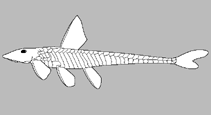
Dorsale stekels (totaal) : 2; Dorsale zachte stralen (totaal) : 7; Anale zachte stralen: 6; Wervels: 22 - 23. Distinguished from its congeners by the absence of median abdominal plates between the lateral abdominal plates, and by the presence of a dark spot at the base of the caudal fin separated from the midlateral stripe by an unpigmented or slightly pigmented area, and not extended posteriorly onto the middle caudal-fin rays (Ref. 86269).
Body shape (shape guide): elongated.
Facultative air-breathing in the genus (Ref. 126274)
Levenscyclus en paargedrag
Maturiteit | Voortplanting | Paaien | Eieren | Fecunditeit | Larven
Lehmann, A.P., F. Mayer and R.E. Reis, 2010. A new species of Otocinclus (Siluriformes: Loricariidae) from the Rio Madeira Drainage, Brazil. Copeia 2010(4):635-639. (Ref. 86269)
Status op de Rode Lijst van het IUCN (Ref. 130435: Version 2025-1)
Gevaar voor de mens
Harmless
Gebruik door de mens
Tools
Speciale rapporten
Download XML
Internetbronnen
Estimates based on models
Fylogenetische diversiteitsindex (Ref.
82804): PD
50 = 0.5000 [Uniqueness, from 0.5 = low to 2.0 = high].
Bayesian length-weight: a=0.00851 (0.00374 - 0.01935), b=3.09 (2.90 - 3.28), in cm total length, based on LWR estimates for this (Sub)family-body shape (Ref.
93245).
Fishing Vulnerability (Ref.
59153): Low vulnerability (10 of 100).
🛈