



Zaireichthys lacustris Eccles, Tweddle & Skelton, 2011
Carregue seu(sua) Fotos e vídeos
Imagem do Google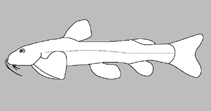 No image available for this species;
drawing shows typical species in Amphiliidae.
Imagem do Google
drawing shows typical species in Amphiliidae.
Classificação / Nomes Nomes comuns | Sinônimos | Catalog of Fishes(Gênero, Espécies) | ITIS | CoL | WoRMS | Cloffa
> Siluriformes (Catfishes) > Amphiliidae (Loach catfishes) > Leptoglaninae
Etymology: Zaireichthys: Composed form Zaire river + Greek,ichtys = fish; the habitat of this fish (Ref. 45335); lacustris: The specific name, 'lacustris', refers to the first species of the genus to be known from a lacustrine environment (Ref. 86935).
Etymology: Zaireichthys: Composed form Zaire river + Greek,ichtys = fish; the habitat of this fish (Ref. 45335); lacustris: The specific name, 'lacustris', refers to the first species of the genus to be known from a lacustrine environment (Ref. 86935).
Meio ambiente: milieu / Zona climática / intervalo de profundidade / faixa de distribuição Ecologia
; Água doce bentopelágico; intervalo de profundidade 10 - 30 m (Ref. 86935). Tropical
Distribuição Territórios | Áreas da FAO | Ecossistemas | Ocorrências | Mapa de pontos | Introduções | Faunafri
Africa: endemic to Lake Malawi (Ref. 86935).
Comprimento de primeira maturação / Tamanho / Peso / Idade
Maturidade: Lm 1.7 range ? - ? cm
Max length : 2.2 cm SL macho/indeterminado; (Ref. 86935); 2.0 cm SL (female)
Max length : 2.2 cm SL macho/indeterminado; (Ref. 86935); 2.0 cm SL (female)
Descrição suscinta Chaves de identificação | Morfologia | Morfometria
Espinhos dorsais (total) : 2; Raios dorsais (total) : 4 - 5; Espinhos anais: 0; Raios anais : 9 - 11. Diagnosis: This species is distinguished from all other members of the genus by the short snout, which is less than one third of the head length, and by its unique habitat, occupying empty snail shells in the lake (Ref. 86935).
Body shape (shape guide): elongated.
Body shape (shape guide): elongated.
This species is recorded from depths of 10-30 m in the southern part and at a depth of about 20 m at Sanga in the central portion of Lake Malawi (Ref. 86935). It has been taken by trawl over the sandy substrata near Monkey Bay, where it is found in empty gastropod shells, and it is also collected in shells by divers (Ref. 86935). It is inquiline with the cichlid fish Pseudotropheus lanisticola in shells of the large gastropod Lanistes nyassanus; the co-existence of the two species in one shell is fortuitous and the catfish occupies probably the upper part of the shell which the cichlid cannot reach (Ref. 86935). Both sexes attain maturity at a standard length of about 17 mm (Ref. 86935). Mature males take up territories in shells; females may share these for some time before depositing their eggs; it appears that females leave the shells shortly after oviposition whereas the males remain in the shells, presumably to guard the brood; the small size of the buccal cavity and the narrow mouth with a width less than 2.5 egg diameters, suggests that mouth brooding is improbable (Ref. 86935). It feeds on ostracods, cladocerans, copepods, chironomid larvae and small trichopteran larvae; some diatom frustules were also observed but it is possible that these were taken fortuitously with invertebrate food items (Ref. 86935).
Ciclo de vida ou comportamento de acasalamento Maturidade | Reprodução | Desova | Ovos | Fecundidade | Larvas
Mature males take up territories in shells; females may share these for some time before depositing their eggs; it appears that females leave the shells shortly after oviposition whereas the males remain in the shells, presumably to guard the brood; the small size of the buccal cavity and the narrow mouth with a width less than 2.5 egg diameters, suggests that mouth brooding is improbable (Ref. 86935).
Referência principal
Carregar suas referências | Referências | Coordenador | Colaboradores
Eccles, D.H., D. Tweddle and P.H. Skelton, 2011. Eight new species in the dwarf catfish genus Zaireichthys (Siluriformes: Amphiliidae). Smithiana Bull. (13):3-28. (Ref. 86935)
Status na Lista Vermelha da UICN (Ref. 130435: Version 2025-2 (Global))
Segura ou pouco preocupante (LC) ; Date assessed: 20 June 2018
CITES
Not Evaluated
Ameaça para os humanos
Harmless
Uso pelos humanos
FAO - Publication: search | FishSource |
Mais informação
Ecologia Trófica
Itens alimentares (presas)
Composição da dieta
Consumo alimentar
Rações alimentares
Predadores
Itens alimentares (presas)
Composição da dieta
Consumo alimentar
Rações alimentares
Predadores
Dinâmica populacional
Parâmetros de crescimento
Idade máxima / tamanhos
Relação comprimento-peso.
Relação comprimento-comprimento.
Frequências de comprimento
Conversão de massa
Recrutamento
Abundância
Parâmetros de crescimento
Idade máxima / tamanhos
Relação comprimento-peso.
Relação comprimento-comprimento.
Frequências de comprimento
Conversão de massa
Recrutamento
Abundância
Ciclo de vida
Reprodução
Maturidade
Maturidade/Rel. das guelras
Fecundidade
Desova
Agregações de desova
Ovos
Desenvolvimento dos ovos
Larvas
Dinâmica larval
Reprodução
Maturidade
Maturidade/Rel. das guelras
Fecundidade
Desova
Agregações de desova
Ovos
Desenvolvimento dos ovos
Larvas
Dinâmica larval
Anatomia
Área branquial
Cérebro
Otólito
Área branquial
Cérebro
Otólito
Fisiologia
Composição corporal
Nutrientes
Consumo de oxigênio
Tipo de natação
Velocidade de natação
Pigmentos visuais
Som de peixe
Doenças e Parasitas
Toxicidade (LC50s)
Composição corporal
Nutrientes
Consumo de oxigênio
Tipo de natação
Velocidade de natação
Pigmentos visuais
Som de peixe
Doenças e Parasitas
Toxicidade (LC50s)
Genética
genoma
Genética
Heterozigosidade
Hereditariedade
Diversidade genética
genoma
Genética
Heterozigosidade
Hereditariedade
Diversidade genética
Relacionado a humanos
Sistemas de aquicultura
Perfis para aquacultura
Estirpes
Casos de Ciguatera
Selos, moedas, diversos.
Sistemas de aquicultura
Perfis para aquacultura
Estirpes
Casos de Ciguatera
Selos, moedas, diversos.
Ferramentas
Livro eletrônico | Guia de campo | Ferramenta auxiliar de frequências de comprimento | Ferramenta sobre a história de vida | Mapa de pontos |
Catch-MSY |
Relatórios especiais
Checar Manutenção em Aquário | Checar Planilhas de Fatos sobre as Espécies | Checar Planilhas de Fatos sobre Aquicultura
Baixar XML
Fontes da internet
AFORO (otoliths) | Aquatic Commons | BHL | Cloffa | Websites from users | Checar Observador de Peixes (FishWatcher) | CISTI | Catalog of Fishes: Gênero, Espécies | DiscoverLife | ECOTOX | FAO - Publication: search | Faunafri | Fishipedia | Fishtrace | GloBI | Google Books | Google Scholar | Google | IGFA World Record | OneZoom | Open Tree of Life | Otolith Atlas of Taiwan Fishes | PubMed | Reef Life Survey | Socotra Atlas | TreeBase | Árvore da vida | Wikipedia: Ir para, procura | World Records Freshwater Fishing | Zoobank | Registro zoológico
Estimativas baseadas em modelos
Índice de diversidade filogenética (Ref. 82804): PD50 = 0.5000 [Uniqueness, from 0.5 = low to 2.0 = high].
Bayesian length-weight: a=0.00389 (0.00180 - 0.00842), b=3.12 (2.94 - 3.30), in cm total length, based on all LWR estimates for this body shape (Ref. 93245).
Nível Trófico (Ref. 69278): 3.0 ±0.4 se; based on size and trophs of closest relatives