



Histiophryne maggiewalker Arnold & Pietsch, 2011
Queensland frogfish
添加你自己的观测位置在 Fish Watcher
| Native range | All suitable habitat | Point map | Year 2050 |

|
| This map was computer-generated and has not yet been reviewed. |
| Histiophryne maggiewalker AquaMaps Data sources: GBIF OBIS |
上传你的 图片 和 影像
照片 | 谷歌图片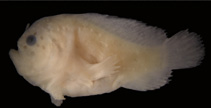 Histiophryne maggiewalker
Juvenile 图片提供人 Arnold, R.J.
照片 | 谷歌图片
Juvenile 图片提供人 Arnold, R.J.
分类 / 名称 俗名 | 同种异名 | Catalog of Fishes(属, 种) | ITIS | CoL | WoRMS | Cloffa
Teleostei > Lophiiformes (Anglerfishes) > Histiophrynidae (Starfingered frogfishes)
Etymology: Histiophryne: Greek, istion, istos = sail + Greek, phryne = toad (Ref. 45335); maggiewalker: Named for Maggie Walker for her service and dedication to science and education at the University of Washington and The Burke Museum of Natural History and Culture (Ref. 87287).
Eponymy: Margaret ‘Maggie’ Walker (d: 1953) was a graduate of, and benefactor to, the University of Washington and The Burke Museum of Natural History and Culture. [...] (Ref. 128868), visit book page.
Etymology: Histiophryne: Greek, istion, istos = sail + Greek, phryne = toad (Ref. 45335); maggiewalker: Named for Maggie Walker for her service and dedication to science and education at the University of Washington and The Burke Museum of Natural History and Culture (Ref. 87287).
Eponymy: Margaret ‘Maggie’ Walker (d: 1953) was a graduate of, and benefactor to, the University of Washington and The Burke Museum of Natural History and Culture. [...] (Ref. 128868), visit book page.
环境:氛围 / 气候带 / 深度上下限 / 分布范围 生态学
海洋 居于水底的; 深度上下限 7 - 12 m (Ref. 87287).
分布 领土 | FAO区域 | 生态系 | 标本纪录 | 分布图 | 简介 | Faunafri
Pacifique: Australia.
大小 / 重量 / 年龄
简单描述 检索表 | 型态特徵 | 形态测量图
背的软条 (总数) : 15; 臀鳍软条: 8; 脊椎骨: 21 - 22. A frogfish of the lophiiform family Antennariidae, genus Histiophryne, unique in having a relatively long illicium and esca, the latter expanded distally, its shape more or less rectangular with rounded edges, and genetic divergence in the nuclear recombination activation gene-2 (RAG2) and cytochrome oxidase-I (COI) genes (Ref. 87287).
Body short and deep, somewhat compressed laterally, vertebral column distinctly sigmoid in shape; head large, its length approximately 29−39% standard length (SL); mouth small(relative to other antennariid taxa), opening strongly oblique to nearly vertical. Jaws bearing 2–4 irregular rows of small villiform teeth; similar teeth present on vomer and palatine. Eye diameter 4.5–4.9% and 8.8–9.1% SL for adults (four specimens) and juveniles (two specimens), respectively. Spinous dorsal fin consisting of three widely spaced spines, anteriormost spine (illicium) relatively long (2.5–4.7% SL); second and third dorsal-fin spines laid back and bound down to surface of head by thick skin; esca relatively long (4.1–6.4% SL), more or less rectangular with rounded edges. Pectoral-fin lobe elongate, leg-like, attached to side of body by loose skin for most of its length. Opercular opening restricted to a small, elongate, tube-like opening situated immediately posteroventral to base of pectoral fin. Caudal peduncle absent, thick fleshy posteriormost margin of soft-dorsal and anal fins extending posteriorly well beyond base of caudal fin, connecting to outermost caudal-fin rays. Skin covering head and body everywhere thick, fleshy, and naked, lacking any visible trace of dermal spinules or cutaneous filaments or appendages. Rays of dorsal, anal, pectoral, and pelvic fins all simple; those of caudal fin all bifurcate. Dorsal-fin rays 15; anal-fin rays 8; pectoral-fin rays 8; pelvic fin with 1 spine and 5 rays; caudal-fin rays 9; vertebrae 21–22, including the anteriormost and posteriormost centra fused to the cranium and hypural plate, respectively (Ref. 87287).
Body shape (shape guide): short and / or deep; Cross section: compressed.
Body shape (shape guide): short and / or deep; Cross section: compressed.
Known only from shallow inshore waters. While some frogfishes are notorious for their insatiable appetite, including tendencies to cannibalize one another, it is possible these four were living together peacefully (Ref. 87287).
生命周期和交配行为 成熟度 | 繁殖 | 产卵场 | 卵 | 孕卵数 | 仔鱼
主要参考文献
上传您的参考资料 | 参考文献 | 合作者 | 合作者
Arnold, R.J. and T.W. Pietsch, 2011. A new species of frogfish of the genus Histiophryne (Teleostei: Lophiiformes: Antennariidae) from Queensland, Australia. Zootaxa 2925:63-68 (Ref. 87287)
CITES
Not Evaluated
对人类的威胁
人类利用
FAO - Publication: search | FishSource |
更多信息
解剖学
鳃区
大脑
耳石
鳃区
大脑
耳石
生理学
身体成分
营养素
耗氧量
游泳类型
游泳速度
视觉色素
鱼声
疾病与寄生虫
毒性(半数致死浓度)
身体成分
营养素
耗氧量
游泳类型
游泳速度
视觉色素
鱼声
疾病与寄生虫
毒性(半数致死浓度)
遗传学
基因组
遗传学
异质性
遗传率
基因多样性
基因组
遗传学
异质性
遗传率
基因多样性
工具
特别资料
下载 XML
网络资源
AFORO (otoliths) | Aquatic Commons | BHL | Cloffa | Websites from users | 核实 FishWatcher | CISTI | Catalog of Fishes: 属, 种 | DiscoverLife | ECOTOX | FAO - Publication: search | Faunafri | Fishipedia | Fishtrace | GloBI | Google Books | Google Scholar | Google | IGFA World Record | OneZoom | Open Tree of Life | Otolith Atlas of Taiwan Fishes | PubMed | Reef Life Survey | Socotra Atlas | TreeBase | 树状分类阶层 | Wikipedia: 转至, 搜寻 | World Records Freshwater Fishing | Zoobank | 动物学的记录
基于模型的估算
首选温度 (参考文献 123201): 23.6 - 24.3, mean 24 °C (based on 19 cells).
系统发育多样性指数 (参考文献 82804): PD50 = 0.5313 [Uniqueness, from 0.5 = low to 2.0 = high].
Bayesian length-weight: a=0.01995 (0.00906 - 0.04395), b=3.01 (2.83 - 3.19), in cm total length, based on all LWR estimates for this body shape (Ref. 93245).
营养阶层 (参考文献 69278): 3.5 ±0.5 se; based on size and trophs of closest relatives
回复力 (参考文献 120179): 高度, 族群倍增时间少于 15个月 (Fec assumed to be > 10,000).