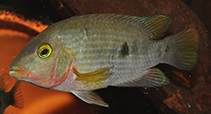
Classification / Names
Tên thường gặp | Các synonym ( Các tên trùng) | Catalog of Fishes(Giống, Các loài) | ITIS | CoL | WoRMS | Cloffa
>
Cichliformes (Cichlids, convict blennies) >
Cichlidae (Cichlids) > Cichlinae
Etymology: Australoheros: From the Latin word 'australis' meaning southern, and the name Heros, after the nominotypic genus of the Heroini tribe.
Tribe; ykeregua: Name from the Guaraní word ykeregua, meaning neighbor (vecino in Spanish). It is based on the
fact that A. ykeregua and A. forquilha have been preliminarily treated as conspecific, two sister group species living in the same river drainage (río Uruguay), though not sympatrically.
Environment: milieu / climate zone / Mức độ sâu / distribution range
Sinh thái học
; Nước ngọt Sống nổi và đáy. Tropical
South America: known only from Argentinean territory in the tributaries of the río Uruguay below the Salto Moconá, province of Misiones.
Bộ gần gũi / Khối lượng (Trọng lượng) / Age
Chín muồi sinh dục: Lm ? range ? - ? cm
Max length : 13.7 cm SL con đực/không giới tính; (Ref. 87600)
Short description
Khóa để định loại | Hình thái học | Sinh trắc học
Các tia vây lưng cứng (tổng cộng) : 15 - 17; Các vây lưng mềm (tổng cộng) : 9 - 11; Tia cứng vây hậu môn: 5 - 6; Tia mềm vây hậu môn: 7 - 9; Động vật có xương sống: 26 - 27. This species is distinguished from all Australoheros species except A. forquilha by the following characters: presence of a series of opalescent pale blue dots along the postero-lateral border of the suborbital series (dark markings in preserved specimens); with checkerboard-spotted dorsal, anal and caudal fins (red spots in live animals and dark grey in preserved specimens); a red to orange branchiostegal membrane, mouth and lower head area and base of pectoral fin; by having comparatively thick lips (shared also with A. tembe); with lower jaw shorter than the upper; E0 scales 25–26 (vs. less than 25); with the longest dorsal fin scale cover (shared also with A. tembe); by having the narrowest head, < 50% head width of HL (vs. more than 50%), shortest interorbital, 10.9% of SL and longest preorbital, 9.3% of SL distances. This species differs from A. forquilha by the absence of the opalescent pale blue dots on each body scale, by not having them widely distributed on the head, but limited to a single line below the suborbital series; in having a red coloration limited to the head region and the base of the pectoral fin (vs. red coloration on the whole belly to the end of the anal fin); by having lower counts of caudal vertebrae 13-14 (vs. 14-15), less caudal peduncle vertebrae, modally 2 (vs. 3), lower total dorsal fin counts 25-26 (vs. 26-27) and E0 scales 25 (vs. 26). It is distinguished from the only other similar species, Australoheros tembe, by the above listed unique characters and by coloration (shared only with A. forquilha) and additionally by a shorter caudal peduncle (including 2 vs. 3 vertebrae) and more dorsal fin rays 10-11 (vs. 9) (Ref. 87600).
Body shape (shape guide): short and / or deep.
Life cycle and mating behavior
Chín muồi sinh dục | Sự tái sinh sản | Đẻ trứng | Các trứng | Sự sinh sản | Ấu trùng
Říčan, O., L. Piálek, A. Almirón and J. Casciotta, 2011. Two new species of Australoheros (Teleostei: Cichlidae), with notes on diversity of the genus and biogeography of the Río de la Plata basin. Zootaxa 2982:1-26. (Ref. 87600)
IUCN Red List Status (Ref. 130435: Version 2025-1)
Threat to humans
Harmless
Human uses
Các công cụ
Special reports
Download XML
Các nguồn internet
Estimates based on models
Phylogenetic diversity index (Tài liệu tham khảo
82804): PD
50 = 0.5000 [Uniqueness, from 0.5 = low to 2.0 = high].
Bayesian length-weight: a=0.03020 (0.01346 - 0.06774), b=3.03 (2.84 - 3.22), in cm total length, based on LWR estimates for this (Sub)family-body shape (Ref.
93245).
Mức dinh dưỡng (Tài liệu tham khảo
69278): 3.2 ±0.5 se; based on size and trophs of closest relatives
Thích nghi nhanh (Tài liệu tham khảo
120179): Chiêù cao, thời gian nhân đôi của chủng quần tối thiểu là dưới 15 tháng (Preliminary K or Fecundity.).
Fishing Vulnerability (Ref.
59153): Low vulnerability (10 of 100).
🛈