



Enteromius teugelsi (Bamba, Vreven & Snoeks, 2011)
Ladda upp din foton och Videor
Google image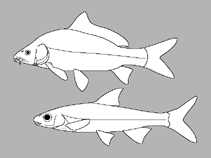 No image available for this species;
drawing shows typical species in Cyprinidae.
Google image
drawing shows typical species in Cyprinidae.
Klassificering / Namn Populärnamn | synonymer | Catalog of Fishes(Släkte, Arter) | ITIS | CoL | WoRMS | Cloffa
> Cypriniformes (Carps) > Cyprinidae (Minnows or carps) > Smiliogastrinae
Etymology: Enteromius: Greek, enteron = intestine + Greek, myo, mys = muscle (Ref. 45335); teugelsi: This species is named after and dedicated to Prof. Dr. Guy G. Teugels (1954-2003), an outstanding ichthyologist who introduced M. Bamba and E. Vreven to fish taxonomy and greatly contributed to the knowledge of the African fishes over the last twenty years (Ref. 87721).
Eponymy: Dr Guy G Teugels (1954–2003) was a Belgian ichthyologist. [...] (Ref. 128868), visit book page.
Etymology: Enteromius: Greek, enteron = intestine + Greek, myo, mys = muscle (Ref. 45335); teugelsi: This species is named after and dedicated to Prof. Dr. Guy G. Teugels (1954-2003), an outstanding ichthyologist who introduced M. Bamba and E. Vreven to fish taxonomy and greatly contributed to the knowledge of the African fishes over the last twenty years (Ref. 87721).
Eponymy: Dr Guy G Teugels (1954–2003) was a Belgian ichthyologist. [...] (Ref. 128868), visit book page.
Miljö: miljö / Klimatzon / djupintervall / distributionsområde Ekologi
; sötvatten bentopelagisk. Tropical
Utbredning Territorier | FAO områden | Ekosystem | Förekomster | Prickkarta | Utplanteringar | Faunafri
Africa: Little Scarcies River basin in Guinea (Ref. 87721).
Storlek / Vikt / Ålder
Kort beskrivning Bestämningsnycklar | Morfologi | Morfometri
Diagnosis: Within West Africa, this species is ditinguished from all other small African barbs (Enteromius) by the following unique combination of characters: last simple dorsal-fin ray smooth on hind margin, vs. denticulate on hind margin in E. cadenati, E. carcharhinoides, E. dialonensis and E. guineensis; two long barbels, vs. no barbels in E. anema, E. clauseni, E. pumilus and E. salessei and single pair of very short barbels in E. pobeguini; no black spot on dorsal fin, vs. black spot on dorsal fin in E. aboinensis, E. callipterus, E. macrops and E. raimbaulti; 3.5 scales between dorsal-fin base and lateral line and 21 to 24 lateral line scales, vs. higher scale numbers: 4.5 to 5.5 and 27 to 30 in E. atakorensis, E. bagbwensis, E. bigornei, E. boboi, E. chlorotaenia, E. lauzannei, E. nigeriensis and E. subensis; the presence of a black mid-lateral band, vs. no mid-lateral band or one to five well defined spots on the flanks in E. aliciae, E. anniae, E. baudoni, E. camptacanthus, E. eburneensis, E. foutensis, E. huguenyi, E. liberiensis, E. macinensis, E. perince, E. stigmatopygus, E. sublineatus, E. sylvaticus, E. tiekoroi, E. traorei, E. trispiloides, E. trispilos and E. walkeri; 12 scales around caudal peduncle, vs. 10 or less in E. bawkuensis, E. ditinensis, E. guildi, E. inaequalis, E. leonensis, E. melanotaenia, E. punctitaeniatus and E. zalbiensis; and the absence of a striped pattern on the mid-dorsal parts, present in E. nikoloensis (Ref. 87721). Although Enteromius teugelsi is very similar in general habitus to E. ablabes and E. parablabes, it can be distinguished from both species by its longer barbels 3/5, vs. 2/3; poorly developed or absent cephalic sensory canals, vs. well developed cephalic sensory canals; and a low number of gill rakers, 3-6 vs. 7-12 and 7-9 (Ref. 87721).
Body shape (shape guide): fusiform / normal.
Body shape (shape guide): fusiform / normal.
Livscykel och parningsbeteende Könsmognad | Reproduktion | Lek | Ägg | Fekunditet | Larver
Huvudreferens
Ladda upp dina referenser | referenser | Koordinator | Medarbetare
Bamba, M., E.J. Vreven and J. Snoeks, 2011. Description of Barbus teugelsi sp. nov. (Cypriniformes: Cyprinidae) from the Little Scarcies basin in Guinea, Africa. Zootaxa 2998:48-65. (Ref. 87721)
Status på IUCN:s rödlista (Ref. 130435: Version 2025-2 (Global))
Sårbar (VU) (B1ab(iii)+2ab(iii)); Date assessed: 10 March 2020
CITES
Not Evaluated
Hot mot människor
Harmless
Mänskliga användningsområden
Fiskeri: saknar intresse
FAO - Publication: search | FishSource |
Ytterligare information
Trofisk ekologi
Livsmedelsartiklar (preys)
Födosammansättning
Födointag
Matransoner
Predatorer
Livsmedelsartiklar (preys)
Födosammansättning
Födointag
Matransoner
Predatorer
Ekologi
Ekologi
Ekologi
Populationsdynamik
Tillväxtparametrar
Max. åldrar / storlekar
Längd-vikt rel.
Längd-längd rel.
Längd-frekvenser
Massakonvertering
Rekrytering
Abundans
Tillväxtparametrar
Max. åldrar / storlekar
Längd-vikt rel.
Längd-längd rel.
Längd-frekvenser
Massakonvertering
Rekrytering
Abundans
Livscykel
Reproduktion
Könsmognad
Mognad/Gills rel.
Fekunditet
Lek
Lekande aggregat
Ägg
Utveckling av ägg
Larver
Larvdynamik
Reproduktion
Könsmognad
Mognad/Gills rel.
Fekunditet
Lek
Lekande aggregat
Ägg
Utveckling av ägg
Larver
Larvdynamik
Anatomi
Gälyta
Hjärna
Otolit
Gälyta
Hjärna
Otolit
Fysiologi
Kroppssammansättning
Näringsämnen
Syreförbrukning
Typ av simning
Simhastighet
Visuella pigment
Ljud från fisk
Sjukdomar & Parasiter
Toxicitet (LC50)
Kroppssammansättning
Näringsämnen
Syreförbrukning
Typ av simning
Simhastighet
Visuella pigment
Ljud från fisk
Sjukdomar & Parasiter
Toxicitet (LC50)
Genetik
Genom
Genetik
Heterozygositet
Ärftlighet
Genetisk mångfald
Genom
Genetik
Heterozygositet
Ärftlighet
Genetisk mångfald
Människorelaterad
Vattenbrukssystem
Vattenbruksprofiler
Avelslinjer
Ciguatera-fall
Frimärken, mynt, diverse.
Vattenbrukssystem
Vattenbruksprofiler
Avelslinjer
Ciguatera-fall
Frimärken, mynt, diverse.
Verktyg
Särskilda rapporter
Kontrollera för underhåll av akvarium | Kontrollera om det finns faktablad om arter | Kontrollera om det finns faktablad om vattenbruk
Ladda ner XML
Internet-källor
AFORO (otoliths) | Aquatic Commons | BHL | Cloffa | Websites from users | Check FishWatcher | CISTI | Catalog of Fishes: Släkte, Arter | DiscoverLife | ECOTOX | FAO - Publication: search | Faunafri | Fishipedia | Fishtrace | GloBI | Google Books | Google Scholar | Google | IGFA World Record | OneZoom | Open Tree of Life | Otolith Atlas of Taiwan Fishes | PubMed | Reef Life Survey | Socotra Atlas | TreeBase | Tree of Life | Wikipedia: Go, sök | World Records Freshwater Fishing | Zoologiskt register
Uppskattningar baserade på modeller
Index för fylogenetisk mångfald (Ref. 82804): PD50 = 0.5000 [Uniqueness, from 0.5 = low to 2.0 = high].
Bayesian length-weight: a=0.00603 (0.00282 - 0.01286), b=3.06 (2.87 - 3.25), in cm total length, based on LWR estimates for this (Sub)family-body shape (Ref. 93245).
Trofisk nivå (Ref. 69278): 3.0 ±0.3 se; based on size and trophs of closest relatives
Resiliens (Ref. 120179): Hög, lägsta populationsfördubblingstid mindre än 15 månader (Preliminary K or Fecundity.).