



Chiloglanis kazumbei Friel & Vigliotta, 2011
muatnaik fotos/gambar dan video
imej Google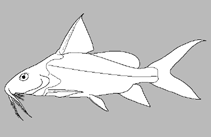 No image available for this species;
drawing shows typical species in Mochokidae.
imej Google
drawing shows typical species in Mochokidae.
klasifikasi / Nama Nama-nama umum | Sinonim (persamaan) | Catalog of Fishes(Marga, Jenis) | ITIS | CoL | WoRMS | Cloffa
> Siluriformes (Catfishes) > Mochokidae (Squeakers or upside-down catfishes) > Chiloglanidinae
Etymology: Chiloglanis: Greek, cheilos = lip + Greek, glanis = a fish that can eat the bait without touching the hook; a cat fish (Ref. 45335); kazumbei: This species is eponymously named for Mr. George Kazumbe, an expert fisherman and friend from Kigoma, Tanzania; he has assisted the authors and several of their colleagues doing fieldwork in Tanzania, and the authors wish to honor him for his service (Ref. 87986).
Eponymy: George Kazumbe from Kigoma, Tanzania, is described as an ‘expert fisherman and friend’. [...] (Ref. 128868), visit book page.
Etymology: Chiloglanis: Greek, cheilos = lip + Greek, glanis = a fish that can eat the bait without touching the hook; a cat fish (Ref. 45335); kazumbei: This species is eponymously named for Mr. George Kazumbe, an expert fisherman and friend from Kigoma, Tanzania; he has assisted the authors and several of their colleagues doing fieldwork in Tanzania, and the authors wish to honor him for his service (Ref. 87986).
Eponymy: George Kazumbe from Kigoma, Tanzania, is described as an ‘expert fisherman and friend’. [...] (Ref. 128868), visit book page.
Lingkungan: lingkungan / zona iklim / kisaran kedalaman / jangkauan distribusi Ekologi
; air tawar bentopelagis. Tropical
Penyebaran Wilayah | Daerah-daerah FAO | Ekosistem | Kemunculan | peta titik | Introduksi | Faunafri
Africa: lower Malagarazi River and Luiche River in
Tanzania (Ref. 87986) and affluents of Malagarazi in Burundi (Ref. 87986, 98755).
Ukuran / Berat / umur
deskripsi pendek Kunci identifiaksi (pengenalan) | Morfologi | Morfometrik
Duri punggung (Keseluruhan (total)) : 2; duri punggung lunak (Keseluruhan (total)) : 5 - 6; Duri dubur: 0; Sirip dubur lunak: 10 - 11; vertebrata, bertulang belakang: 34 - 35. Diagnosis: Chiloglanis kazumbei can be distinguished from all species in the Malagarasi and Luiche basins by the following combination of features: relatively long dorsal spine length, 16.1–21.3% of standard length vs. 7.5–13.6% in C. asymetricaudalis, 8.2–12.7% in C. igamba and 4.1–7.8% in C. orthodontus; relatively long pectoral spine length, 19.1–23.6% of standard length vs. 12.1–16.5% in C. asymetricaudalis, 9.9–15.1% in C. igamba and 10.9–17.2% in C. orthodontus; relatively wide occipital shield width, 6.1–8.3% of standard length vs. 3.7–4.7% in C. asymetricaudalis, 2.8–4.9% in C. igamba and 2.4–3.8% in C. orthodontus; and moderately long adipose fin length, 17.1–22.8% of standard length vs. 13.3-19.8% in C. asymetricaudalis, 10.3–16.3% in C. igamba and 25.0-31.3% in C. orthodontus (Ref. 87986). Additional features that distinguish C. kazumbei from congeners within its range include a distinctive pigmentation pattern with dark patches on the dorsal and pectoral fins, a dark band on the anal fin, and a caudal fin that is deeply forked with a slightly longer lower lobe vs. not deeply forked in C. lufirae, C. igamba and C. orthodontus, or forked with greatly elongated upper lobe in males of C. asymetricaudalis (Ref. 87986).
Body shape (shape guide): elongated; Cross section: flattened.
Body shape (shape guide): elongated; Cross section: flattened.
This species is typically found in small to moderate sized rapids (Ref. 87986).
Siklus hidup dan perilaku kawin Kematangan | Reproduksi, perkembang biakan | Pemijahan | telur-telur | Fekunditas | Larva
rujukan utama
Unggah referensi Anda | Acuan | Koordinator | mitra
Friel, J.P. and T.R. Vigliotta, 2011. Three new species of African suckermouth catfishes, genus Chiloglanis (Siluriformes: Mochokidae), from the lower Malagarasi and Luiche rivers of western Tanzania. Zootaxa 3063:1-21. (Ref. 87986)
CITES
Not Evaluated
ancaman kepada manusia
Harmless
penggunaan manusia
Perikanan: tidak ada kepentingan
FAO - Publication: search | FishSource |
informasi lanjut
Ekologi trofik
Item makanan (mangsa)
Komposisi makanan
Konsumsi makanan
Ransum makanan
Pemangsa
Item makanan (mangsa)
Komposisi makanan
Konsumsi makanan
Ransum makanan
Pemangsa
Dinamika populasi
Parameter pertumbuhan
Maks. usia / ukuran
Panjang-berat rel.
Panjang-panjang rel.
ukuran frekuensi
Konversi massa
pemulihan
Kelimpahan
Parameter pertumbuhan
Maks. usia / ukuran
Panjang-berat rel.
Panjang-panjang rel.
ukuran frekuensi
Konversi massa
pemulihan
Kelimpahan
Siklus hidup
Reproduksi, perkembang biakan
Kematangan
Kedewasaan / insang rel.
Fekunditas
Pemijahan
Agregasi pemijahan
telur-telur
pekembangan telor
Larva
Dinamika larva
Reproduksi, perkembang biakan
Kematangan
Kedewasaan / insang rel.
Fekunditas
Pemijahan
Agregasi pemijahan
telur-telur
pekembangan telor
Larva
Dinamika larva
Anatomi
Area insang
Otak
Otolith
Area insang
Otak
Otolith
Fisiologi
Komposisi tubuh
Nutrisi
Konsumsi oksigen
Jenis renang
Kecepatan berenang
Pigmen visual
Suara ikan
Penyakit & Parasit
Toksisitas (LC50)
Komposisi tubuh
Nutrisi
Konsumsi oksigen
Jenis renang
Kecepatan berenang
Pigmen visual
Suara ikan
Penyakit & Parasit
Toksisitas (LC50)
Genetika
genom
Genetika
Heterozigositas
Diturunkan
Keanekaragaman Genetik
genom
Genetika
Heterozigositas
Diturunkan
Keanekaragaman Genetik
Yang berhubungan dengan manusia
Sistem akuakultur
profil budidaya air
Strain
Kasus Ciguatera
Perangko, koin, dll.
Sistem akuakultur
profil budidaya air
Strain
Kasus Ciguatera
Perangko, koin, dll.
Alat, peralatan
E-book | Penuntun lapangan | tanda freqkuenci panjang | peringkat sejarah hidup | peta titik |
Tangkap-MSY |
laporan khas
muat turun XML
Sumber internet
AFORO (otoliths) | Aquatic Commons | BHL | Cloffa | Websites from users | semak peneliti ikan | CISTI | Catalog of Fishes: Marga, Jenis | DiscoverLife | ECOTOX | FAO - Publication: search | Faunafri | Fishipedia | Fishtrace | GloBI | Google Books | Google Scholar | Google | IGFA World Record | OneZoom | Open Tree of Life | Otolith Atlas of Taiwan Fishes | PubMed | Reef Life Survey | Socotra Atlas | TreeBase | Tree of Life | Wikipedia: pergi, Cari | World Records Freshwater Fishing | Zoobank | Catatan Zoologi
Estimasi berdasarkan model
Indeks keanekaragaman filogenetik (Acuan 82804): PD50 = 0.5000 [Uniqueness, from 0.5 = low to 2.0 = high].
Bayesian length-weight: a=0.00389 (0.00180 - 0.00842), b=3.12 (2.94 - 3.30), in cm total length, based on all LWR estimates for this body shape (Ref. 93245).
Tingkat Trofik (Acuan 69278): 3.2 ±0.4 se; based on size and trophs of closest relatives