



Homatula laxiclathra Gu & Zhang, 2012
Ladda upp din foton och Videor
Google image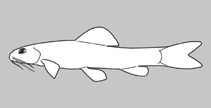 No image available for this species;
drawing shows typical species in Nemacheilidae.
Google image
drawing shows typical species in Nemacheilidae.
Klassificering / Namn Populärnamn | synonymer | Catalog of Fishes(Släkte, Arter) | ITIS | CoL | WoRMS | Cloffa
> Cypriniformes (Carps) > Nemacheilidae (Brook loaches)
Etymology: Homatula: Greek, homos, homoios = similar + Greek, atylos, atylotos = without callosities; laxiclathra: Name from the combination of Latin words laxus (wide) and clathrus (barred), alluding the presence of wider vertical bars on each side of body; an adjective.
Etymology: Homatula: Greek, homos, homoios = similar + Greek, atylos, atylotos = without callosities; laxiclathra: Name from the combination of Latin words laxus (wide) and clathrus (barred), alluding the presence of wider vertical bars on each side of body; an adjective.
Miljö: miljö / Klimatzon / djupintervall / distributionsområde Ekologi
; sötvatten bottenlevande. Subtropical
Utbredning Territorier | FAO områden | Ekosystem | Förekomster | Prickkarta | Utplanteringar | Faunafri
Asia: China.
Storlek / Vikt / Ålder
Kort beskrivning Bestämningsnycklar | Morfologi | Morfometri
Homatula laxiclathra is similar to H. variegate, H. berezowskii, and H. longidorsalis in the shared presence of slender bodies with uniform depth [9.3–15.8% (mean 12.5) SL], a character distinguishing them from all remaining species of this genus where they have deeper bodies [13.6–23.9% (mean 16.6) SL] and their body depth evenly decreases posterior to the posterior end of the dorsal-fin base. The new species differs from H. variegata, H. berezowskii, and H. longidorsalis in having vertical brown bars on the caudal peduncle twice as wide as (vs. much narrower or slightly wider than) their interspaces. This new species, along with H. berezowskii, is further distinguished from H. variegata and H. longidorsalis by the presence of a shorter head (length 15.6–21.1% SL vs. 18.3–25.3), a shallower caudal peduncle (depth 8.4–11.4% SL vs. 9.6–13.6), a shorter adipose crest along the dorsal midline of the caudal peduncle anteriorly not extending to the midway of the analfin base (vs. extending beyond the vertical through the anal-fin origin), a scaleless (vs. partially scaled) predorsal body, and an intestine with (vs. without) a loop or bend behind the stomach. It is further distinct from H. berezowskii in having an oblique (vs. truncate) posterior margin of the caudal fin, and a narrower interorbital space [width 19.9–24.9 (average 22.5)% HL vs. 24.1–29.7 (average 27.0)]. The new species has an intestine with a loop anteriorly reaching the posterior surface of the U-shaped stomach, whereas the other related species do not have a loop at this portion of the intestine (Ref. 88693).
Body shape (shape guide): elongated.
Body shape (shape guide): elongated.
Livscykel och parningsbeteende Könsmognad | Reproduktion | Lek | Ägg | Fekunditet | Larver
Huvudreferens
Ladda upp dina referenser | referenser | Koordinator | Medarbetare
Gu, J.-H. and E. Zhang, 2012. Homatula laxiclathra (Teleostei: Balitoridae), a new species of nemacheiline loach from the Yellow River drainagein Shaanxi Province, northern China. Environ. Biol. Fishes 94:591-599. (Ref. 88693)
Status på IUCN:s rödlista (Ref. 130435: Version 2025-2 (Global))
Sårbar (VU) (B1ab(iii)); Date assessed: 12 November 2024
CITES
Not Evaluated
Hot mot människor
Harmless
Mänskliga användningsområden
FAO - Publication: search | FishSource |
Ytterligare information
Trofisk ekologi
Livsmedelsartiklar (preys)
Födosammansättning
Födointag
Matransoner
Predatorer
Livsmedelsartiklar (preys)
Födosammansättning
Födointag
Matransoner
Predatorer
Ekologi
Ekologi
Ekologi
Populationsdynamik
Tillväxtparametrar
Max. åldrar / storlekar
Längd-vikt rel.
Längd-längd rel.
Längd-frekvenser
Massakonvertering
Rekrytering
Abundans
Tillväxtparametrar
Max. åldrar / storlekar
Längd-vikt rel.
Längd-längd rel.
Längd-frekvenser
Massakonvertering
Rekrytering
Abundans
Livscykel
Reproduktion
Könsmognad
Mognad/Gills rel.
Fekunditet
Lek
Lekande aggregat
Ägg
Utveckling av ägg
Larver
Larvdynamik
Reproduktion
Könsmognad
Mognad/Gills rel.
Fekunditet
Lek
Lekande aggregat
Ägg
Utveckling av ägg
Larver
Larvdynamik
Anatomi
Gälyta
Hjärna
Otolit
Gälyta
Hjärna
Otolit
Fysiologi
Kroppssammansättning
Näringsämnen
Syreförbrukning
Typ av simning
Simhastighet
Visuella pigment
Ljud från fisk
Sjukdomar & Parasiter
Toxicitet (LC50)
Kroppssammansättning
Näringsämnen
Syreförbrukning
Typ av simning
Simhastighet
Visuella pigment
Ljud från fisk
Sjukdomar & Parasiter
Toxicitet (LC50)
Genetik
Genom
Genetik
Heterozygositet
Ärftlighet
Genetisk mångfald
Genom
Genetik
Heterozygositet
Ärftlighet
Genetisk mångfald
Människorelaterad
Vattenbrukssystem
Vattenbruksprofiler
Avelslinjer
Ciguatera-fall
Frimärken, mynt, diverse.
Vattenbrukssystem
Vattenbruksprofiler
Avelslinjer
Ciguatera-fall
Frimärken, mynt, diverse.
Verktyg
Särskilda rapporter
Kontrollera för underhåll av akvarium | Kontrollera om det finns faktablad om arter | Kontrollera om det finns faktablad om vattenbruk
Ladda ner XML
Internet-källor
AFORO (otoliths) | Aquatic Commons | BHL | Cloffa | Websites from users | Check FishWatcher | CISTI | Catalog of Fishes: Släkte, Arter | DiscoverLife | ECOTOX | FAO - Publication: search | Faunafri | Fishipedia | Fishtrace | GloBI | Google Books | Google Scholar | Google | IGFA World Record | OneZoom | Open Tree of Life | Otolith Atlas of Taiwan Fishes | PubMed | Reef Life Survey | Socotra Atlas | TreeBase | Tree of Life | Wikipedia: Go, sök | World Records Freshwater Fishing | Zoobank | Zoologiskt register
Uppskattningar baserade på modeller
Index för fylogenetisk mångfald (Ref. 82804): PD50 = 0.5000 [Uniqueness, from 0.5 = low to 2.0 = high].
Bayesian length-weight: a=0.00724 (0.00352 - 0.01491), b=3.01 (2.84 - 3.18), in cm total length, based on LWR estimates for this (Sub)family-body shape (Ref. 93245).
Trofisk nivå (Ref. 69278): 2.7 ±0.3 se; based on size and trophs of closest relatives
Resiliens (Ref. 120179): Mellan, lägsta populationsfördubblingstid 1,4-4,4 år (Preliminary K or Fecundity.).