Klassifizierung / Names
Namen | Synonyme | Catalog of Fishes(Gattung, Arten) | ITIS | CoL | WoRMS | Cloffa
>
Gymnotiformes (Knifefishes) >
Hypopomidae (Bluntnose knifefishes)
Etymology: Hypopygus: Greek, hypo = under + Greek, pyge = tail (Ref. 45335); minissimus: The specific epithet, minissimus, is from the superlative of the Latin minimus (smallest), in reference to the status of this species as the smallest known gymnotiform (Ref. 88778).
Environment: milieu / climate zone / Tiefenbereich / distribution range
Ökologie
; süßwasser benthopelagisch. Tropical
South America: Hypopygus minissimus is known only from the upper Orinoco in Venezuela (vicinity of San Fernando de Atabapo, Río Cunucunuma, and Río
Sipapo), and from a tributary of the Casiquiare canal in Venezuela (Río Candela) (Ref. 88778).
Size / Gewicht / Alter
Geschlechtsreife: Lm ? range ? - ? cm
Max length : 6.2 cm TL Männchen/unbestimmt; (Ref. 88778)
Kurzbeschreibung
Bestimmungsschlüssel | Morphologie | Morphometrie
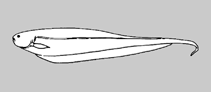
Hypopygus minissimus is diagnosed from congeners by the following combination of characters: the absence of oblique bands (versus presence in all congeners), the absence of scales at midbody (versus presence in all congeners), the absence of the sixth infraorbital bone (versus presence in all congeners except H. hoedemani and H. lepturus), the total number of anal-fin rays (102–113 versus 136–170 in all congeners except H. hoedemani and H. lepturus), and the dorsal rami of the intermittent branch of the anterior lateral line nerve visible as two black parallel lines (versus not visible in H. ortegai) (Ref. 88778).
Body shape (shape guide): elongated.
Life cycle and mating behavior
Geschlechtsreife | Fortpflanzung | Ablaichen | Eier | Fecundity | Larven
de Santana, C.D. and W.G.R. Crampton, 2011. Phylogenetic interrelationships, taxonomy, and reductive evolution in the Neotropical electric fish genus Hypopygus (Teleostei, Ostariophysi, Gymnotiformes). Zool. J. Linn. Soc. 163:1096-1156. (Ref. 88778)
IUCN Rote Liste Status (Ref. 130435: Version 2025-1)
Bedrohung für Menschen
Harmless
Nutzung durch Menschen
Tools
Zusatzinformationen
Download XML
Internet Quellen
Estimates based on models
Phylogenetic diversity index (Ref.
82804): PD
50 = 0.5020 [Uniqueness, from 0.5 = low to 2.0 = high].
Bayesian length-weight: a=0.00372 (0.00139 - 0.00994), b=3.06 (2.83 - 3.29), in cm total length, based on LWR estimates for this (Sub)family-body shape (Ref.
93245).
Trophic level (Ref.
69278): 3.1 ±0.4 se; based on size and trophs of closest relatives
Fishing Vulnerability (Ref.
59153): Low vulnerability (10 of 100).
🛈