>
Cypriniformes (Carps) >
Sundadanionidae (Tiny danios)
Etymology: Sundadanio: Sunda: Asiatic island; Danio: from ‘dhani’, local Bengali/Bangla name for small minnows (Ref. 2031); rubellus: From the Latin adjective 'rubellus', meaning reddish, in reference to the live coloration of the fins of males.
An adjective.
More on authors: Conway, Kottelat & Tan.
Environment: milieu / climate zone / نطاق العمق / distribution range
البيئة
; المياه العذبة القاع. Tropical
Asia: peat swamp forests of the Southern Kapuas River Delta in West Kalimantan, Indonesia.
الحجم / وزن / العمر
النضج: Lm ? range ? - ? cm
Max length : 1.9 cm SL ذكر/ مختلط الجنس; (Ref. 88800)
وصف مختصر
مفاتيح التعريف | الوصف الخارجي | قياسات المظهر الخارجي
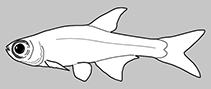
الأشعة الظهرية الناعمة (المجموع) : 9; أشعه شرجية لينه: 9; فقرات: 34 - 36. Distinguished from all congeners, except Sundadanio echinus, by the presence of the secondary lateral stripe in both sexes (vs. secondary lateral stripe present only in males in S. retiarius and S. margarition or absent in S. axelrodi, S. atomus, S. gargulae and S. goblinus). Can be further diagnosed by the following combination of characters: large adult body size (largest specimen examined 19.4 mm SL); live males with blue-emerald green sheen across dorsal body surface, secondary lateral stripe intense red orange, running along ventral edge of blue-emerald green sheen from posterior to opercular opening to point opposite middle of anal fin, and an intense black-red marking across anterior portion of anal fin; preserved males with a well developed dark lateral stripe of roughly uniform depth along entire length, horizontal through ventral border of which, when brought forward, extending through dorsal half of eye; secondary lateral stripe well developed, consisting of small melanophores running parallel to dark lateral stripe along its ventral margin from posterior to opercular opening to point opposite middle of anal fin; presence of a weak reticulate pattern along dorsal body surface posterior to dorsal fin; absence of dark markings on dorsal and caudal fins; presence of enlarged scales next to window in body musculature; scales posterior to enlarged scales next to window in body musculature and anterior to anal-fin origin with a single small tubercle at centre; complete covering of scales on caudal peduncle (Ref. 88800).
Body shape (shape guide): fusiform / normal.
Inhabits peat swamp forests (Ref. 88800).
Life cycle and mating behavior
النضج | التكاثر | وضع البيض | بيض | الخصوبة | Larvae
Conway, K.W., M. Kottelat and H.H. Tan, 2011. Review of the Southeast Asian miniature cyprinid genus Sundadanio (Ostariophysi: Cyprinidae) with descriptions of seven new species from Indonesia and Malaysia. Ichthyol. Explor. Freshwat. 22(3):251-288. (Ref. 88800)
IUCN Red List Status (Ref. 130435: Version 2025-1)
استخدامات بشرية
مصائد: غير ذات اهمية
أدوات
تقارير خاصة
Download XML
مصادر علي الأنترنت
Estimates based on models
Phylogenetic diversity index (مرجع
82804): PD
50 = 0.5059 [Uniqueness, from 0.5 = low to 2.0 = high].
Bayesian length-weight: a=0.01122 (0.00514 - 0.02450), b=3.04 (2.87 - 3.21), in cm total length, based on all LWR estimates for this body shape (Ref.
93245).
مستوى غذائي (مرجع
69278): 3.0 ±0.2 se; based on size and trophs of closest relatives
Fishing Vulnerability (Ref.
59153): Low vulnerability (10 of 100).
🛈