Classification / Names
Tên thường gặp | Các synonym ( Các tên trùng) | Catalog of Fishes(Giống, Các loài) | ITIS | CoL | WoRMS | Cloffa
>
Cichliformes (Cichlids, convict blennies) >
Cichlidae (Cichlids) > Cichlinae
Etymology: Australoheros: From the Latin word 'australis' meaning southern, and the name Heros, after the nominotypic genus of the Heroini tribe.
Tribe; tavaresi: Named for Felipe Tavares Autran, a student in Laboratório de Sistemática e Evolução de Peixes Teleósteos, Universidade Federal do Rio de Janeiro (UFRJ), Brazil, during the 1990’s. He first recognized this species as new in his unpublished monograph (Autran, 1995) on the "Cichlasoma" facetum species complex, under orientation of Wilson Costa. This study, although widely known among Brazilian ichthyologists, was never published (Ref. 89866).
Eponymy: Felipe Tavares Autran was a student when he first recognised this species as new, in his unpublished monograph (Autran, 1995) on the Cichlasoma facetum species complex. [...] (Ref. 128868), visit book page.
Environment: milieu / climate zone / Mức độ sâu / distribution range
Sinh thái học
; Nước ngọt Tầng nổi. Tropical
South America: Upper rio Tietê drainage, upper rio Paraná basin in São Paulo, Brazil.
Bộ gần gũi / Khối lượng (Trọng lượng) / Age
Chín muồi sinh dục: Lm ? range ? - ? cm
Max length : 7.9 cm SL con đực/không giới tính; (Ref. 89866)
Short description
Khóa để định loại | Hình thái học | Sinh trắc học
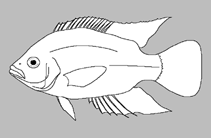
Các tia vây lưng cứng (tổng cộng) : 16 - 17; Các vây lưng mềm (tổng cộng) : 10 - 11; Tia cứng vây hậu môn: 7 - 8; Tia mềm vây hậu môn: 8 - 9; Động vật có xương sống: 26. Distinguished from all other species of Australoheros (except A. facetus) by having prognathous mouth (vs. isognathous); from species of the A. facetus, A. forquilha, A. kaaygua and A. scitulus species groups, and from A. acaroides, A. ykeregua, A. angiru and A. taura by having 12 caudal vertebrae (vs. 13 - 15) and 14 precaudal vertebrae (vs. 12 - 13); from species of the A. facetus, A. forquilha and A. kaaygua species groups by having three abdominal bars in all stages of life (vs. always four abdominal bars in juveniles, and adults with three bars in about 50% and four in about 50% of all specimens examined); from A. perdi by having 26 total vertebrae (vs. 25); from A. ykeregua by the absence of dark marks on the suborbital region (vs. presence); from A. agiru by having a conspicuous rounded caudal-fin base spot (vs. spot very narrow or absent); from all its congeners of the A. autrani species group (except A. mattosi and A. montanus) by having a fewer body depth (39.0 - 42.2% SL in A. tavaresi vs. 45.7 - 50.9% SL in A. autrani, 44.6 - 49.0% SL in A. barbosae, 47.3 - 51.2% SL in A. ipatinguensis, 46.6 - 49.8% SL in A. macacuensis, 44.0 - 48.2% SL in A. macaensis, 43.8 - 50.1% SL in A. muriae, 42.6 - 46.1% SL in A. paraibae, 47.4 - 51.3% SL in A. ribeirae, 43.7 - 46.0% SL in A. robustus, 44.0 - 48.2% SL in A. saquarema, 42.6 - 50.3% SL in A. capixaba); from A. saquarema, A. muriae, A. robustus, A. barbosae, A. macacuensis, A. ipatinguensis, A. paraibae and A. ribeirae by having a longer caudal peduncle (caudal peduncle length 9.8 - 11.6% SL in A. tavaresi vs. 6,6 - 8,0% SL in A. ipatinguensis, 6.7 - 9.0% SL in A. saquarema, 5.1 - 7.9% SL in A. macacuensis, 5.5 - 8.7% SL in A. barbosae, 7.1 - 8.9% SL in A. muriae, 6.4 - 8.1% SL in A. paraibae, 7.4 - 9.2% SL in A. robustus and 6.6 - 9.1% SL in A. ribeirae); from A. barbosae, A. macacuensis, A. paraibae, A. ribeirae and A. saquarema by having a fewer preorbital depth (51.2 - 60.0 % SL in A. tavaresi vs. 60.5 - 65.3% SL in A. barbosae, 62.2 - 65.4% SL in A. macacuensis, 60.4 - 65.2% SL in A. paraibae, 64.2 - 73.3% SL in A. ribeirae, 66.0 - 69.1% SL in A. saquarema); from A. macacuensis and A. montanus sp. n. by having arms of trunk bar 7 with the same width (vs. posterior arm of trunk bar 7 wider than anterior one); from A. mattosi by having anal-fin base squamation beginning at the sixth anal-fin spine (vs. anal-fin base squamation beginning at the third anal-fin spine); and from A. ribeirae by having a fewer head depth (head depth 80.6 - 94.2% HL vs. 95.4 - 98.9% HL) (Ref. 89866).
Life cycle and mating behavior
Chín muồi sinh dục | Sự tái sinh sản | Đẻ trứng | Các trứng | Sự sinh sản | Ấu trùng
Ottoni, F.P., 2012. Three new species of Australoheros from southeastern Brazil, with taxonomic notes on Chromys oblonga, Heros autochton and H. jenynsii (Teleostei: Labroidei: Cichlidae). Vertebrate Zoology 62(1):83-96. (Ref. 89866)
IUCN Red List Status (Ref. 130435: Version 2025-1)
Threat to humans
Harmless
Human uses
Các công cụ
Special reports
Download XML
Các nguồn internet
Estimates based on models
Phylogenetic diversity index (Tài liệu tham khảo
82804): PD
50 = 0.5000 [Uniqueness, from 0.5 = low to 2.0 = high].
Bayesian length-weight: a=0.01380 (0.00659 - 0.02894), b=3.07 (2.89 - 3.25), in cm total length, based on LWR estimates for this (Sub)family-body shape (Ref.
93245).
Mức dinh dưỡng (Tài liệu tham khảo
69278): 3.2 ±0.5 se; based on size and trophs of closest relatives
Fishing Vulnerability (Ref.
59153): Low vulnerability (10 of 100).
🛈